

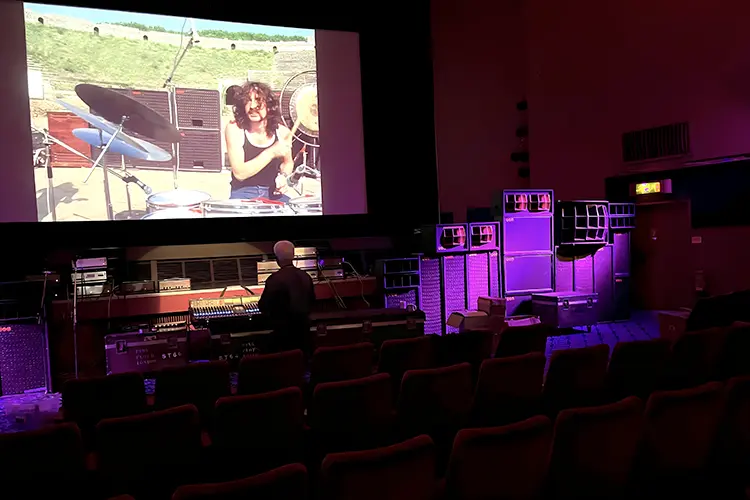
Over half a century after its original filming, Pink Floyd’s iconic concert film Live at Pompeii has been digitally remastered in 4K and now features a new high-resolution Dolby Atmos audio mix by Steven Wilson.
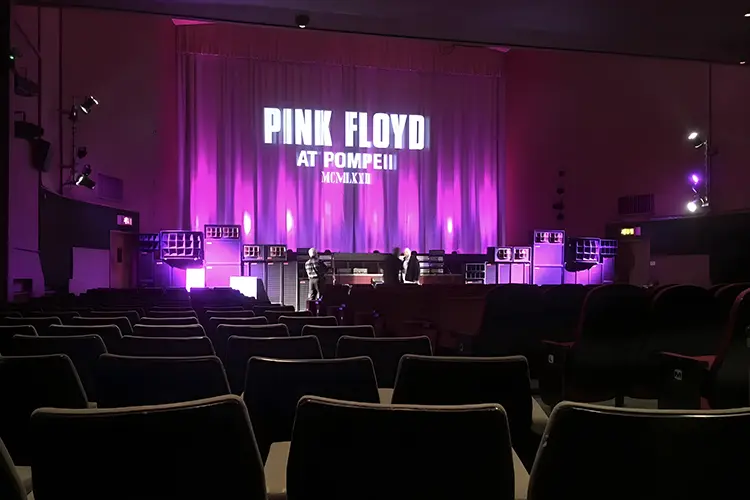
Thanks to the painstaking restoration carried out by Chris Hewitt (author and audio historian behind CH Vintage Audio), the world-premiere audience was able to hear the film through the very same analogue PA system that Pink Floyd used in 1971 at Pompeii’s Roman amphitheatre: an innovative WEM rig fitted with period-correct Celestion G12, G10 and MH1000 loudspeakers.
Before we dive into Live at Pompeii, tell us about your beginnings: how did your career in audio start?
I started listening to rock when I was 14, still in secondary school. I grew my hair long and got expelled, so at 16 I enrolled at a college in Rochdale, near Manchester. I hardly set foot in class: I joined the students’ union and discovered my true passion—organising concerts. My days were spent promoting bands, joining student protests and going to festivals. Before I knew it, I was working as a road manager and sound engineer. Before turning 17, I took part in my first festival in England with the Grateful Dead… and now, nearly 71, I’m still on the same path.
Today I own CH Vintage Audio. We hold one of the largest collections of 1960s and 1970s audio gear: WEM, Vox, HH, Marshall, Shure, Martin, Fender, Music Man, Selmer and many other brands. We supply everything from PAs and vintage mixing desks to tape machines, rack effects, microphones, antique radios and more. This equipment is rented out for film, TV, music videos and recording sessions.
Which other bands have you worked with?
I did one of Motörhead’s very first tours, back when Lemmy was broke and always borrowing things. Everyone called him “Lemmy Fiver” (“Lemmy, lend me a fiver”). The nickname suited him perfectly and that’s where it started.
When the punk wave hit, I worked with the Sex Pistols, the Stranglers, The Adverts, Chelsea—where Billy Idol played guitar—The Damned and The Dickies when they came over from the United States… practically everyone bridging the end of prog rock and the start of punk.
Tell us about Pink Floyd and your relationship with the band and their music
I think the first time I saw Pink Floyd was around 1969 at Manchester’s Free Trade Hall. The show began in complete darkness. They had a WEM PA, and the only thing visible in the gloom was the faint orange glow of UV paint on the WEM badges of the speaker cabinets. They also had a couple of H&H amps with green luminescent panels.
The sound coming off stage was like someone frying bacon and eggs and pouring milk on cornflakes. For the first five or ten minutes, the roadies were actually cooking and eating breakfast in the dark… then the band came on and played Alan’s Psychedelic Breakfast. The panning effects swept round the hall—it blew my mind.
After the gig I bought their album Ummagumma. On the back cover there’s a photo taken at Biggin Hill Airfield, south of London, with the crew, the van and all the gear laid out on the tarmac. Apparently it was inspired by how the US Navy sets out equipment on an aircraft-carrier deck during displays. Ever since, I’d dreamt of taking a photo like that.
About five years later, in 1975, I’d just returned from seeing Pink Floyd at Knebworth. We’d hired a van for the show and I thought: “It’s a sunny day—let’s pull out my gear and set it up in this car park, just like Ummagumma.” The caretaker rushed out, thinking we were staging an illegal concert, but of course we were only doing a photo shoot. That’s where it began, though I never imagined where it would end up.
Great segue to Live at Pompeii. What inspired you to pair Pink Floyd’s original PA with the film?
I’d written four books on live-sound history, and Pink Floyd features prominently in all of them. Last year we did a hi-fi show and played Floyd music through the PA and desk from The Dark Side of the Moon. A man who knew my books asked if I still had the Pompeii PA. He collects and restores vintage cinema gear and said a friend of his owns a vintage theatre; he suggested it would be amazing to locate an original print of the film and bring everything together.
Last February, while I was filming in Abbey Road’s Studio 2, reinstalling some ’60s Beatles gear I own, he called to say, “We may have found the 35 mm negative.” That was thrilling, but two weeks later he rang again: Steven Wilson of Porcupine Tree had just remixed the Pompeii soundtrack, and it was finally coming out as an album. Then he asked, “Do you want to use Pink Floyd’s original sound system at the world premiere?” And that’s how it happened.
How did you end up acquiring the PA?
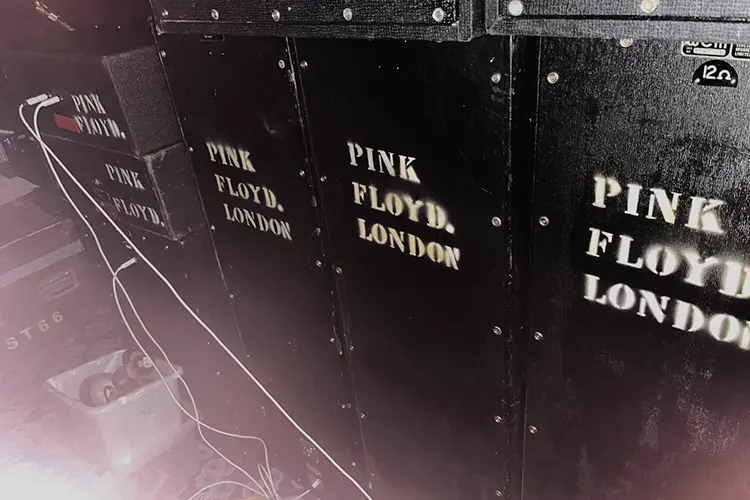
I started by buying six WEM Audio Masters that had belonged to Pink Floyd—five working and one not. Once you own even a small bit of Floyd gear, people come out of the woodwork saying, “I’ve got this,” or “I’ve got that—are you interested?” The collection just kept growing.
The trouble now is that people offer me Division Bell-era kit that’s been in a warehouse for 30 years and want £100,000 just because Pink Floyd used it once. They’re only wooden boxes with speakers, whereas the Pompeii and Dark Side of the Moon PAs were truly unique.
What Pink Floyd did with live sound back then was groundbreaking. Over time, the PAs they used were still great but became fairly standard tech for the era. I’m talking about the PAs only—because their shows, whether Pink Floyd, Roger Waters, David Gilmour or Nick Mason, have always pushed the boundaries and always will.
Can you give me specific details of the PA?
The Live at Pompeii PA was designed by WEM (Watkins Electric Music), a British company that pioneered product lines for large-scale concert sound reinforcement. A hallmark of the WEM sound—and this PA was no exception—was the use of Celestion speakers in many models.
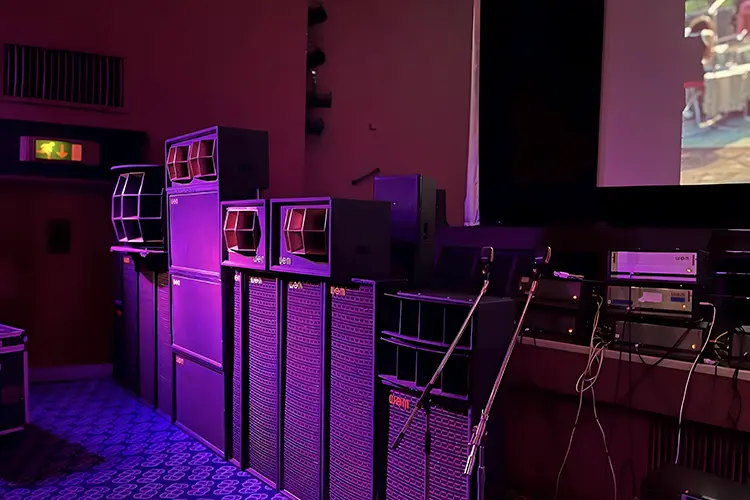
The exact configuration for the Pompeii PA (each left and right tower) was:
- 10 SL100 slave amplifiers
- 6 WEM 4 × 12″ columns with Celestion and Goodmans 12″ speakers
- 2 WEM 2 × 12″ columns with Celestion 12″ speakers
- A WEM Festival stack consisting of:
- 2 × 15″ Celestion bass module
- 4 × 12″ Celestion lower-mid module
- 6 × 10″ Celestion cone-speaker upper-mid module
Additionally:
- Pressure-horn boxes with one four-way Celestion MH1000 and one vertical three-way MH1000
- Extra 15-cell Vitavox multicell horns
The 12″ and 10″ Celestion cone speakers—models G12 and G10—were new designs, using different cones and suspensions from Celestion’s guitar-amp speakers. The MH1000 was a mid-range compression driver developed by Les Ward.
Some components needed repair. What was the restoration process like?
With the Pompeii PA, it was all about the original speakers. Several 10″ Celestions in the Festival stack and some 12″ Celestion G12s in the columns were blown. I used off-the-shelf parts: I’ve got a good stock of Celestion drivers—even rare pre-ROLA ones—so we reconed the speakers and they were ready to go.
The mixing desk was a bigger task. The original was gone, so we had to recreate it, and we were lucky to involve Andy Bereza. He designed the desk for Pink Floyd and later founded Allen & Heath. Andy still had all the original measurements and schematics. We first made a 28-channel dummy replica with only two working channels. When Allen & Heath heard about it, they were so impressed they offered to finish it and turn it into a fully working analogue console with the same components.
So, although the original mixer was destroyed, the one we use now is essentially the same console that toured with Live at Pompeii and The Dark Side of the Moon, right up to the Wish You Were Here tour.
What made this PA special?
Let’s start with the sound. We brought the Pompeii PA into the cinema and their engineer initially wanted to give us only a stereo feed, warning us not to “turn it up too loud,” as if it were just a novelty. He boasted about his “state-of-the-art Dolby Atmos system, fantastic sub-bass, digital desk, digital amps, racks of processors…”. I listened and politely asked, “When I’ve plugged mine in, will you at least listen to it?” Guess what? As soon as we powered up the original PA he said, “Right, we’ll barely use the cinema system tonight except for the surround channels. Your analogue PA sounds so much better.”
Technically, every speaker in the Pompeii system runs full-range—no electronic crossovers, because they mostly hadn’t been invented yet. Crossovers didn’t appear until the Dark Side of the Moon tour. We take a stereo feed from the soundtrack, and everything on the same channel gets the same signal. The only thing approaching a crossover is two 2 µF capacitors on the positive leg feeding the horns. Everything else—the 15s, 12s, 10s and even the amps—receives the same signal.
Another key factor is the Celestion drivers. British-made speakers sound different from those made elsewhere because they’re built in damp climates. These Celestions were made in Ipswich, East Anglia, whereas many American speakers came from sunny California. In rainy England the cones are “born damp,” giving a completely different tone—and I swear you can hear it.
How were the screenings? What was the outcome?
We held the world premiere with the Pompeii PA at the Parkway Cinema in Barnsley—right in the middle of Yorkshire. The owner prides himself on top-notch vintage projection, and the blend of original analogue sound in a vintage theatre was special. A normal screening there draws about 20 people; we sold out all 200 seats, including three guys who drove from the south of France just to hear the PA. They planned to sleep in their car until I invited them to my place.
The result? I’d never heard a sound system get a standing ovation, but the room was full of engineers and musicians. Many audio people grew up with Pink Floyd—put on anything Floyd and they’ll come. Comments like “Amazing sound for such an early rig—loud yet crystal clear” were common. The consensus: “a unique experience” and “incredibly authentic hearing Pompeii through the very gear it was recorded on.”
This week, SONY Music, which now holds all Pink Floyd rights, sent me the new Live at Pompeii LP and Blu-ray on Nick Mason’s instruction, along with a note saying I was doing a fantastic job with this PA.
What are you working on next? Any big projects ahead?
We’ve got two dates in June to run Live at Pompeii through the system again: 7–8 June at Nick Mason’s house in Wiltshire, and 20–21 June at the Northwest Hi-Fi Show in Cheshire. We’ll also be at PLASA, London Olympia, 7–9 September 2025.
I also own David Bowie’s 1972–73 Ziggy Stardust PA and Led Zeppelin’s 1970 PA. Like the Pompeii rig, these are the actual touring systems, not replicas. I’m getting them fully operational; my plan is to get Robert Plant to perform and to stage some Bowie-themed events too.
On top of that, a collector from Essex travelled across the US acquiring gear used by Buddy Holly and Elvis. I bought the lot—late ’50s, early ’60s pieces: Ampex tape machines, Altec speakers, RCA mics. I’m recreating a Sun Studio in England with it. We’re also building an Abbey Road control room, because I own most of the gear the Beatles recorded and mixed on.