


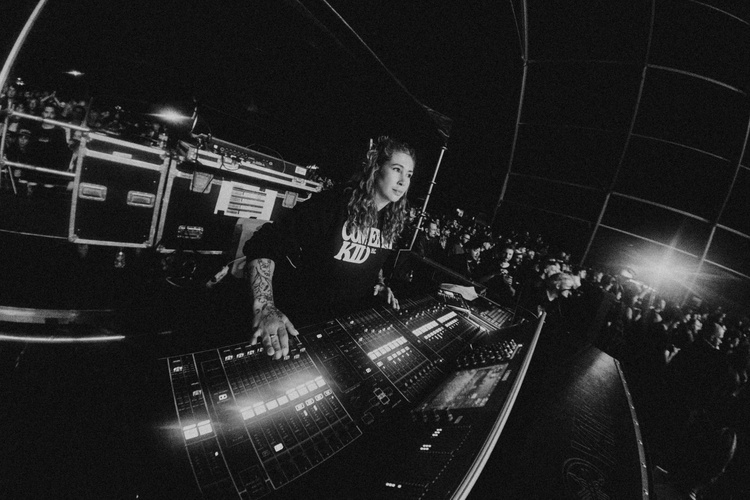
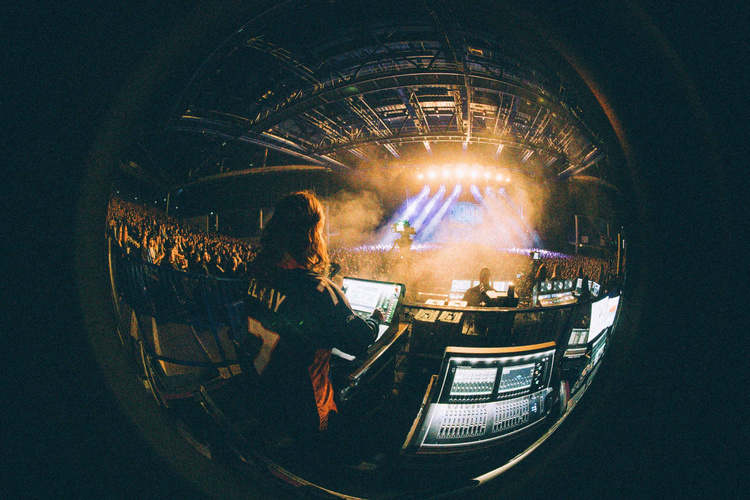
During a concert, Conni Ettinger’s hands barely stop moving. She adjusts levels, rides faders, modifies effects and moves through the console layers as though interpreting a musical score. Her mix does not rely solely on scenes, automation or previously stored settings.
Everything responds to the musical development of each song and to what is happening on stage.For Ettinger, this way of working is a deliberate choice.
Of course, I could automate certain parts of the mix, but I do not want to. For me, it is like playing an instrument and being part of the show. I prefer to remain actively involved rather than simply unmuting a channel for a single snare hit. I work extensively with the faders. There are many ways to make a mix work; this is mine. The console is my instrument, and I try to play it to the best of my ability.
Her approach reflects a vision of live sound in which technology becomes an expressive tool. Preparation is essential, but the mix remains alive throughout the entire performance.
Musicians notice the effort you put in
Ettinger particularly values continuity with artists. Working repeatedly with the same band allows her to learn its repertoire, understand its dynamics and anticipate what each song requires in a live setting.
“I receive the set list and, even if I have mixed those songs a hundred times, I listen to them again before the tour. I ask myself what I can add to make them work better. It might be a vocal throw, highlighting a small solo, adding reverb or adjusting a delay. The question is what I can contribute so that the audience leaves the venue thinking the concert was incredible.”
This preparation is not about filling the mix with effects, but about identifying specific interventions that reinforce the musical intention. In her view, bands notice when an engineer has studied the material and become genuinely involved in the artistic proposal.
“You almost end up performing a part within the band. You truly become part of it through what you can contribute from the mixing position.”
For FOH professionals, this relationship between knowledge of the repertoire and the ability to react is one of the elements that separates a technically correct mix from a genuinely musical experience.
From the Catholic Church to death metal and punk rock
Ettinger now works on international tours primarily associated with heavier musical styles, including punk rock, ska, deathcore and metalcore.
It is the area in which I have eventually found my place. I like the music, but I also like the people. It is a very open and generous community filled with great people.
Her introduction to the world of audio, however, took place in a very different environment: a Catholic church. As a child, she was an altar server and met a young priest who encouraged children and teenagers to sing and experiment with different instruments.
Those activities eventually developed into small concerts using a modest PA system and a Behringer mixing console. Ettinger began to familiarise herself with XLR cables, connections and the fundamental principles of sound production.
At the age of twelve, she recorded her first CD at her local youth centre and, two years later, already had her first Cubase licence. She also began taking two-hour train journeys to Vienna to observe concerts from a different perspective: the work of the crews, the technical operation, stage changeovers and everything that happens away from the audience’s view.
It was there that she realised she wanted to become part of the industry.
“That is exactly what I did when I finished school.”
She began by offering to help, shadowing experienced professionals, observing their work and gradually building a network of contacts.
“That is undoubtedly one of the most important parts. The entire industry operates like one major networking event. Every concert is an opportunity to build relationships.”
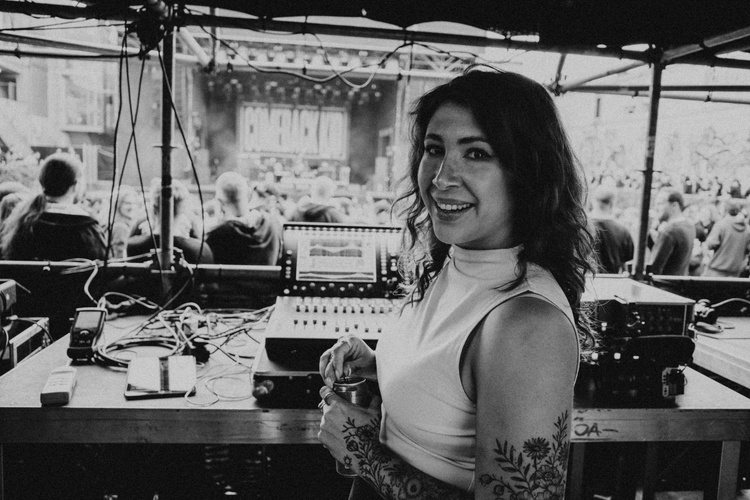
“The entire industry operates like one major networking event,” says Conni Ettinger. Photo credit: Mike Casey.
There were also unexpected opportunities. When she was 19, a colleague of a colleague became ill and Ettinger stepped in to help. She unloaded the trailer, connected the backline and assisted with everything that was required.
“I then stayed with that band for seven years and eventually became its front-of-house engineer.”
From that point onwards, new contacts, local jobs in Vienna and further tours followed. Her career developed through a combination of preparation, availability, confidence and the ability to take advantage of opportunities within the live production environment.
Mixing the tension of a song: “It is like breathing”
When discussing her working methodology, Ettinger quickly highlights her preference for organising the mix around DCAs.
“My entire system is built around that logic in one way or another. It is probably because my training and early career were strongly connected to studio work. When I look at a mixing console, I almost see a Pro Tools session in my head.”
Her usual configuration includes DCAs for drums, guitars, bass, backing vocals and lead vocals. From this structure, she creates a central layer from which she controls most of the performance.
“I have an overall DCA containing everything except the lead vocal, as well as another DCA for effects. Once I have adjusted the individual signals, I move to the DCA layer and remain there for approximately 90% of the show.”
From that surface, she makes small movements that follow the development of each song.
“I make many subtle fader adjustments to follow the song’s dynamic arc. For example, I might lower the overall DCA by 2 or 3 dB during a pre-chorus and return it to its previous position when the chorus arrives. That allows the audience to feel that the song is alive. It is like breathing.”
The same philosophy applies to effects. Vocal reverbs do not necessarily remain fixed to a single preset throughout the concert. Ettinger modifies their parameters in real time from the effects section to adapt them to each passage.
The objective is not to make conspicuous movements, but to create contrast, depth and a sense of progression without the audience necessarily being aware of the technical process.
Sometimes we forget who we are mixing for
This way of working connects with one of her central convictions: the mix belongs to the audience.
“I put as much effort as possible into improving the show, the sound and the audience’s experience. Sometimes I feel that engineers forget who we are mixing for. We are there for the audience, not for ourselves.”
For that reason, she considers it essential to leave the FOH position periodically and walk around the venue.
You need to listen from the positions occupied by the audience instead of remaining on your front-of-house throne throughout the entire show. We should do everything possible to make the concert sound good for the audience. That is essentially what I try to do.
For touring and rental professionals, this observation has practical implications. The reference heard at the control position does not always represent the experience across the rest of the venue. The interaction between system coverage, acoustics, audience density and the geometry of the space can significantly alter the perception of the mix.
Walking through different areas makes it possible to detect imbalances, intelligibility problems or tonal differences that are not always apparent from the console.
Technical ability and life on tour
Ettinger believes that technical competence represents only one part of the professional profile required to work in live production.
“For me, technical ability and the social side of the job are almost equally important.”
Touring involves spending days or weeks together in confined spaces, working under pressure and dealing with very different personalities. In that environment, attitude, personal hygiene, stress management and communication skills can be just as important as mastery of the console.
We have all worked with grumpy engineers, people who perhaps drink a few too many beers or do not take their personal hygiene particularly seriously. When you have to live with them on a tour bus, it is not exactly the best experience.
The ideal combination, she explains, is to find professionals who are excellent at their jobs and also pleasant to work and live with.
“You also need to know how to read the room, manage different egos and adapt to very different personalities. Otherwise, you will never be able to communicate your technical expertise effectively.”
In live production, communication directly affects the result. A poorly explained problem, a defensive response or an unclear instruction can create unnecessary delays and tension. By contrast, a cohesive crew responds more effectively when incidents occur.
No one told me I could become a sound engineer
Looking back at her school years, Ettinger highlights the limited visibility that technical careers in the entertainment industry had at the time.
“When you are at school, the range of careers presented to you seems fairly limited. We have made progress today, but when I was studying, no one said: ‘You can become a sound engineer.’ They talked about working in a bank, becoming a teacher, a doctor, a nurse or pursuing another conventional profession. No one really explained that these technical jobs existed. Curiously, the person who did was a Catholic priest.”
Her first years within the industry were not easy either. Being young, appearing unsure of herself or not fitting the traditional crew profile could make someone the target of patronising or inappropriate comments.
“At every concert, someone asks whether they should carry something for you because it is heavy. It can be very frustrating. Sometimes one bad experience is enough to make someone leave and pursue a different career.”
In her case, those situations strengthened her determination.
“They made me feel that I needed to prove myself, carry the heaviest equipment and arrive extremely well prepared so there would be no room for those comments. You have to overcome that initial barrier, and it is not easy. You end up working even harder and proving repeatedly that you belong in this industry.”
Ettinger particularly emphasises the abilities of the women who have managed to establish themselves within the industry.
The few female colleagues I have are outstanding. I have met some who are simply incredible, and I know that they also had to go through all of these situations to reach where they are today. That is why they are so good. Perhaps that could be seen as the positive side, assuming there can be one.
In this context, she considers the emergence of initiatives such as Women in Live Music in Europe, Sisters of Music in Austria and SoundGirls in North America particularly valuable. These organisations provide guidance, support networks and safe spaces for people seeking to develop careers in professional audio.
Confidence is built through experience
For Ettinger, confidence is an essential tool in live sound. However, it cannot be acquired through theoretical training alone.
The transition from audio school to taking responsibility for an entire concert can be considerable. Signal flow, interaction with musicians, coordination with production and problem-solving are primarily learnt in real working situations.
“Live sound is exciting. You only have one opportunity to make everything sound good, ensure that the signal flow works and allow the musicians to perform a successful show. The song is only played once.”
For this reason, she advocates training with a greater emphasis on practical experience.
“I would like to see more education based on hands-on experience. Many people are afraid to take their first steps into the industry because they cannot find an opportunity to gain practical experience. It would be fantastic to organise regular workshops or training sessions in venues. They would help women and men alike.”
Professional confidence increases with every setup, every soundcheck and every incident successfully resolved.
The more you work and the more practical experience you accumulate, the better. You make mistakes and go through difficult moments when something does not work, but you learn to find quick solutions. That is how confidence develops, because eventually you reach a point where you think: nothing can frighten me anymore; I can handle any situation.
When there is no soundcheck
That confidence also makes it possible to deal with less-than-ideal situations. On certain occasions, Ettinger may even say: “Let’s not soundcheck today.”
There is not always enough time. At festivals, a band may arrive late, some musicians may be missing or only a few minutes may be available for a line check.
For Ettinger, this does not necessarily mean that the concert has been compromised.
I set everything up, load my scene and carry out a quick line check before the show begins. When the first song starts, the mix has to be adjusted very quickly. It is a very punk rock approach, but I trust my system and my equipment.
Advance preparation then becomes decisive. The console, stagebox, microphones, stands, radio frequencies and signal distribution must all be resolved before the band takes the stage.
“In a particularly stressful festival situation, the only thing I may be able to do is prepare the console, stagebox, microphones on stands and wireless frequencies. You have to make sure that all of that infrastructure is working.”
The actual construction of the mix can begin during the line check and continue into the first song.
“I know it can be done because my system and my equipment are reliable.”
Her approach does not remove the importance of a complete soundcheck, but it demonstrates the extent to which experience, show-file organisation and confidence in the system make it possible to respond when production conditions are less than ideal.
Ultimately, Conni Ettinger’s philosophy combines technical preparation, musical understanding and active participation. The console is not simply the final link in the audio chain. In her hands, it becomes another instrument within the performance: one that follows the breathing of the songs, reinforces their dynamics and connects the stage with the audience.