


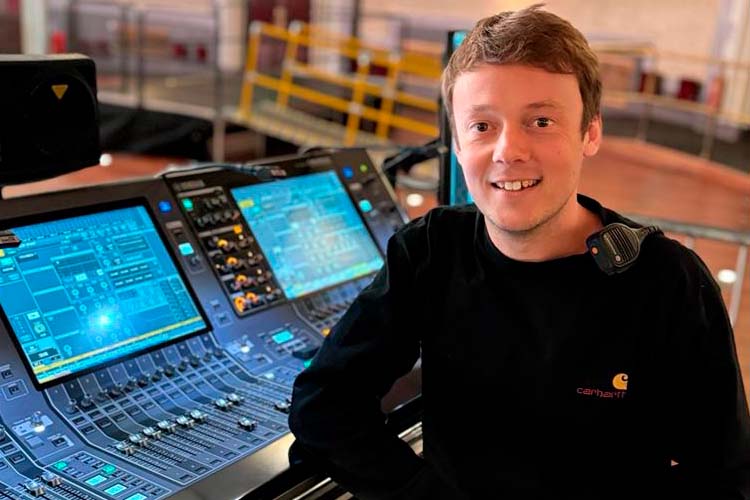
ISP & Light Magazine interviews Phil Jones, Royal Blood's sound engineer, who has a strong affinity for Yamaha mixing consoles. Jones discovered that the Yamaha RIVAGE PM5 digital mixing system provides many solutions to the challenges they have been facing during tours since the pandemic.
Royal Blood got back to touring, post pandemic, in 2021, and as their sound engineer, you used the Yamaha RIVAGE PM5 digital mixing system. This system has provided many solutions to the post-pandemic touring challenges they've been facing. What are these solutions that set it apart from other sound systems on the market? Why did you choose it for Royal Blood's tour? How did it adapt to the band's needs?
Post pandemic, I really wanted to streamline my touring setup and the way I mixed the band. Ultimately, the reason I wanted to change to the Rivage system, is because I thought it would give me the best combination of audio quality and reliability going forward. In 2019, the band performed 2nd from Top at Reading & Leeds festivals, these were some of the last shows they played before the pandemic. I had some vintage gear doing bits of outboard and some of it didn’t perform well during the Reading show. I got through the show, and no one noticed, but it was a wakeup call that I needed to change things! One of our first major trips out of the UK post pandemic was to Mexico. Air freight costs after the pandemic had gone through the roof and we had to source all the audio gear locally. We managed to get a PM7 system, and I turned up with only a show file on a USB stick, a first for me. It was perfect and I was very impressed with the system.
You've known the band since their early days, as you worked as their Tour // Production manager as well as FOH sound engineer. However, as they grew from small pubs to large stadiums, you focused more on sound. What did this change mean to you, and did it present significant challenges?
I started with the boys in 2013 and we’ve just celebrated 10 years of working together. I had started out touring with other artists always mixing FOH, but often wearing other hats such as Tour Manager and Production Manager. When a band is that size, you all must be able to adapt and wear multiple hats. My background is as a musician, playing drums. My main interest has always been in more of the creative side of mixing. I have really enjoyed the other roles on tour, but FOH mixing has always been the goal. When the shows get bigger, naturally there is more pressure and often more to do in each role. I decided to focus on FOH mixing and took on the advice of our old Tour Manager; Steve Chapman, to specialize and not spread myself too thin. I wouldn’t say there were any specific challenges, just that it had to be as good as possible. When the shows are bigger, the room for error becomes less and less.
You first encountered Yamaha RIVAGE PM digital mixing systems at the Neighborhood Weekend Festival in 2019, and when RIVAGE PM5 was launched the following year, you didn't hesitate to try it out. What impressed you so much about this sound system?
I am always interested in new products and try to keep an eye out for what’s coming out. My friend Brian Worthen, who mixes the Foo Fighters, had shown me the PM10 he had out with him earlier that summer and he was loving it.
I was very familiar with Yamaha consoles and workflow already and I had heard great things about the sound quality, particularly the Rupert Neve aspects.
Besides excellent sound quality, the RIVAGE PM5 system can simplify the logistical and cost aspects of a global tour. How did this crucial factor influence Royal Blood's tour?
As I’ve briefly mentioned before, the console has so many excellent built in plug-ins, it has nearly entirely alleviated the need for external processing. In all honesty, I do use 3 trusted bits of Outboard, but that is a lot less than the 12+ I used to use! I can also do without these pieces when the budget is very tight. We haven’t had any issues sourcing Rivage consoles around the world thus far, so I can simply turn up with a USB stick and I’m ready to go.
Regarding the sound modeling features integrated into the RIVAGE PM system, how did they contribute to enhancing sound quality and versatility during the tour?
The onboard plug in processing on the Rivage consoles is unmatched by any other console on the market. These are often not simply ‘models’ but authorized plug in versions from Bricasti, Eventide, Rupert Neve Designs etc. The console has so many units I was using externally, built in. I now don’t have to worry at all about latency or external computers, meaning I’m free to concentrate on mixing. There are so many different options for shaping the sound and the various effects are seemingly endless. More importantly, they are all excellent. Many consoles have a multitude of effects, but every unit I’ve used on the Rivage consoles sounds outstanding. If the band or artist wants something specific from a record, I have such a wide range of tools at my disposal, to recreate that sound. On occasion, I have been able to find effects used on the record because they used the same units in the studio.
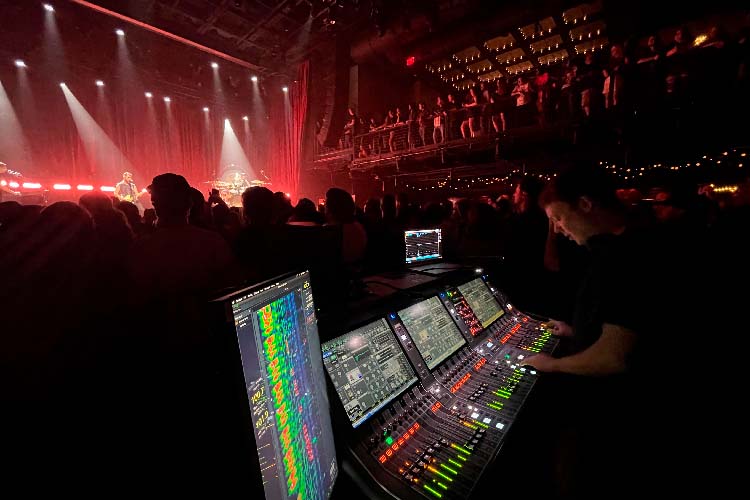
In addition to working for Royal Blood, you've also been involved in the SG Lewis tour. What is your workflow for collaborating with artists and bands that have completely different sound requirements and achieving the sound mix that both desire? How do you deal with the technical challenges of each and teamwork?
I think with any artist I work for, I try and keep in mind that I’m not trying to reinvent the wheel. Keeping things simple is a good start, inevitably these days things can get complicated because the capability is there! SG has a lot of playback, some live instruments and some heavily processed live vocals. It is completely different to Royal Blood! I first start by speaking to the artist and asking how they want it to sound, do they want it to be close to the record or have more of a live feel? What are the most important aspects of the recordings they’d like to recreate live. I try manage expectations early on with what is possible in the live domain. I’ll then go and listen to the record/s and think about various bits of processing. I’ll talk to the band and the musical director (MD) about their thoughts too. In rehearsals, I’ll always make sure to record run throughs and have playback sessions with everyone so people can have their input. This is invaluable and it is so easy to do with Virtual Soundcheck on the Rivage. The artist is in charge, ultimately and I have to try and represent their music as best I can, every night.
What are your typical creative and preparatory processes before a major event? Do you have any special routines that you follow?
Let’s use Glastonbury as an example; this year, we were 2nd from top on Pyramid stage (The Main Stage).
Firstly, I try to remember that this is just another show and although it’s huge and clearly important, I am in many ways doing the same job as I did the night before. I often make short notes during a show, so in the morning I’ll go through the multitrack and address any notes and make sure I’m at a good place with the mix. Importantly, at a festival I’ll try and have a lengthy conversation with the system engineer about what to expect and their process with the PA tuning. I will always try and get some time with the PA, on this occasion I think I got nothing, so mildly terrifying. In the event of a major show like this, I do lots of checks. I wouldn’t say any special routines, but I go through all my equipment and make sure everything is operating correctly. I make sure always to go over mic positions, to speak to the rest of the team and make sure we’re all on the same page. Communication, between every department is absolutely essential and so often where things go wrong. I will do as much in advance as possible or as early as possible in the day. Again, I remind myself it’s another show, do your best and it’ll be fine. Relax, always. You earn your stripes when the pressure is on, or when things go wrong, this is live music after all.
How do you handle the pressure of working at large live concerts or festivals and ensuring that everything sounds perfect from a sound perspective?
I feel it’s paramount to remind myself that 99% of the time, it simply cannot be perfect. It will not sound exactly the same everywhere, it probably won’t sound exactly as I want it to and that’s ok. We are not in a properly controlled environment; we don’t know exactly how the band are going to play and we can’t sit in every seat. We work in a team and in the audio department everyone plays their role. There has to be trust between us and we must work together.
I try to remember what exactly it is I have control over and that is the mixing console and, to a degree, the PA. Once I can really focus on what is Once I can really focus on what is my responsibility and under responsibility and under my control, I’m in a better situation. I focus in and I can be a perfectionist, I have a very exact idea of how I think everything should sound. I work hard and I put my all in, I do really try my best and I care hugely about the results. That is all I can do. On the day, I try to keep it in the day and just focus on the task at hand.
Tours can be exhausting in terms of schedules and travel. How do you take care of yourself and maintain a high level of performance in all performances?
Touring can be a strange way of life and is certainly not for everyone. Fortunately, I really enjoy it and it works for my lifestyle. I think it’s really important to have hobbies and interests outside of the tour, also to keep in touch with friends and loved ones back home. It’s so easy to become absorbed in the bubble of touring. Let us remember, it’s only rock and roll, we’re not saving lives out here. In the pandemic, I stopped drinking alcohol and using any other substances completely. I can safely say this has been the best decision of my life. I try and keep fit and on Royal Blood there are 5 or 6 of us who run, regularly to keep fit and we all love it. I also do some climbing. Trying to stay healthy means that touring becomes manageable and actually considerably more fun, in my experience. I’ve done the cliché rock and roll partying and then some and it’s dull and very repetitive. I try and make the most of days off and go and see things, sights etc., I’m seeing more of the world than ever these days.
Having an affinity for Yamaha mixing consoles is an advantage. Can you share some tips for other sound engineers who want to maximize their efficiency when working with these consoles?
Keep it simple! Too often I see engineers making things very complicated for themselves. You don’t need to compress everything and use 10 plug ins on every channel. The User Defined Keys (UDK’s) are an invaluable tool to program making sure everything is at your fingertips. In the show, things happen fast, and you don’t want to be digging through menus. Use the new macro functions which I am just getting into myself, I am finding new things for them to do and can see myself using these to improve workflow going forward. Specifically with these consoles, I would always suggest using the Bricasti reverb, Master Bus Processor and the 5045 Primary Source Enhancer. These plug ins will make your life easier and your mixes sound better. I am not the most technical engineer out there and I am learning all the time. I would suggest anyone to try some new things, experiment with those buttons you haven’t used before and see what everything does. Most importantly, use your ears and not your eyes to mix.