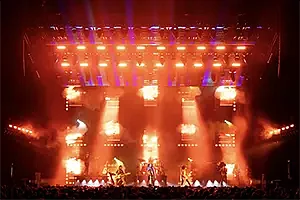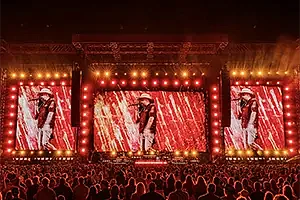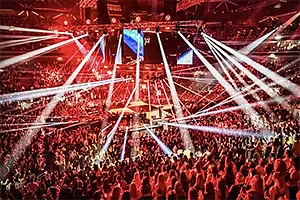
The automation specialist MOTOR Stage Automation (MSA) designed, engineered and supplied two spectacular kinetic elements and their control systems for The Legendary Tour by Swedish power metal band Sabaton.
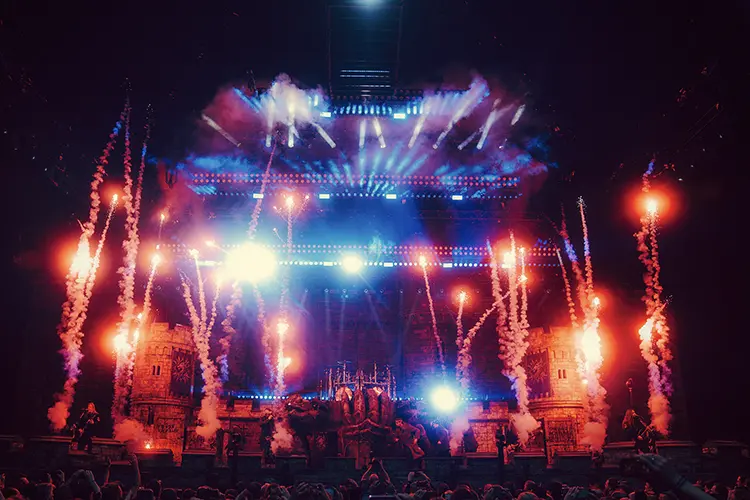
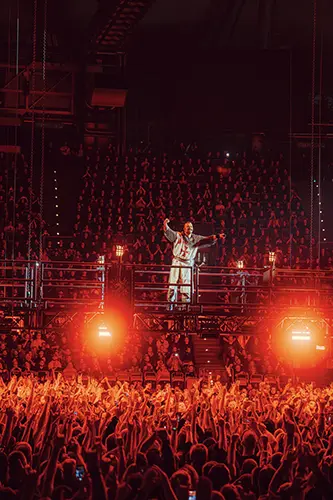
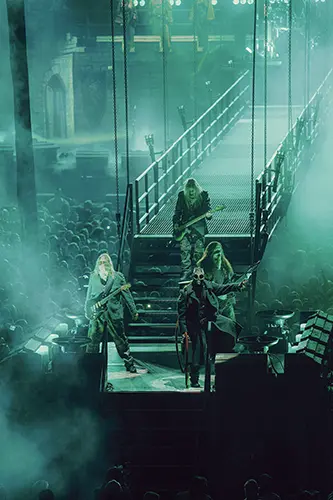
An imposing 30-metre runway, equipped with articulated stairs —customisable to suit stage height— at each end, appears during the show to connect the A and B stages, allowing the band to move around, interact and get closer to fans across the arena while flying above their heads, driving the drama and energy in the room to a peak.
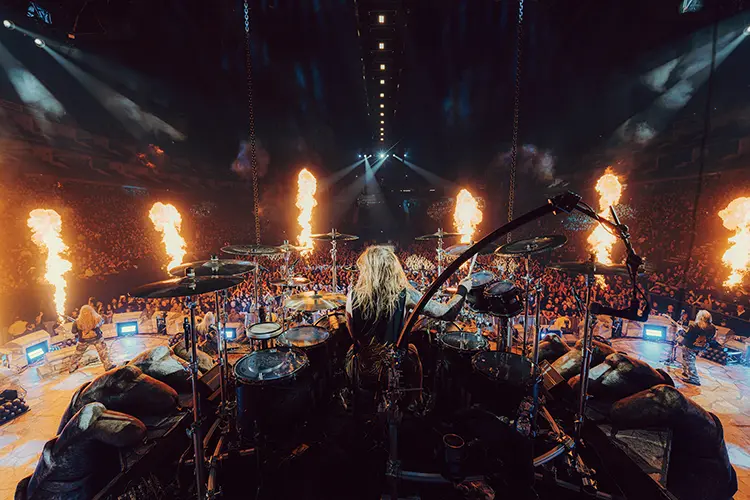
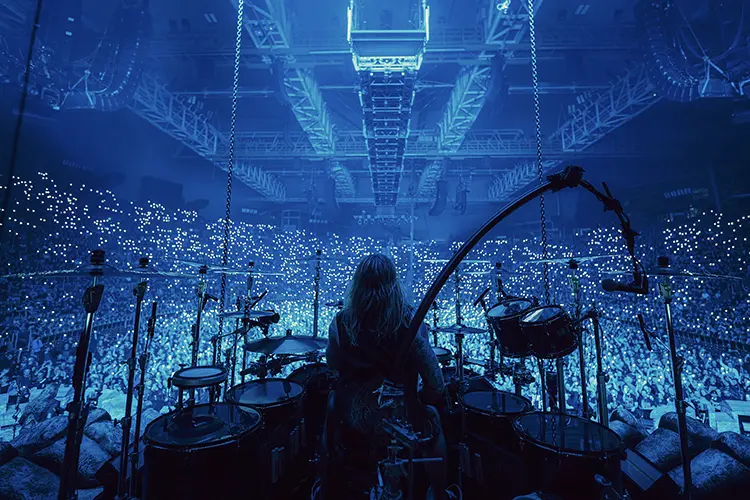
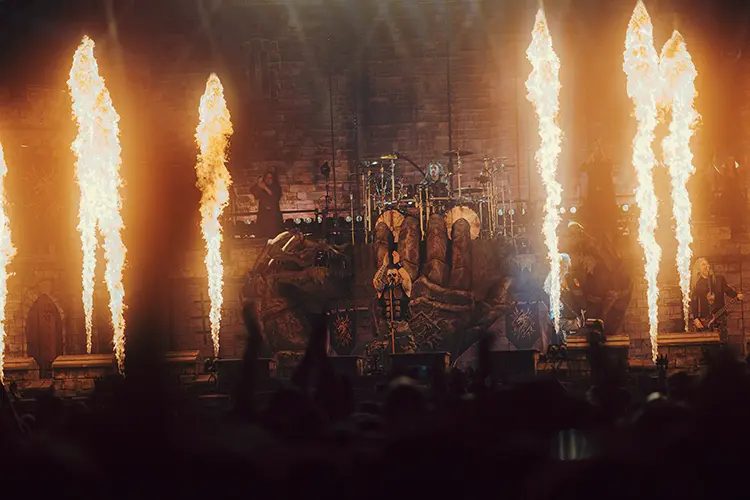
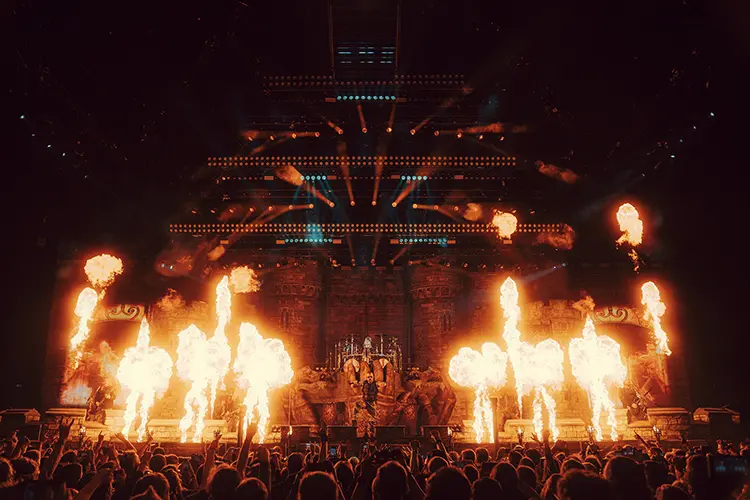
The theatricality continued with a second, equally striking moving element: a central drum platform that descends from the roof during the changeover to “land” on a set of three giant inflatable hands, manufactured by Airworks, which emerge from a dedicated riser onstage.
The automation project was managed for MSA by Jimmy Johnson, who explained that everything began with a comprehensive risk assessment in accordance with EN 17206, from which the equipment requirements were defined. Every part of the automation elements had to be optimised for touring, meeting the demanding itinerary and build schedules without delays.
Walking above the audience
The runway is constructed from a series of off-the-shelf components suspended from a main structure (mother grid) built using MSA’s new stock of HOF MLT FOUR heavy-duty trussing, selected for its strength and efficient assembly. The entire structure is flown using 14 Moveket hoists (10 x 1250 kg units and 4 x 500 kg units), equipped with V-Motion control systems.
The modular M:Cat system is designed to be scalable and packs down into dedicated carts for transport and rapid deployment.
We wanted load-ins and load-outs to be as smooth and fast as possible, so this was a key factor in the development of the entire system, noted Jimmy.
The M:Cat runway is positioned in the centre of the venues, perpendicular to the stage, and descends at key moments in the show via folding stairs that land onto the stages, allowing safe access for the band.
A show that is already high-energy becomes even more intense when the band walks along it directly above the audience, making it one of the defining moments of The Legendary Tour.
The runway needed to support up to 10 people while accommodating lighting and special effects, making the combination of M:Cat, the MLT FOUR structure and Moveket automation the obvious choice. The runway sections —with integrated wheels for positioning— weigh 300 kg per 3 metres unloaded, and the full length comprises eight sections, resulting in a total load of 2.4 tonnes, plus lighting fixtures, smoke machines and SFX.
Jimmy noted that tour planning began well in advance, allowing time to assess project requirements and consult with safety and engineering experts Blumano Associates for the risk assessment. Following this stage, he was able to determine which equipment would deliver the best and safest solutions.
MSA holds a large inventory of Moveket products, and one of the reasons for investing heavily in the brand —in addition to its quality— is that it complies with SIL and European standards for flying objects above audiences. HOF MLT FOUR is a newly developed product resulting from collaboration between HOF and MSA, and a recent investment has further expanded MSA’s existing stock of HOF trussing.
Rising to the occasion
The drum platform is positioned at centre stage and remains a focal point throughout the high-energy show.
Production manager Johan Bengs presented MSA with a concept from the band, along with a sketch from drummer Hannes van Dahl and several creative ideas, including having the platform lifted by giant hands. Jimmy and the MSA team explored various options using stage lifts, custom systems or chain hoists before deciding on four Moveket 1250 kg hoists with V-Motion drives and a flown platform, offering greater flexibility and adaptability for venues of different sizes.
The movement needed to be highly visual and part of the show’s narrative, so it had to be smooth and precise. Hannes also needed to safely access and secure himself on the structure, which required a dedicated solution, along with fast setup and teardown.
The design and engineering process also had to allow drum technician Emanuel “Kebbe” Isaksson to build and prepare the kit safely at every show, taking into account multiple factors, including minimising work at height.
The solution involved building the drum kit on the floor on wheels, rolling it into position pre-show, and then lifting it to working/backline height, where Hannes accesses it via a first-level entry point integrated into the scenic castle set. This concept was developed by set designer —and lighting designer— Bertil Mark in collaboration with the band. The platform is then flown up into the roof and later descends to meet the inflatable hands emerging from the stage.
 |
 |
Working on this with Johan and the stage management team was essential to ensure a safe and efficient workflow, and crew safety is just as important as artist safety at all times, stated Jimmy,
One of the most rewarding aspects of this project for Jimmy and the MSA team has been the highly collaborative nature of designing and building the automation elements, involving input from backline, set, lighting and stage management departments, as well as the artists themselves.
Bassist Pär Sundström, who also serves as the band’s manager, was actively involved in the creative process. “Johan encouraged us to combine our skills and experience to collectively develop the most impactful, safe and functional solutions”, explained Jimmy. “This led to four key conceptual pillars in the automation design: how, what, why… and ‘what if…?’”.
With this approach, all safety measures were considered from the outset and integrated into the design. After minimising work at height, safety railings and harness anchor points were added, along with fall protection systems accessible from the main structure, ensuring that even in cases of “unplanned maintenance”, the crew could intervene safely.
The platform also needed to be prevented from rotating —an issue identified in earlier tests— so eight RCF LightLocks were installed beneath it, acting as stabilisers similar to those used on ships. Hannes also received full training during the summer 2025 leg of the tour on emergency and rescue procedures, and head rigger Yose Lawson played a key role in ensuring safe operations at height.
Collaboration
Jimmy involved Yose from the early stages of the project, as they needed someone with an overall view of both the design and operation of the automation across different venues.
“Yose was key to ensuring that the engineering and rigging were viable for both the platform and the runway”, explained Jimmy, adding that together they minimised work at height and improved accessibility without the need to climb. Yose also brought in a team of specialist riggers who advanced ahead of the tour, preparing the rigging at each venue before the tour’s arrival.
Even seemingly minor details were addressed, such as equipping each roof truss with an independent cable management pick integrated into the cable bridges, allowing each truss to be raised and lowered independently for automation, lighting and special effects.
UK Rigging was selected by Johan and Yose to supply the tour’s rigging elements. Together with automation and the other departments —lighting, audio, video and staging—, the production travelled in a total of 24 trucks: three dedicated to automation and four to the daily advanced rigging package, operated by A and B teams provided by Yose’s company, Rigging Machine.
Mother grid
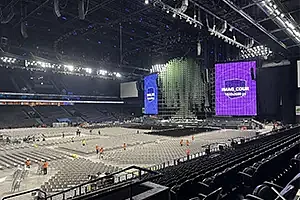
An over-stage main structure (mother grid) from MSA supported these automation and technical elements, comprising 9 m x 6 m sections built from HOF MLT FOUR trussing.
This structure housed all automation hoists, cable management, and safety and rescue equipment. Lighting fixtures for this grid were supplied by MSA’s sister company, Vigsø Rentals, as it made sense to pre-integrate them into the trussing.
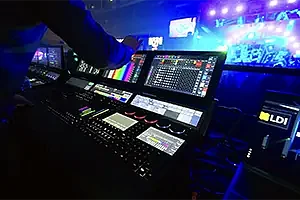
The tour’s automation programmers and operators were Kentaro “Ken” Johnson and Sam Colclough, running the show on a fully redundant Moveket Expert III console system.
The automation team also included MSA operations manager Daniel Klausen; special projects engineer Valdemar Enemark; automation crew chief Martin Kirch; and automation and performer safety technician Gareth Sumnall.
It has been a fantastic project, built on strong teamwork between highly talented professionals, and we are all looking forward to the next stages of the tour. I believe production managers and designers truly value a personalised approach, which is at the core of MSA’s vision. We are driven as much by challenges as by finding creative and workable solutions, concluded Jimmy.
Photos: Jens de Vos (@jensthepanda), courtesy of Sabaton