


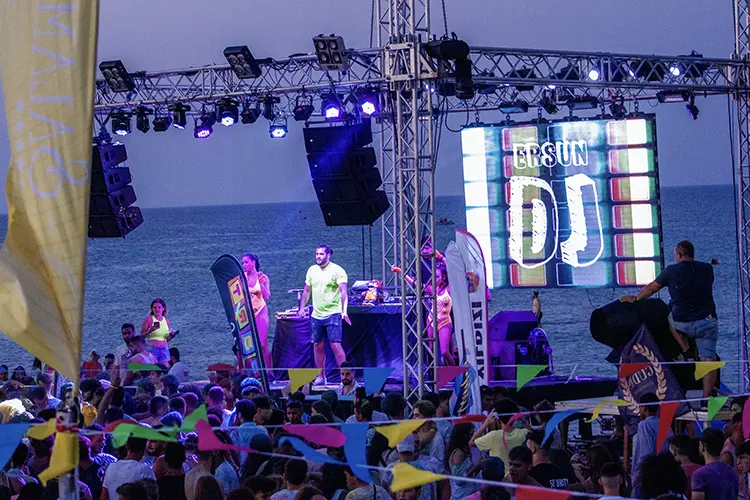
A busy electronic music festival held on a Mediterranean beach featured the design and installation of the sound system by Hortus Audio, which deployed its LVT line arrays alongside CBA subwoofers for a large-scale concert on the sand for the first time.
During two days of open-air performances featuring international DJs and renowned producers, the goal was to deliver powerful, clear, and uniform sound to thousands of attendees across the venue, without sacrificing quality at any point on the beach.
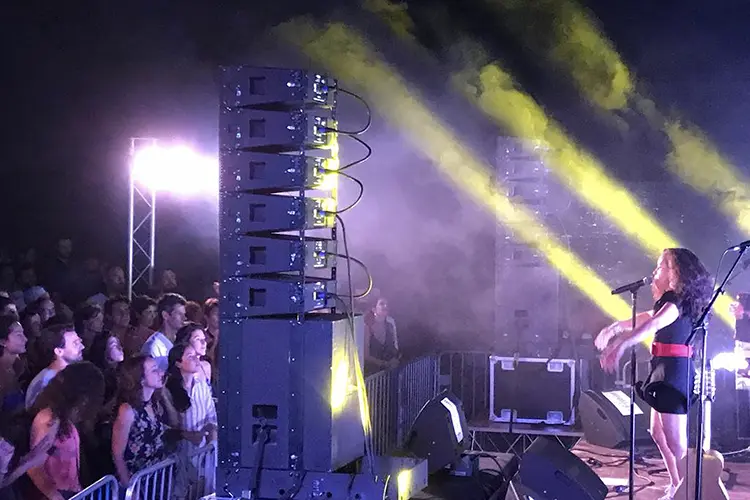
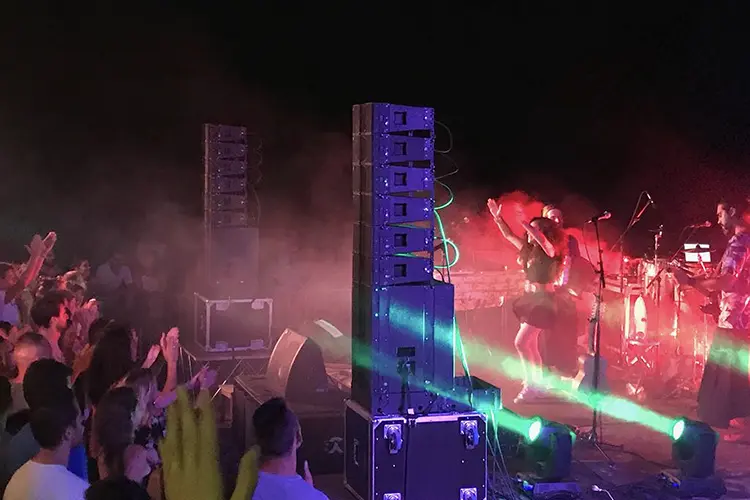
To achieve this, Hortus Audio opted for two towers of LVT line arrays, one on each side of the main stage, and a compact bank of CBA subwoofers. The suspended LVT line arrays handled the precise distribution of mid and high frequencies, while sixteen CBA subwoofers, arranged in a line in front of the stage, provided the deep bass foundation characteristic of electronic music. Thanks to this combination, a wide and balanced sound range was achieved, covering everything from deep lows to detailed highs without the need for additional reinforcement units.
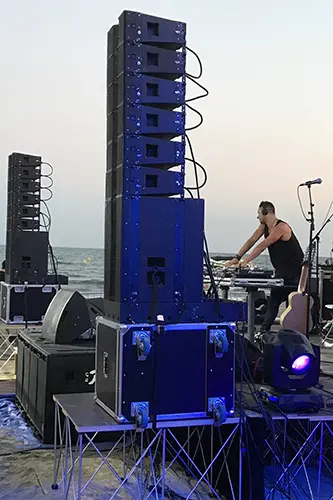 The beach environment posed several challenges. Unlike enclosed venues, the beach lacks walls to reflect sound, so acoustic energy tends to dissipate quickly. Additionally, the constant wave noise competes with low frequencies, and the sea breeze can diminish clarity in the highs over long distances. The sand, on its part, complicates the stability of structures and carries the risk of salt corrosion on the equipment. In the face of these challenges, careful design planning and terrain-adapted logistics were essential.
To maximize coverage and minimize unwanted dispersion, the line arrays were oriented toward the sea, projecting sound along the stretch of sand where the audience gathered, while avoiding directing it toward residential areas or nearby ecosystems. The CBA subwoofers were configured in cardioid mode, enhancing front-facing bass output and reducing reflections toward the stage and the rear of the venue. This setup significantly reduced unwanted vibrations behind the stage and ensured impactful bass on the dance floor without disturbing the surroundings.
To reach the back rows without sacrificing temporal coherence or excessively increasing volume at the front, two delay towers were installed about fifty meters from the stage. Each tower housed a pair of full-range speakers, synchronized with the main system to reproduce sound with the exact delay needed to integrate seamlessly with the front sound field. This way, attendees in distant positions enjoyed the same quality and musical presence as those closest to the stage.
All system control was managed through digital DSP with integrated processing, allowing real-time adjustment of EQ, levels, and delays from the control desk. This flexibility was key to compensating for potential high-frequency attenuation due to wind and maintaining the clarity of percussion and vocals. Pre-event simulations and in-situ measurements refined array angles and tonal balance; during performances, the technical team made minor tweaks to adapt to changing musical styles, occasionally boosting sub-sonic frequencies during intense techno sets or increasing vocal intelligibility when live singers were on stage.
The installation required exhaustive planning and was completed in just ten hours immediately before the festival started. Eight specialized technicians and riggers worked on the sand, anchoring reinforced aluminum towers with base plates and counterweights to ensure stability. The self-powered LVT modules with built-in DSP simplified cabling and sped up setup. To protect the CBA subwoofers from sand and moisture, they were placed on levelled platforms and the cabling was run through elevated conduits. Logistics were complicated by limited truck access, solved with an off-road vehicle and flatbed trailer that transported equipment during low-tide periods when the sand was firmer.
 |
 |
During the performances, the system’s performance remained consistent and outstanding. In the front rows, sound pressure was intense but distortion-free; in the more distant areas, the sound stayed clear and immersive up to 80 meters from the stage. The bass was deep and punchy without muddying the mids, while the highs remained crisp without becoming fatiguing after hours of high-volume music. Several guest engineers praised the faithful translation of the mix from the booth to the entire audience, and some artists noted that the sound quality helped them connect more effectively with the crowd.
The acoustic impact outside the venue was virtually nil: thanks to the directional approach and cardioid subwoofer configuration, no noise complaints were recorded in the surrounding areas, demonstrating a proper balance between power and environmental responsibility. Teardown was completed in under six hours after the festival closed, returning the beach to its original state without a trace of equipment or structures.
In short, Hortus Audio’s intervention in this beachfront electronic music festival demonstrated that, with rigorous acoustic design and professional technology adapted to the environment, it is possible to create high-level outdoor sound venues.
Having overcome the challenges of the sea, wind, and sand, the LVT line arrays and CBA subwoofers delivered a uniform and powerful audio experience, meeting the demands of organizers, artists, and attendees. The lessons learned on this project now serve as a reference for future events in complex venues, optimizing the balance between rapid installation, reliable performance, and minimal environmental impact.