
Alte Oper Frankfurt installs Germany’s first Meyer Sound TIGRA system
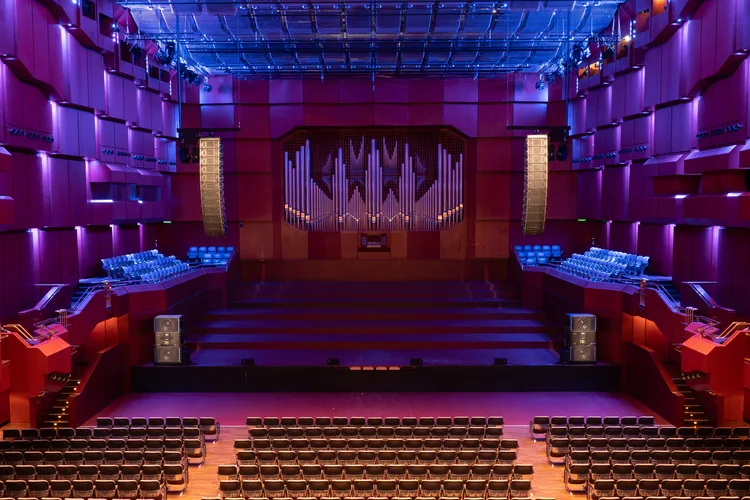
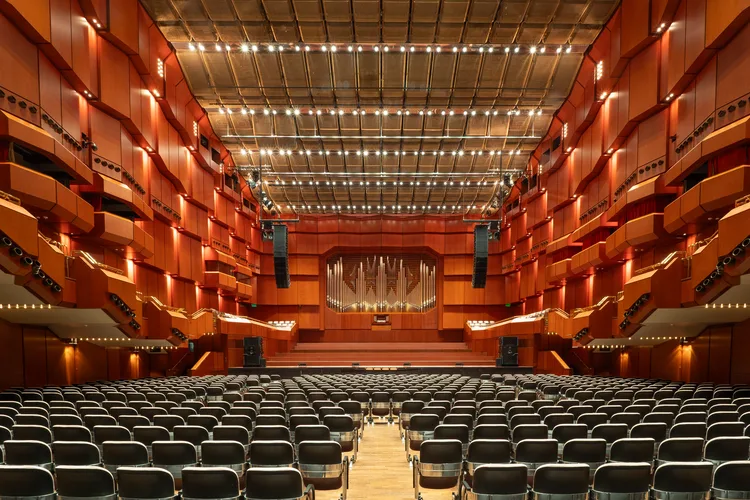
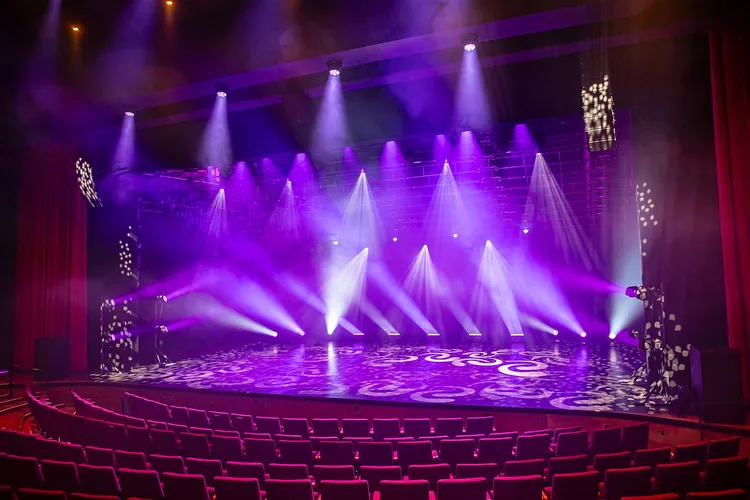
The 2,400-seat Großer Saal at Alte Oper Frankfurt has replaced its 18-year-old PA with a Meyer Sound TIGRA line array: the first in Germany and the first in Europe to run an entirely digital signal path, over a Milan AVB network. Designed and installed by Desch Audio.
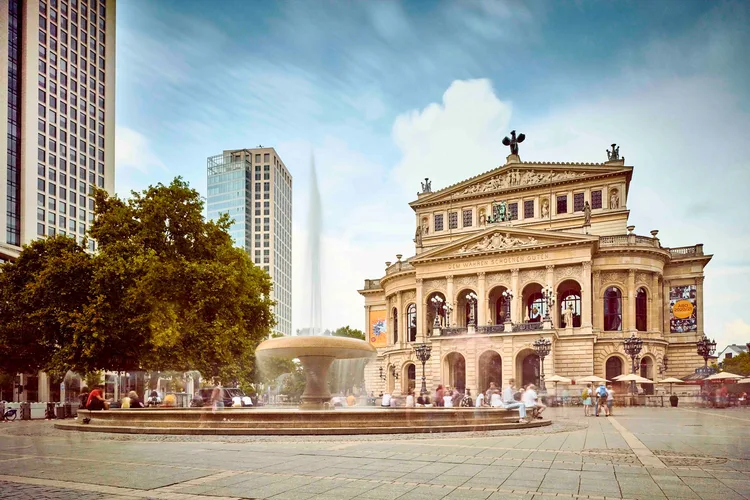
Built in 1880 as Frankfurt’s opera house and reopened as a concert hall in 1981, the Alte Oper hosts orchestral concerts, galas, conferences and other events nearly every day. After 18 years with its previous PA, the venue sought a self-powered, fully networked system capable of meeting the hall’s unusual physical and acoustic demands.
A compact array for tight rigging limits
The Großer Saal’s main arrays are raised and lowered through a flap in the ceiling, imposing strict limits on the size and weight of the PA. Desch Audio modified the existing rigging, but larger arrays could not fit within those limits, while smaller options lacked the required output. TIGRA met both demands.
The system: 18 TIGRA-L and six TIGRA-W loudspeakers in two arrays, with six 2100-LFC low-frequency control elements on the ground, eliminating the need to fly subwoofers. ULTRA-X40 and ULTRA-X42 cover the seating flanking the stage and ULTRA-X20 provide fill. Three Galileo GALAXY 816 Network Platforms handle processing and routing.
Sold before it reached the market
Siershahn, Germany-based Desch Audio designed and installed the system. Jürgen Desch has been the Alte Oper’s audio consultant for 35 years, and about a decade ago his company installed a self-powered Meyer Sound system in the smaller Mozart-Saal. Desch, who has worked with the brand since 1981, committed to TIGRA based on early specifications, months before its public introduction and without having heard it.
When I saw the TIGRA concept, I was sure it was absolutely the right loudspeaker. I have never done this before in my life: sold a brand-new sound system that was not yet on the market, says Jürgen Desch.
The hall’s previous experience helped. “Their support functions flawlessly, and due to their close proximity, the supply of spare parts is very fast,” says Alte Oper Frankfurt Head of Sound Pascal Flügel.
Milan: digital to the loudspeaker, with remote monitoring
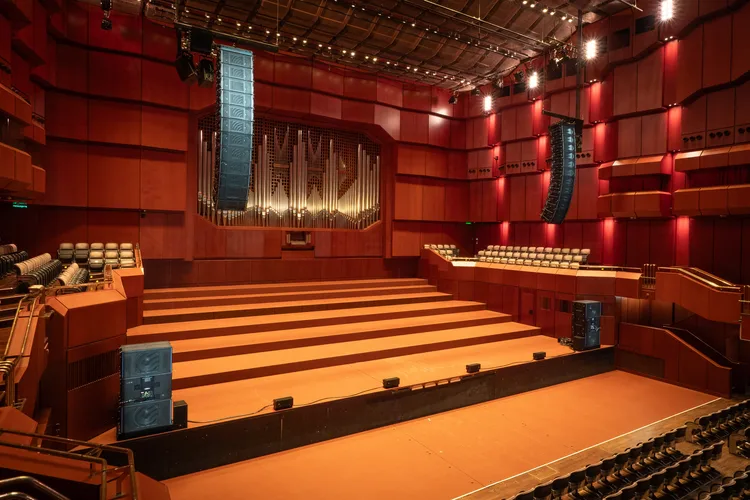
“The decision to use Milan was made even before the specific system was finalised,” Flügel says. TIGRA’s GEN-1 technology brings signal processing and networked control onboard the loudspeaker. A redundant Milan AVB network carries digital audio from the GALAXY processors through Luminex GigaCore switches to the loudspeakers, while Meyer Sound’s Nebra software provides centralised monitoring and control.
That visibility matters when equipment is difficult to access. With the previous system, amplifiers located above the hall powered multiple loudspeakers, making problems difficult to pinpoint. Now the house engineers can monitor individual loudspeakers and identify issues remotely. “We avoid unnecessary D/A and A/D conversions, and we are immediately alerted if a loudspeaker encounters any issues,” Flügel says. Meyer Sound Europe supported the project with system modelling, array aiming and on-site optimisation.
Fewer reflections in a hall built for orchestra
The Großer Saal was rebuilt for unamplified orchestral music, with mahogany panelling on every level and seating beside the stage. The challenge is to direct sound precisely toward listeners while minimising reflections from the surrounding surfaces. “It’s a very difficult room,” Desch says. “When you make mistakes, you really hear them.”
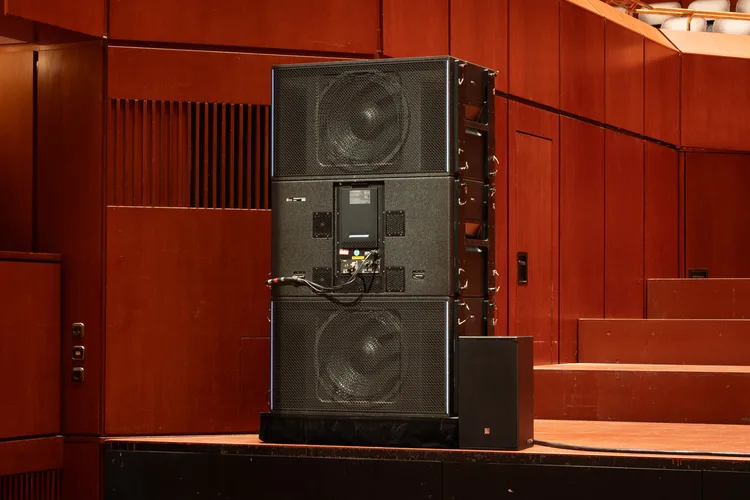
“By selecting the TIGRA-W and L models, lateral reflections have been effectively minimised,” Flügel says. “The system is significantly more direct than the previous one.” TIGRA’s controlled cardioid low-frequency pattern also reduces sound radiated toward the stage, which is now much quieter.
Calculation is one thing, and reality is another. We didn’t expect a sound image as good as the one we have now, says Jürgen Desch.
Products used: Meyer Sound TIGRA-L (18), TIGRA-W (6), 2100-LFC (6), ULTRA-X40, ULTRA-X42, ULTRA-X20, Galileo GALAXY 816 (3); Nebra software; Luminex GigaCore switches.
Photos: © Thomas Tratnik (hall) and Norbert Miguletz (exterior)
Latest
Home →
Groupe Novelty launches Novelty Asia
Robe T15 and T3 fixtures light Singapore Ballet’s Coppélia at the Esplanade
The Mexican Miami hides custom-finished 1 SOUND loudspeakers in its architecture
MA Lighting wins grandMA3 design patent case in China
KLANG brings immersive monitoring to Street Road Studios
INFiLED InfiPixmk2: 60×60 mm LED mini-modules that turn façades into displays



Geese tour Getting Killed with two DiGiCo Quantum225 DS Pulse consoles
Kingston City Hall ups the ambience with Anolis
TAQA Theater De Vest moves its main hall to Robe T1 Profiles