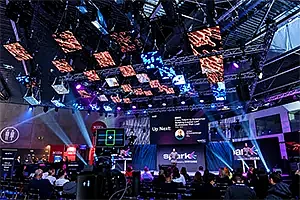
IBC2026 focused on some of the technologies that are most directly transforming content production, distribution and monetisation.
Generative and agentic artificial intelligence, connected media applications, new interchange standards, sustainability and non-terrestrial 5G networks featured prominently throughout the technical programme held in Amsterdam.
More than 600 speakers participated across the different IBC2026 stages, with a programme that sought to move the technology debate beyond the experimental phase and towards specific use cases and challenges facing the audiovisual industry. The organisation structured much of the content around three main areas: the transformation of business models, disruptive technologies and the impact these changes are having on people and organisations.
AI moves from experimentation to workflow integration
Artificial intelligence played a particularly prominent role. One session brought together representatives from MotoGP and Dutch operator KPN to examine how AI is changing media operations, from content creation to monetisation. Another discussion focused on the evolution towards agentic AI and which audiovisual processes are already becoming suitable for automation through autonomous agents.
Multimodal generative AI was another major focus. Tubi participated in a session dedicated to systems capable of working simultaneously with text, images, audio and video, while representatives from Avid and Fremantle discussed the application of these technologies to production management. Gracenote, meanwhile, joined other market participants to examine the different strategies companies are pursuing to introduce AI into their operations.
This approach was significant because IBC2026 did not present artificial intelligence solely as a creative tool. The programme also addressed production, management, content discovery, monetisation and operational transformation, indicating that the discussion is beginning to shift from technology demonstrations towards effective integration within media infrastructures.
Interoperability, standards and new architectures
IBC2026 also devoted a significant part of its programme to the evolution of audiovisual infrastructures. MovieLabs provided an update on its 2030 Vision, while the Future Media Townhall brought together specialists from Dolby, 5G-MAG, Orange and Nokia to examine the development and implementation of connected media applications from both technological and commercial perspectives.
Another discussion focused on DMF MXL, with participation from CBC and the European Broadcasting Union, while SMPTE examined the relationship between open source and standards and how the two models can work together to accelerate technological innovation.
This section was particularly relevant to broadcasters, manufacturers and systems integrators because it directly addressed interoperability and the evolution of the architectures on which future production and distribution workflows will be built.
From terrestrial 5G to satellite connectivity
Connectivity also expanded its reach. One session examined the integration of non-terrestrial 5G networks — 5G NTN — into the mobile ecosystem, including direct-to-device communications and roaming between terrestrial and satellite networks. Representatives from Kratos, neXat and Es'hailSat participated.
For the broadcast and remote production industry, this convergence between mobile and satellite infrastructures opens up new possibilities for contribution, outside broadcasting and content distribution in locations where conventional network availability remains limited.
Sustainability based on metrics, not just commitments
The programme also addressed reducing the energy impact of production and streaming. The Media Tech Sustainability Series examined real-world examples of sustainable production in environments where reliability, scale and performance cannot be compromised, while Greening of Streaming presented new findings related to consumption measurement and the transition towards streaming practices based on quantifiable data.
Overall, the IBC2026 agenda reflected an industry that is beginning to demand tangible results from technologies that, until recently, were presented primarily as trends. Applied AI, automation, interoperability, hybrid connectivity and energy efficiency are now linked to real-world workflows, business models and infrastructures.