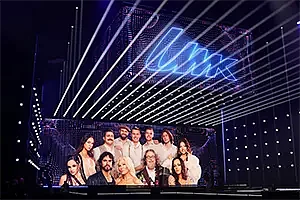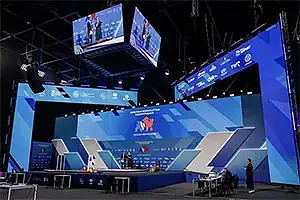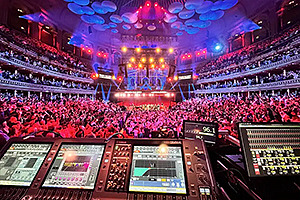
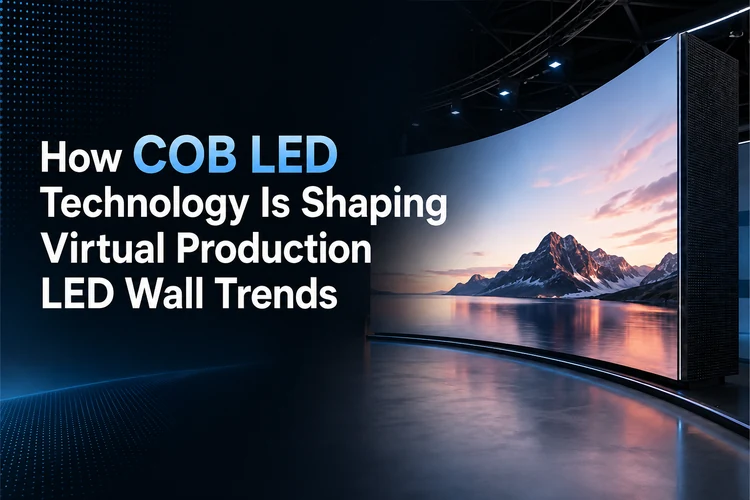
Virtual production is no longer confined to large film stages. Broadcast, advertising, streaming and corporate communications are adopting real-time LED environments, raising expectations for resolution, color, camera performance and physical durability.
In this context, COB technology is beginning to play a central role.LED walls used in virtual production are rapidly expanding their range of applications. What only a few years ago was associated mainly with major film productions is now moving into television studios, streaming spaces, commercial production, corporate events and XR environments.
The shift is not simply about installing more screens. The proximity between cameras, talent and the LED surface is forcing significant improvements in display optical quality. Finer pixel pitch, more accurate color reproduction, wider viewing angles and greater resistance to everyday use have become important requirements for this type of installation.
Against this backdrop, Chip-on-Board (COB) technology is gaining relevance for its ability to increase pixel density while creating more uniform and durable surfaces.
From large stages to increasingly compact studios
Production with real-time rendered backgrounds is no longer reserved for large film studios. Broadcasters can use virtual sets to change environments quickly, while production companies and agencies can create different settings without physically building each set.
Streaming rooms, corporate studios, product launch stages and content creation spaces are also joining this trend. XR stages take the concept even further by combining physical stage elements with real-time graphics for both cameras and live audiences.
This diversification introduces an important issue: many of these installations have significantly less space available than a traditional film stage.
When the camera operates just a few meters — or even closer — from the screen, any imperfection becomes much more visible. Pixel structure, color inconsistencies or certain patterns can end up appearing in the captured image.
Cameras are raising the bar for LED
A display suitable for digital signage will not necessarily perform well in front of a professional camera.
Today’s sensors can capture very subtle variations in lighting, color and texture. This makes several parameters particularly important.
- Pixel pitch and density. Higher pixel density helps prevent the physical structure of the display from becoming visible in close-up shots and reduces the risk of moiré patterns.
- Color uniformity. Color and contrast must remain consistent even when cameras operate from off-axis positions or move around the stage.
- Short viewing distances. In smaller studios, both talent and cameras may operate very close to the LED wall, so the surface must retain image definition and visual continuity.
- Stability during long operating hours. Studios may run for many consecutive hours, making thermal management, brightness stability and low failure rates important considerations.
These are precisely some of the requirements driving the adoption of COB in virtual production applications.
What really changes with COB
In a conventional LED architecture based on SMD (Surface Mounted Device), individually packaged LED devices are soldered onto the circuit board.
COB takes a different approach: LED chips are mounted directly onto the substrate and the entire surface is subsequently encapsulated with a protective resin layer.
The change may appear mainly structural, but it has important consequences for studio applications. By removing part of the individual packaging, COB can achieve ultra-fine pixel pitches, including pitches below 1.0 mm, increasing the available pixel density.
The continuous encapsulation layer also creates a physically more uniform surface. On camera, this can translate into an image with less visible granularity and smoother continuity between pixels.
It also changes the optical behavior of the display: a homogeneous surface can help reduce harsh reflections and improve the appearance of backgrounds where smooth gradients, shadows and natural tones are required.
Close-ups without revealing the screen
This becomes particularly important in compact studios. With a sufficiently fine pitch, camera operators gain greater freedom to move closer to the LED wall, change framing or shoot close-ups without making the screen texture visible.
This opens the door for corporate studios, regional broadcasters and smaller production companies to build fully functional virtual production environments without requiring large stage volumes.
The improvement therefore goes beyond image quality. It can also influence the physical design of the studio and the way cameras are used within the space.
A surface built to withstand studio use
There is another, less visible advantage that is especially relevant from an operational perspective: physical protection.
A studio is a working environment filled with cameras, tripods, structures, lighting, scenery and equipment that is constantly being moved. In conventional LED modules, exposed components can be vulnerable to impacts, dust, moisture or electrostatic discharge.
The encapsulation used in COB creates a sealed surface that is more resistant to physical contact, protecting the chips against minor impacts during set construction and scenery changes.
The smooth surface also simplifies cleaning and can help reduce module failures and downtime, something particularly relevant when the installation forms part of a production infrastructure used on a daily basis.
The panel is only one part of the system
COB can address issues related to pixel density, uniformity and physical protection, but a virtual production LED wall depends on a much broader technical ecosystem.
To operate correctly in front of professional cameras, other factors must also be considered, including:
- Refresh rate and genlock. High refresh rates and synchronization between the display and camera are essential for avoiding scan lines and shutter-related artifacts.
- Grayscale and low-light reproduction. Good grayscale depth preserves detail in shadows and dark cinematic scenes.
- Video processing. Processors must handle color calibration, high-resolution signals and low-latency video feeds.
- Camera tracking. In advanced virtual production environments, camera movement must be communicated to the graphics engine in real time so that perspective and content respond coherently.
For this reason, the evolution of LED walls for virtual production cannot be understood simply as a race to achieve finer pixel pitch. Final image quality depends on the integration of the panel, processing, synchronization, rendering and tracking.
LEDMAN brings COB to studios and broadcast environments
LEDMAN is developing COB solutions specifically aimed at these professional applications. The company combines its experience in ultra-high-definition displays and fine-pitch technology with systems designed for virtual production stages, broadcast studios and corporate audiovisual environments.
Its approach combines proprietary COB technology with system calibration to address both the optical requirements of professional cameras and the operational demands of installations subjected to intensive daily use.
The expansion of virtual production into new sectors therefore points to a clear evolution: LED walls will increasingly need to deliver higher resolution in less space, perform better in front of cameras and withstand far more demanding physical use.
COB is emerging as one of the technologies capable of addressing all three requirements simultaneously.