In recent years, LED has evolved from a niche solution into a standard across many professional environments. In 2026, the question is no longer whether it will replace projection, but in which cases it delivers greater value and how it impacts the business of integrators and rental companies.
A clear evolution: LED matures (but doesn’t solve everything)
LED has evolved significantly in three key areas: resolution, robustness and image quality.
The progressive reduction in pixel pitch has allowed solutions once limited to large outdoor stages to move into demanding indoor environments such as corporate events, studios and conferences. Today, working with pitches in the 1.x–2.x mm range is common in applications where it was unthinkable just a few years ago.
From a construction standpoint, technologies such as COB (Chip on Board) are introducing relevant improvements, especially in rental environments. Greater mechanical resistance, surface uniformity and improved black performance provide clear advantages for intensive use. However, these solutions still coexist with SMD, which remains the market standard due to its balance of cost, performance and ease of maintenance.
At the same time, MicroLED development points toward further gains in efficiency and density, although its adoption in general rental remains limited due to cost.
Brightness, contrast and consumption: the real balance
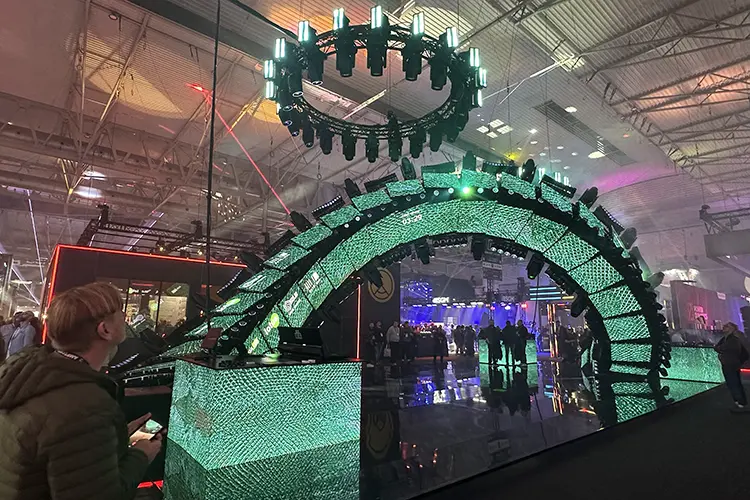
LED delivers brightness and contrast levels that make it suitable for environments with uncontrolled ambient light. This is one of the main reasons for its adoption in corporate events and stage broadcast. However, this performance comes with implications. In large-format configurations, energy consumption and the associated infrastructure remain critical factors. Although efficiency has improved, electrical sizing is still a key variable in the technical design of many events.
The limits of LED: beyond the commercial narrative
Despite its growth, LED is not a universal solution. Initial investment remains high, especially for fine pixel pitches. This is compounded by logistical factors such as transport, weight and setup times, which can be decisive depending on the type of production. In addition, one factor is becoming increasingly important: commercial obsolescence. The rapid evolution of pixel pitch and image quality can make relatively new equipment less attractive in certain market segments.
In this context, LED should be understood as a highly effective tool in specific scenarios, but not necessarily the optimal option in all cases.
Projection: a technology that doesn’t disappear, it specializes
Far from being sidelined, projection has found its place in applications where LED is not competitive or simply not viable.
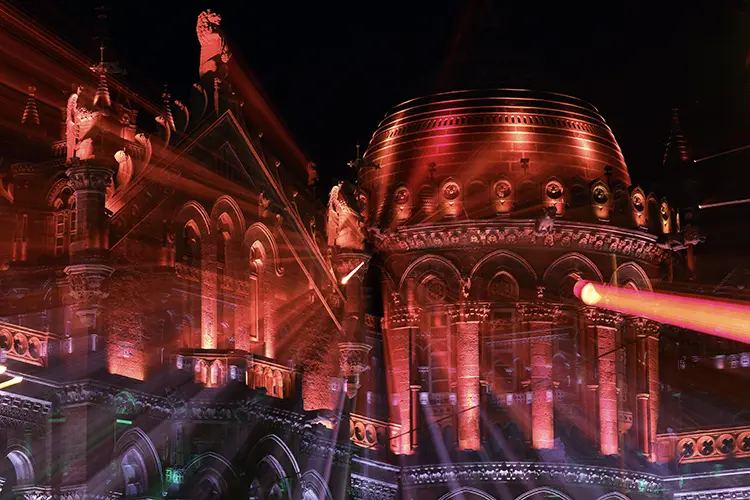
Videomapping remains one of its natural domains, thanks to its ability to adapt to complex surfaces and irregular geometries. Likewise, in large-scale surfaces or architectural interventions, projection continues to offer a cost/result ratio that is difficult to match. It also retains advantages in terms of logistics and flexibility in certain event formats, especially for temporary solutions or those with lower technical requirements.
Rather than replacement, what is happening is a redefinition of each technology’s role.
The decisive factor: real ROI in rental companies
Beyond technical performance, the element shaping investment decisions is return.
LED requires clear strategic planning. Its profitability largely depends on utilization rate, client type and company positioning. Not all local markets or client profiles demand the same level of solution. In addition, the speed at which technical specifications evolve introduces a level of risk that is not always present in more mature technologies.
Projection, on the other hand, offers greater flexibility in many scenarios, allowing adaptation to a wider range of projects, although with clear limitations in environments where LED has already become the standard.
In this context, the decision should not be framed as substitution, but as portfolio balance.
Conclusion: technology vs strategy
In 2026, the debate between LED and projection is no longer technological, but strategic.
LED will continue to grow and expand in applications where it delivers clear added value. Projection, for its part, will remain an essential tool in certain contexts, especially where flexibility, scale or cost are determining factors.
For integrators and rental companies, the key is not choosing one technology over another, but understanding when, how and for whom each investment makes sense. Ultimately, the standard is not set by the technology, but by the business.