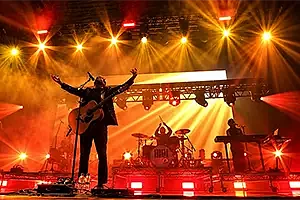
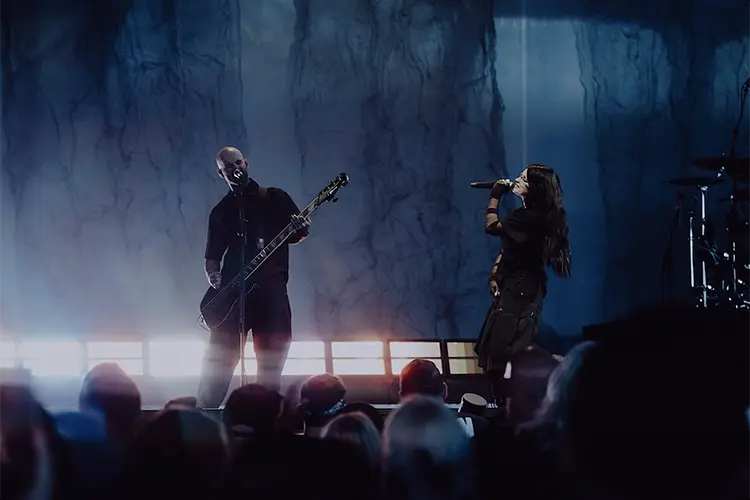
Most touring lighting designs are built by combining different types of fixtures, each intended to perform a specific function. However, the Spiritbox production that toured North America in 2026 was developed using just one fixture model.
Lighting designer and programmer PJ Carruth used exclusively 20 GLP JDC2 IP fixtures equipped with the new firmware 2.0, in what is believed to be the first touring deployment of this version.
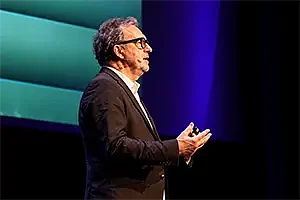
Carruth, a Los Angeles-based designer and programmer, came to lighting through mathematics and science. He began learning moving light programming from his high school math teacher and continued developing his skills while studying Applied Physics.
Since then, his work has focused on preprogrammed, timecoded shows. His clients value both his creative abilities and his technical approach and engineering background.
I'm typically hired for timecoded productions that require a high level of rhythmic synchronization. Many of my clients value my engineering mindset and my background in Applied Physics. That makes me a good fit for unconventional applications, explains Carruth.
A lighting design based on a single fixture model
Canadian metalcore band Spiritbox presented Carruth with a particular creative challenge. Their music alternates between crushing rhythms and extended atmospheric sections, often within the same song.
The lighting design had to reflect that musical structure rather than simply follow the beat. The programming therefore focused on percussion elements, using light as a means of visually reinforcing the composition.
"Spiritbox wants a visual aesthetic built around staccato effects, so my programming leans heavily into the percussion elements of their songs. It's important for the lighting to establish a specific atmosphere for each moment, acting as a kind of visual subtitles throughout the concert", says Carruth.
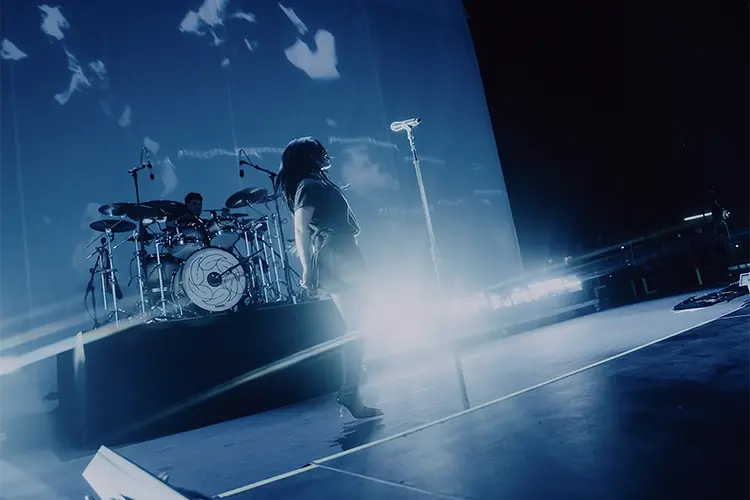
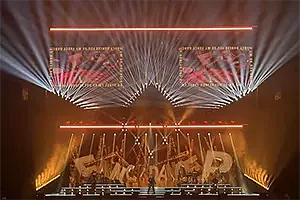
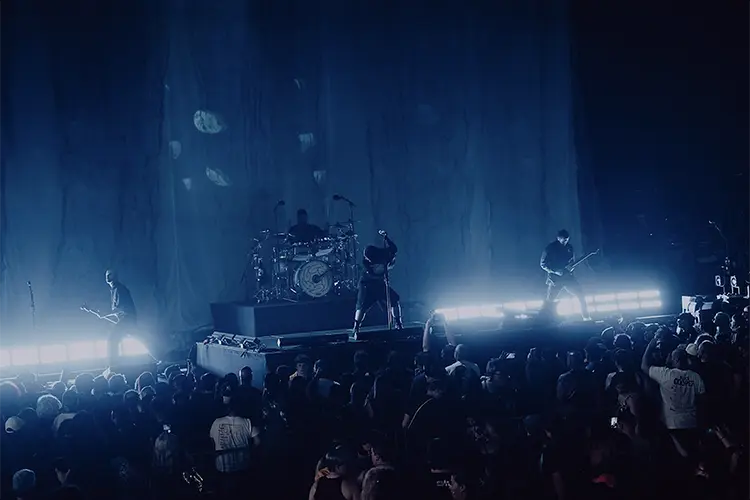
The touring package consisted of 20 GLP JDC2 IP fixtures supplied by Volt, arranged in a single row on the floor at the back of the stage. The decision to develop the entire show using just one fixture type required making full use of the JDC2 IP's technical and creative capabilities.
"We knew that for this tour we needed a fixture that could serve as a Swiss Army knife. The JDC family has always stood out for its strobe engineering, particularly because its control modes respect the programmer's ability to make full use of its capabilities", explains Carruth. "We knew we were only going to bring one fixture type, so we needed something versatile, and there's nothing more versatile than the JDC2 IP. Over the course of a full-length show, we can create a completely different look for every song".
Timecode programming and DMX response
The Spiritbox show is synchronized using timecode. For Carruth, a fixture's suitability for this type of production depends on how accurately it responds to DMX signals, beyond the features it offers. "The JDC2 is a reliable, highly responsive fixture that doesn't seem to have any measurable input latency, making it ideal for timecode programming against a defined timing grid", he says.
The designer also emphasizes the importance of precise control over LED effects.
Given my background in digital communication theory, I don't believe LED fixtures necessarily need a shutter channel. Much of my programming relies on Nyquist effects rather than synchronized shutter effects, and random generators rather than random shutter effects. That's why I pay particular attention to how a fixture responds to DMX signals.
The JDC2 IP combines a 12-segment beam line comprising 84 high-output LEDs with a colour plate featuring 1,728 LEDs that allow individual pixel control. However, its capabilities go beyond the hybrid strobe concept that GLP introduced with the JDC1.
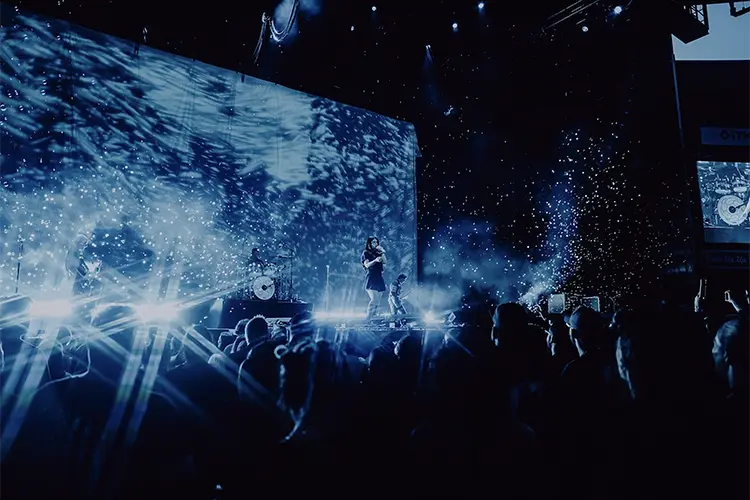
The fixture can generate digital content through GLP DigiFX, a system that can be controlled directly from the lighting console. Effects are processed in real time by algorithms running on the fixture's integrated dual-core processor, without the need for a media server in the signal path. The unit can also display NDI video streams on its LED plates.
Firmware 2.0: Canvas mapping and DigiFX content generation
One of the main innovations introduced in firmware 2.0 is a Canvas-based positioning system, with relative, absolute and segmented modes. This feature allows fixtures to be positioned within a defined coordinate space, ensuring that content is distributed correctly across multiple units rather than repeated identically on each one.
In the Spiritbox setup, this capability made it possible to use the 20 fixtures installed in a single row as one continuous visual surface. "We love the DigiFX system. It's remarkable how all its elements come together to generate a continuous pattern across all the JDC2s through DMX-configured Canvas mapping", explains Carruth.
The designer initially programmed the show using DigiFX without relying on external video sources. Later, during rehearsals, he incorporated some NDI feeds while retaining all the original programming as a backup system.
"At first, I programmed the show without external video, using only DigiFX. When we got to rehearsals, we added some NDI cues, but thanks to the way MA3 handles recipe tagging, I was able to keep the DigiFX programming as an emergency backup in case of video failure, activated with a single click of a macro. I was never worried about our media server failing", he comments.
Carruth also highlights the ease of configuration offered by the new mapping system. "Canvas was much more intuitive than I had imagined. It didn't take me long to create DMX presets for the different Canvas configurations I wanted to use and then apply them to either DigiFX or the video stream".
NDI video integration without external processing
The JDC2 IP fixture accepts up to four external NDI streams directly through its two Gigabit EtherCon ports, without requiring a dedicated interface or external video processing systems. Although the show was initially designed using DigiFX, Carruth incorporated NDI content during rehearsals after the production's VJ presented several visual concepts suited to particular cues.
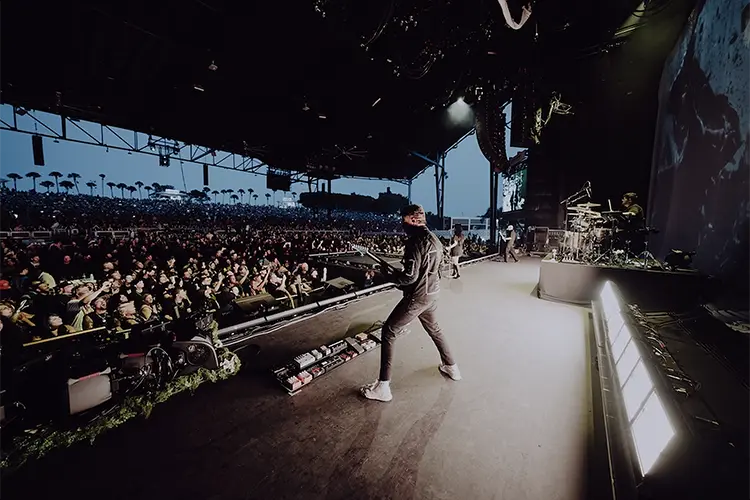
The system's performance in terms of latency was highly satisfactory.
The initial programming was entirely based on DigiFX, but during rehearsals our VJ showed us some looks that we incorporated into different cues. We found that the latency was practically zero, to the point where the video walls and projector lagged behind the JDC2s, explains Carruth.
This capability made it possible to create one of the show's most memorable moments.
During an interlude featuring a spoken poem, the same visual content was displayed on the IMAG screens, the projector and the row of JDC2 IP fixtures.
The strobes displayed legible text as part of the visual composition. At outdoor concerts, where ambient light reduces the contrast of screens and projections, the fixtures' contribution became particularly significant.
"During the interlude, the IMAG screens, projector and JDC2s were all showing the same content. At the outdoor shows, the feed displayed on the JDC2s made a huge difference", says the designer.
Fast setup and adaptation to touring demands
Beyond the creative possibilities, the production had to meet the operational demands of a tour with limited setup, changeover and console access times. The configuration based on a single fixture model and integrated programming helped simplify the technical crew's daily work.
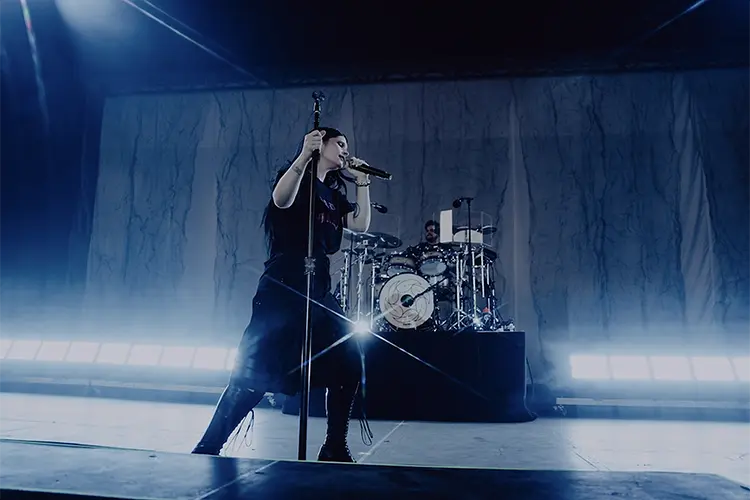
"The time available for changeovers and working at the console was very limited on this tour, but the setup and programming of these fixtures were so streamlined that we weren't worried about getting everything up and running quickly", explains Carruth.
The designer concludes by expressing his interest in continuing to use this technology in future projects: "I'm looking forward to incorporating these fixtures into future productions".
Image credits: © Alex Bemis
 Instagram
 Facebook
 LinkedIn
 X
 YouTube