In professional audio, video, broadcast and lighting applications, cable performance depends not only on the conductors and their electrical characteristics. The outer jacket protects the cable against environmental conditions, and its properties influence aspects such as flexibility, durability, safety and service life.
There is no single jacket material suitable for every application. Temperature, UV exposure, water, oils, chemicals, abrasion, frequent handling and fire-safety requirements can all influence the choice of compound. Therefore, selecting the right jacket means considering not only the signal the cable carries, but also where and how it will actually be used.
PVC: flexibility for everyday professional use
PVC remains one of the most versatile solutions, particularly for applications where flexibility and ease of handling are priorities.
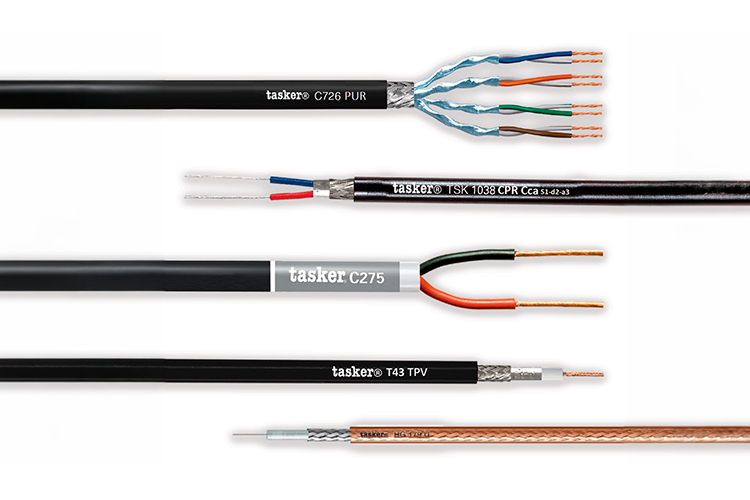
For example, Tasker C275 is a professional speaker cable featuring two Soft PVC jackets with different densities. This construction is designed to provide the flexibility required for speaker connections and premade cables, where frequent handling and easy routing can be as important as electrical performance.
Silicone: extreme temperatures and high flexibility
Where softness must be combined with an exceptionally wide operating-temperature range, silicone offers specific advantages.
TSK74 is a divisible flat audio cable with an Extra Soft silicone rubber jacket. With an operating range from -60 °C to +180 °C, it is designed for demanding environments, including medical applications, water parks and beauty centres.
This material can therefore be useful in installations where conventional cable jackets may become too rigid at low temperatures or deteriorate due to prolonged exposure to heat.
PE: protection for fixed outdoor installations
For fixed outdoor installations, polyethylene provides an effective barrier against environmental exposure.
C128 PE, a balanced microphone cable for outdoor use, combines an external PE jacket resistant to UV radiation, water, chemicals and oils with an inner PVC sheath.
This type of construction can be useful when cables are installed in conduits, pits or exposed areas where moisture, sunlight or contaminants create greater demands than in a conventional indoor installation.
FEP: demanding environmental and temperature conditions
Applications involving demanding temperatures or exposure to aggressive environmental conditions may require materials such as FEP.
The compact RG179/U 75 Ω mini-coax uses FEP for both its outer jacket and core insulation. Its resistance to UV, water, chemicals, solvents and oils makes it suitable for video connections where both reduced dimensions and protection against environmental conditions are required.
LSZH: when fire safety is a priority
In permanent installations inside buildings, cable selection must also take fire behaviour into account.
LSZH compounds combine flame-retardant characteristics with the absence of halogens, helping to reduce smoke and corrosive gases in the event of fire. These properties make this material particularly relevant in public buildings, commercial environments and other installations where safety regulations form part of the cable requirements.
Tasker uses LSZH jackets in its high-performance CPR-approved cables, including Cca and B2ca classes. For example, TSK1038 CPR Cca is a 110 Ω DMX cable with a UV-resistant LSZH jacket and Cca-s1-d2-a3 classification.
NBR, TPV and PUR: cables designed to move
Touring, stage and mobile broadcast applications introduce a different set of requirements. Cables are repeatedly deployed, coiled, stepped on and exposed to changing environments, making flexibility and mechanical resistance particularly important.
FMW24400 NBR, a 24 × 4.00 mm² multipolar speaker cable for professional mobile and stage applications, uses a nitrile jacket resistant to fresh and salt water, oils, grease, fuels and chemicals, as well as cuts, abrasion and trampling.
For mobile broadcast applications, T43 TPV combines an Extra Flex TPV jacket with 12G-SDI performance. Its jacket is flame-retardant and halogen-free, while also providing resistance to UV, water, chemicals and oils.
Data cabling used on tour faces similar mechanical demands. C726 PUR features a polyurethane jacket on a flexible Cat.7 cable, providing resistance to UV, chemicals, water and oils and allowing operation at temperatures down to -40 °C.
Matching the cable to the actual installation
Choosing the correct jacket therefore requires looking beyond the cable's electrical function. Two cables carrying the same type of signal may require very different mechanical characteristics depending on whether they are permanently installed in a building, buried in a conduit, exposed outdoors or frequently handled on tour.
Consequently, a microphone, speaker, video, DMX or data cable should be selected not only according to bandwidth, impedance or conductor cross-section, but also taking into account the temperature range, installation type, mechanical stress, environmental exposure and fire-safety requirements.
The outer jacket is not simply a protective covering: it forms part of the cable's overall performance and can directly affect its reliability and service life.
 Instagram
 Facebook