

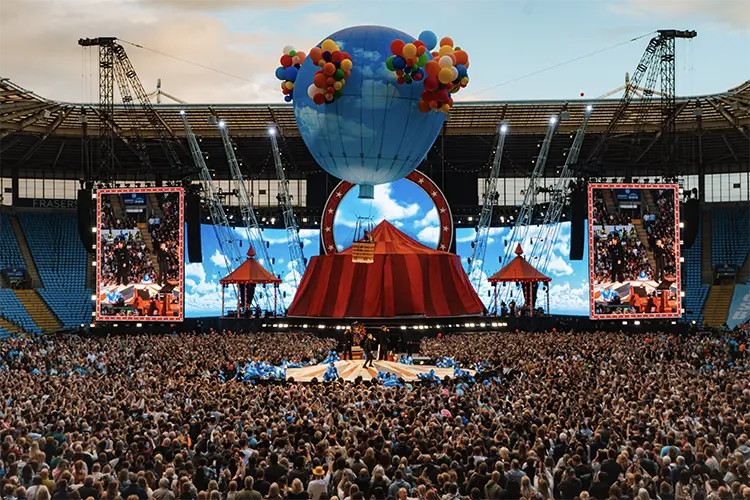
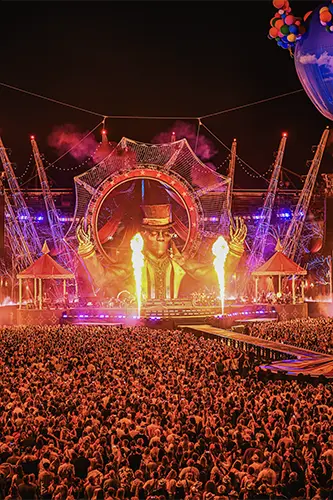
The number 13 may be considered unlucky by some, but for British pop icons Take That, their thirteenth tour, The Circus Live - Summer 2026, has proved anything but.
The original 2009 production was the fastest-selling tour in UK music history—600,000 tickets in less than five hours—while the new 2026 version welcomed 736,000 spectators to 17 stadiums across the UK and Ireland and broke Amazon Music’s live event streaming record.
This reimagining became one of the most talked-about live shows of the year. Skan, a Clair Global brand, supported the tour with an innovative PA system design, a specialist audio crew and comprehensive technical support.
It is a once-in-a-lifetime experience that they have managed to bring to life for a second time! Take That are pop royalty and are considered a 'national treasure' in the UK. They are also lovely people, the band is fantastic and I love working with them all. Everyone involved in the show feels enormously proud of what we have created together. From hearing about the fans’ experiences, we can see that the tour has brought people together in an extraordinary way. We knew it would be good, but I do not think anyone imagined just how good it would be. It is one of my favourite tours of all time, says Becky Pell, Take That’s long-standing Monitor Engineer.
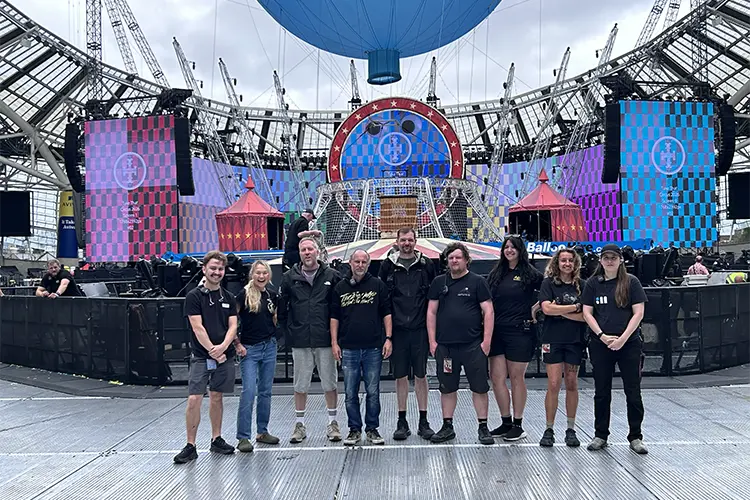
The technical framework surrounding the tour proved essential. Pell continues: "This has been a Skan project for a long time and, as always, they have done an excellent job with the planning, preparation and technical support. Skan’s Chris Fitch, Matt Vickers and Tom Tunney make a great team, and Liam Tucker played a key role in overseeing the audio production and coordinating everything on site. Both he and our RF Engineer, Emma-Jane Lee, have been my main technical supports throughout the process".
Maximum concentration and an unconventional setup
Becky knows how to work under pressure and make decisions in real time. During the show, it can be difficult to decide where to look at any given moment—there is action everywhere—but every element of the production can be heard thanks to the coordination of the audio team.
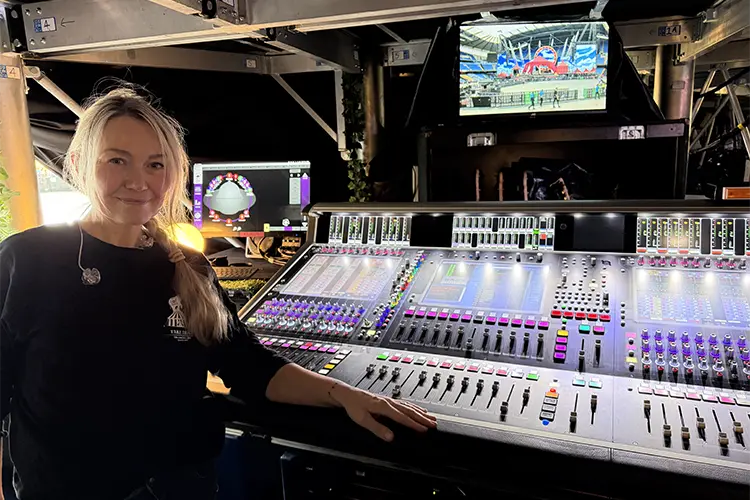
"I have to concentrate hard because so many extraordinary things are happening that it would be easy to become distracted", she adds. "We use an unconventional monitor setup: I have no direct view of the stage, as I am in a curtained-off space beneath the stage-left band riser, directly below the drum kit. In front of me is a screen fed by the video department, which usually focuses on the three performers. It is very different from a typical monitor mix, and I had to get used to it when I first worked this way on the 2024 This Life tour. However, on a show with so much activity happening around me, this restriction is useful because it helps me stay focused".
Becky manages numerous cues and often prepares the next effect while a song is still being performed. "It is a bit like spinning plates: I might be adjusting a vocal fader and checking that the performers remain in time with enough click on the B-stage to prevent them from drifting towards what they hear from the PA system, while simultaneously line-checking the next song. It is intense and challenging work, but I enjoy finding ways to make everything run as smoothly as possible".
 Everyone performing on stage uses in-ear monitoring systems. Becky mixes Take That, their guest singer, the band and the technicians on a DiGiCo Quantum 7. "There are around 50 performers in the cast and, although they receive just one shared mix, managing that many people and bodypacks is a considerable task in itself. To keep that work separate, we also have a DiGiCo SD12 that receives the FOH mix and adds extra channels, such as the show calls and cues. RF Engineer Emma-Jane handles that console and the Shure microphones".
Stage Technician Louis Briggs manages the bodypacks and in-ear monitors used by Take That and their band, while Sierra Raia, Delay PA Technician and Assistant Stage Technician, looks after the dancers’ equipment. Both use Wisycom and Sennheiser systems.
Becky continues: "I have used Rupert Neve 5045 primary source enhancers for a long time to reduce spill into the vocal microphones. However, I was so impressed by the Mustard source enhancers included in the latest DiGiCo update that I decided to use them this time".
Four audience microphones were positioned along the front edge of the A-stage. Becky raised their levels between songs so that the artists could hear the audience when they were performing on that stage.
Mixing monitors means working at the intersection of technology, creativity and people. The better I understand an artist’s preferences, behaviour and body language, the better I can anticipate what they need. Audience noise is just one of the factors that must be taken into account, as is the sound coming from the PA system when they are on the B-stage. Because of the laws of physics, they hear it considerably later than the direct sound from their in-ear monitors. If they tried to sing along with what they hear from the PA, everything would quickly fall out of sync. They are highly professional and accustomed to working this way: they keep their in-ears in, which represents 90% of the challenge on a B-stage. They know they need to turn up their bodypacks and when to do so to remain locked into their mixes. This does not completely block out the PA sound, and they also have to concentrate, but they have mastered it.
Becky uses Klang integrated with the console: "I love it because it allows me to create very natural-sounding mixes. Binaural technology creates the impression that sounds are coming from the environment around us, from outside the head, as they do in real life, rather than being confined to the narrow space between the ears. Stereo is an artificial way of listening, and our subconscious auditory system has to work hard to interpret it. Klang reduces the fatigue caused by prolonged use of in-ear monitors because it recreates our natural way of hearing without requiring the brain to reorganise the information".
A unique show to mix
Gary Bradshaw’s departure after 30 years with the band made way for a new FOH Mix Engineer. Steve Carr was selected for the role, bringing experience of mixing large orchestras, female pop artists and stadium rock acts—fields in which he established relationships with Britannia Row, Clair Global and, now, Skan.
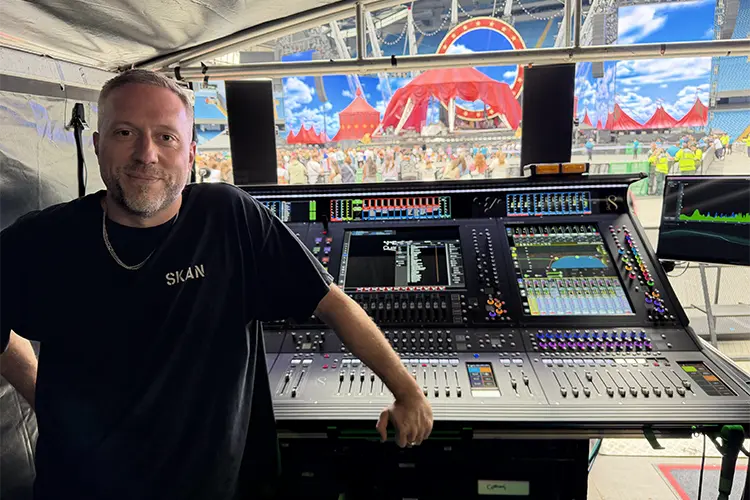
"This tour has been the first time I have worked with Skan in any significant capacity, and the experience has been fantastic", he begins. "I have felt valued and supported. The whole team has been outstanding. I would particularly like to mention Tom Tunney and Matt Vickers: after exchanging just a few emails and having several conversations, they understood what I needed from my control package and prepared it exactly as I wanted. I could not have been more satisfied. At first, I did not fully understand the scale of the job, but after watching their previous shows, I realised just how extraordinary a Take That production is".
Musical Director Mike Stevens and the band work to keep the live versions faithful to the original recordings while bringing their own character and personality to the songs. "The sonic aim is for the audience to recognise the records immediately, but with all the energy and excitement that only a live band can provide. The show continues to build until it reaches an enormous emotional climax during 'Rule the World'. It is a very unusual production to mix because it includes a bit of everything. Pop lies at its heart, but it also incorporates elements of disco, R&B and indie rock, which makes mixing it great fun".
Carr also chose DiGiCo and mixed the show on a Quantum 8. "The decision proved to be the right one because the session continued to grow during production rehearsals. The console offers enormous processing power and a good selection of Mustard options, so I was able to carry out most of the dynamic and tonal processing on it. For outboard equipment, I use Distressors on the vocals, a Bricasti M7 for room reverb, an SSL bus compressor and a Neve master bus transformer".
Steve used a fully redundant LiveProfessor system running on a Mac without an RME MADI interface. "It gave me very stable performance with extremely low latency. I used the plugin rack to process the drum and keyboard buses, as well as the vocal channel inserts. I used Mayor Applebaum Master Transformer, Kush Clariphonic, Oeksound soothe3, Valhalla VintageVerb, H-Delay, H-Verb, UAD Roland Dimension D, Eventide Audio H3000, and Waves PSE and Noise Suppression. We made a deliberate effort to mix the band with a rockier and more powerful sound, and we achieved that. The visual spectacle was enormous, and we wanted the sound to match it and even reinforce those grand visual elements. Three open microphones singing harmonies in front of a stadium-sized PA system and surrounded by screaming fans is not a typical situation. I had to reduce noise spill and improve vocal isolation to maintain the clarity of the mix. I used primary source enhancers alongside noise suppression and side-chain compression to increase both the clarity and impact of the vocals".
A controversial system design
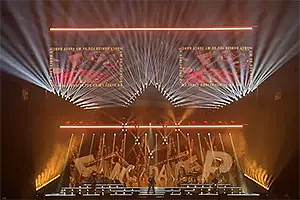
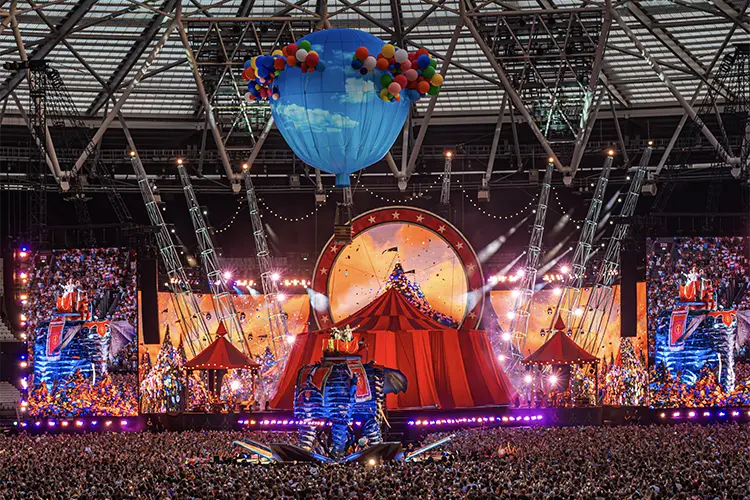
Skan’s Matt Vickers was tasked with designing a PA system that would deliver the stadium result Steve was looking for. "Working with Production Director Chris Vaughan, Production Manager Wez Wearing and the rest of the team is always as enjoyable as it is demanding because expectations are exceptionally high", explains Matt. "There is strong mutual respect between us as the audio supplier, the production team and the creative team led by Kim Gavin. Everyone understands that the audio system is essential, but also that it must disappear visually into the overall show design as much as possible. That is no small task when large loudspeaker arrays are suspended and aimed directly at the audience".
Matt’s solution was to design a system with as few visible components as possible, reducing its visual impact without compromising audio quality or vocal clarity. "The result was main arrays comprising 18 d&b audiotechnik GSL cabinets, supported by 12 ground-stacked SL-Subs per side. We used left-right subwoofer arrays: a controversial and very 1990s-style solution, but one that provided highly even coverage", he notes. "We applied the same philosophy throughout the rest of the system. During the design phase, we integrated the front-fill loudspeakers into the downstage edge behind acoustic windows. This ensured complete coverage of the front rows without the audience being able to see the loudspeakers".
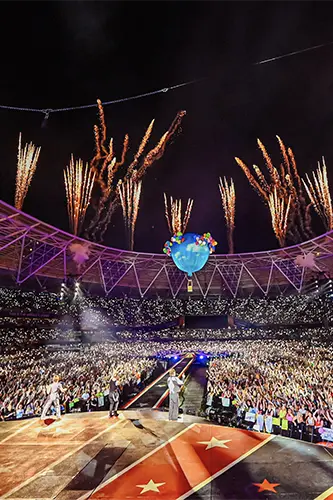
As almost half of the show took place on the B-stage—a 360-degree performance space located in the centre of the venue—it was necessary to install a ring of nearfield loudspeakers to keep the sound image anchored to the performers rather than to the main PA system.
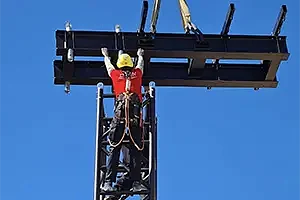
The loudspeakers were integrated into the risers surrounding the stage. When the B-stage opened to allow the moving elephant, operated by the performers themselves, to travel towards the main stage, the loudspeakers moved with it. They also had to withstand the large quantities of water that fell on them during the opening sequence. The main arrays were suspended from cantilevered beams extending from the video wall support masts. This presented several engineering challenges, including the inability to use wind-bracing systems. We solved this by setting the header height as close as possible to the final trim height, thereby reducing the pendulum effect caused by the long chain drops. Sharing those headers added another layer of complexity. Lighting fixtures occupied the same structure to provide front light, while the winch system above incorporated pulleys and diverters for the aerial performance systems, including an artist who was suspended and spun by her hair above centre stage.
 |
 |
Despite these challenges, the installation had to remain tidy, serviceable and capable of lowering the arrays overnight or during high winds without requiring anyone to climb the structure. "The final cable plan used a three-inch gap in one corner of the video wall, allowing both the loudspeaker and lighting cables to pass through. This simplified installation and removal, reduced cable lengths and the number of aerial connections, and gave the entire system a cleaner appearance".
A roof-hung ring delay system was used for the larger shows. "It allows us to provide a consistent, uncompromised listening experience throughout the venue", explains Matt. "Every audience member has bought a ticket to enjoy a special night, and they all deserve the best sound we can provide. Becky and Steve achieved exceptional results with this system. After investing so much time in its design, there is no better reward than watching talented sound engineers get the most from it. Monitoring is never easy when performers frequently work in front of the PA system, but both the artists and the band delivered flawless performances, providing Steve with excellent source material from which to build the FOH mix".
The approach of some of the industry’s leading professionals
 At each venue, Crew Chief and System Engineer Joachim Dewulf helped Steve with the daily adjustments. "Meeting Joachim on site was very refreshing. We have a very similar approach to live sound systems and, as soon as I brought the mix up through the PA, I knew it was going to be a very enjoyable couple of months", Steve adds. "The relationship between a FOH Engineer and a System Engineer is very important. For me, it makes the difference between simply doing the job and truly enjoying the tour. Mixing is a creative task, and your emotions are connected to what you do. The key is to communicate well, think in similar ways when necessary, work together under pressure and deliver consistent results. I realised very quickly that we were going to have a great professional relationship".
Becky agrees: "Joachim has provided a steady hand while overseeing the entire project, and it has been a pleasure to have Steve Carr as my FOH counterpart. He is a great engineer with an excellent attitude".
The team was completed by professionals selected by Skan: Lee Saddington, FOH Minder and Delay Technician; Patrick Boyd, Stage Left PA Technician; Craig Burns, PA Technician; Conor O'Grady, Ring Delay PA Technician; Tom Nunes, Ring Delay Technician for load-out; Finlay Watt, Control Technician during rehearsals; Martin Gehring and Kim Kusters, Riggers; Sierra Raia, Delay PA Technician; and Julia Bochenska, Stage Right PA Technician. Alongside Conor, Stage Technicians Louis and Julia are graduates of Britannia Row’s Live Audio Technician Apprenticeship.
To conclude, Becky highlighted that the team worked to the highest standards and met the demands of the show. She also noted that the project pushed the limits of what was possible in every department and praised the professionalism of everyone involved in the tour.