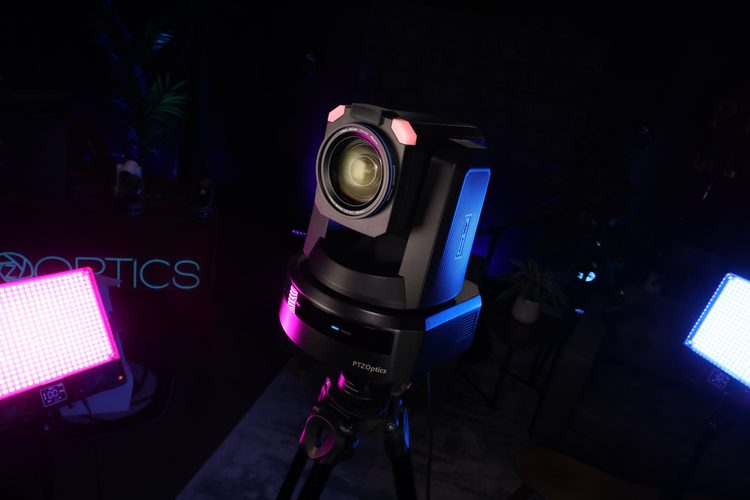
The new camera, which will make its public debut at IBC2026, combines a 1-inch sensor, 4K60, 20x optical zoom and multicamera synchronization with tracking and automation tools.
PTZOptics has introduced Rise 4K, a new PTZ camera that expands the manufacturer’s offering into more demanding broadcast production environments. Beyond 4K resolution, the most significant step forward is its connectivity: 12G-SDI, genlock, timecode, FreeD and SFP+ join a platform that also retains HDMI, USB and IP.
The camera uses a 1-inch, 50 MP CMOS sensor and can capture Ultra HD 4K at up to 60 fps. Its lens offers 20x optical zoom and an approximately 71-degree horizontal field of view, while autofocus is based on phase detection.
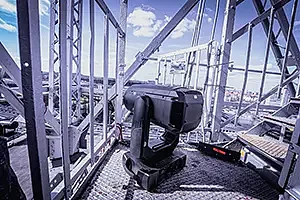
It also incorporates optical image stabilization and an integrated three-stage ND filter. Brushless motors are used for robotic movement, an especially relevant feature in live production when the camera needs to perform visible on-air moves rather than simply switch between preset positions.
More than a PTZ camera for streaming
Probably the most significant aspect of Rise 4K is the platform’s move towards conventional multicamera broadcast infrastructures.
The 12G-SDI output carries 4K60 over a single SDI connection, alongside 3G-SDI, HDMI and USB 3.0. It also features a 12G-compatible SFP+ connection for fiber-based installations, particularly useful in auditoriums, sports venues, distributed studios or productions where significant distances separate the cameras from the control room.
Genlock and timecode enable multiple units to be integrated into a synchronized system, while FreeD provides the positional data required to use the camera in certain virtual production and augmented reality workflows.
Rise 4K also includes XLR inputs with 48 V phantom power, local recording to TF card, and front and rear tally lights.
For networked workflows, it supports NDI HX, SRT, RTMP and RTSP. According to the information provided by the manufacturer, support for ST 2110 or full-bandwidth NDI has not been announced at this stage, so its approach combines a broadcast infrastructure based primarily on SDI and fiber with IP distribution and control.
Horizon brings control, adjustment and automation together
The camera ships with Horizon Web, PTZOptics’ browser-based control platform. From this interface, operators can manage PTZ movement, image parameters, color, presets, tracking and auto-framing functions.
For multicamera matching, it includes waveform, vectorscope and RGB parade tools, bringing the control environment closer to the requirements of a conventional production workflow and allowing more precise matching between different camera positions.
Automatic tracking can keep a subject framed while reducing certain repetitive operations. The interesting point here is not so much replacing the operator as increasing the number of robotic camera positions that a single person can supervise within a production.
From NAB prototype to IBC product
Part of this platform was previewed at NAB Show 2026, where PTZOptics demonstrated a broadcast camera still under development featuring a 1-inch, 50 MP sensor, 4K60, 20x optical zoom, 12G-SDI and genlock.
Rise 4K now represents the commercial arrival of that concept and will make its public debut at IBC2026, taking place from September 11 to 14 at RAI Amsterdam, on the PTZOptics booth 1.B07.
The camera is available to order now, with first shipments scheduled for the fourth quarter of 2026.