
From cathedral acoustics to the sound of a rock band with Meyer Sound's NADIA
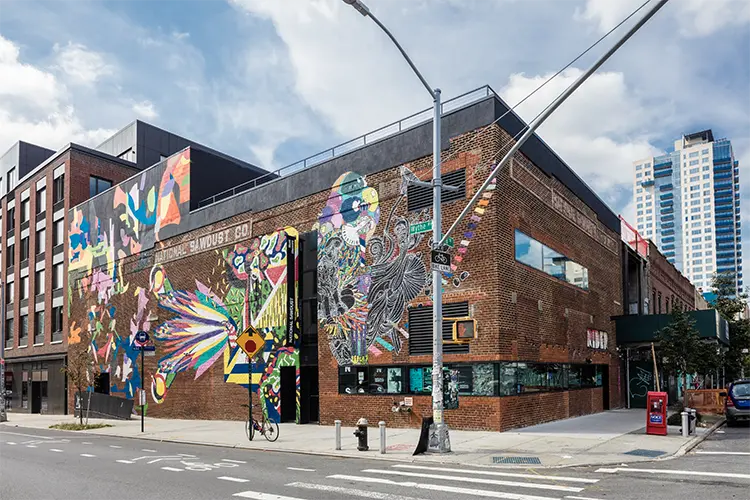
On a single night, National Sawdust may bring together eight composers with different sound setups and acoustic requirements: audio tracks moving around the audience, the acoustics of a cathedral, or a drier, more controlled environment for a rock band.
When we launched NADIA, we said that National Sawdust was our benchmark venue for spatial audio integrated with active acoustics. They needed to be on our benchmark platform, explains Steve Ellison, Meyer Sound's Director of Spatial Sound.
Active acoustics and spatial audio on a single platform
Operating on a Milan AVB network, NADIA dedicates one processing path to Constellation active acoustics and a separate path to amplified audio. At National Sawdust, Spacemap Go now controls spatial mixing on this second path, replacing an earlier version of the tool that the venue had been using since 2019.
"What this upgrade does is remove technology as an obstacle for artists", explains Ana De Archuleta, Executive Vice President of Business & Innovation at National Sawdust. "Composers walk into this room and stop thinking about the technology. They simply move sound wherever they want and reshape the room's acoustics in real time to suit each piece".
"Spacemap Go is a tool you can put in front of an artist and say, 'Why don't you try mixing from the stage?' It's very intuitive", says Garth MacAleavey, Director of Sound and Technical Design at National Sawdust.
MacAleavey has integrated both processing paths into his show control system. "I need to create program changes in QLab to tell three different systems what to do, so that when I can't attend a rehearsal, the sound is already set up", he explains. "My colleagues can run through the show's cues, and the mixes will change, Constellation will adjust its settings, and Spacemap Mix and Channel Snapshots will also be updated".
Early reflections for Constellation
The original installation used a single processor dedicated to reverberation, while the new NADIA system has three.
We have been able to incorporate early sound reflections, which help musicians hear themselves better on stage and allow the audience to perceive the width and depth of the space more clearly during performances, explains Jessica Borowski, Senior Acoustic Engineer at Meyer Sound.
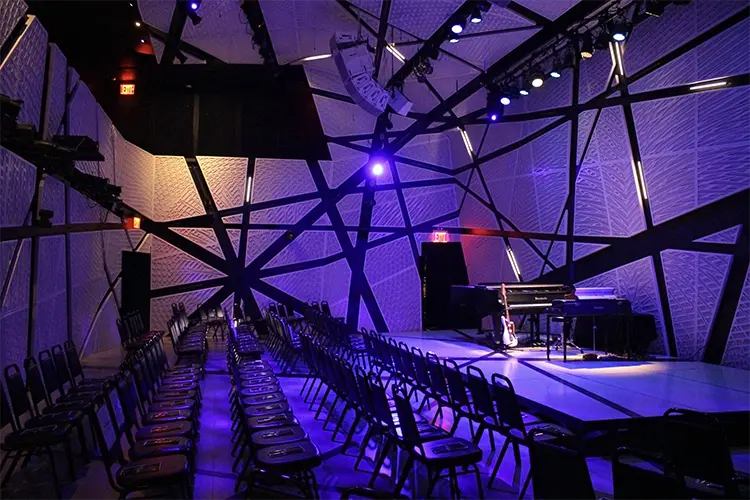
Borowski and Leonardo Serani, Constellation Support Specialist at Meyer Sound, also rebuilt the acoustic settings the venue regularly used, including an exceptionally long 10-second reverb that, in MacAleavey's hands, can function as a musical instrument, as demonstrated during performances by vocalist Theo Bleckmann.
"When he arpeggiates through different notes, you can hear chords continuing to resonate from his voice", explains MacAleavey.
After seven years of working with the system, MacAleavey took part in the final day of the upgrade, spending an hour carefully listening to the new settings. "Now it's like having a customised menu with exactly what our engineers and sound designers are looking for when they need to apply reverb or achieve a more defined sound through early reflections", he says.
Spatial performances that can travel between venues
NADIA and Spacemap Go make it easier to adapt spatial audio productions between venues equipped with these technologies.
In September, musician and composer Erik Hall made his National Sawdust debut with interpretations of works by Steve Reich and Simeon ten Holt, playing four instruments live alongside prerecorded tracks.
The spatial design for Reich's Music for 18 Musicians was developed with MacAleavey and Ellison during Hall's residency at the FreshGrass Institute, held at Studio 9 in North Adams, Massachusetts. It was subsequently adapted for National Sawdust and, two days later, for the University at Buffalo's Experimental Intermedia Lab. "My solo adaptation of 'Music for 18 Musicians' was recorded one track at a time in my home studio, and Meyer Sound's system effectively brought that studio to the audience", explains Hall. "It transformed a stereo recording into a complete three-dimensional experience, as if the listener were sitting in the same room, surrounded by the instruments".
"This is a space where artists can develop new works", says MacAleavey. "Even established artists can come here, take advantage of this system, and bring their compositions and performances to an entirely new level".
It's the beginning of something bigger: a five-year partnership in which Meyer Sound is not simply equipping our space but becoming a true collaborator in the productions we present on this stage, concludes De Archuleta.
Photo credits: Jordan Fields
Follow Meyer Sound
 Instagram
 Facebook
 LinkedIn
Latest
Home →
Shure MV360: four capture modes to take immersive sound to the next level
LD Christina Rupp: the music festival that changed her career
Ryan Penny takes the helm of d&b audiotechnik's sales operations in the US

ETC Halcyon becomes an integral part of the technical setup behind major musicals
Three stages and three technologies as L-Acoustics transforms the sound of Les Escales
Four nights, 545 lighting fixtures and a grandMA3 system for Oques Grasses’ farewell concert



System of a Down turns 96 iESPRITE LTL fixtures into a wall of light synchronised with video
A home run of light: eleven Robe SVOPATT fixtures take centre stage in the Sunday Night Baseball opening sequence
The Rockettes' Christmas Spectacular expands its AV production with real-time cameras