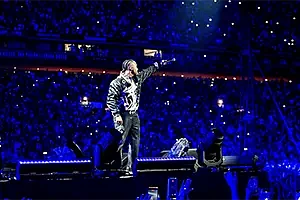
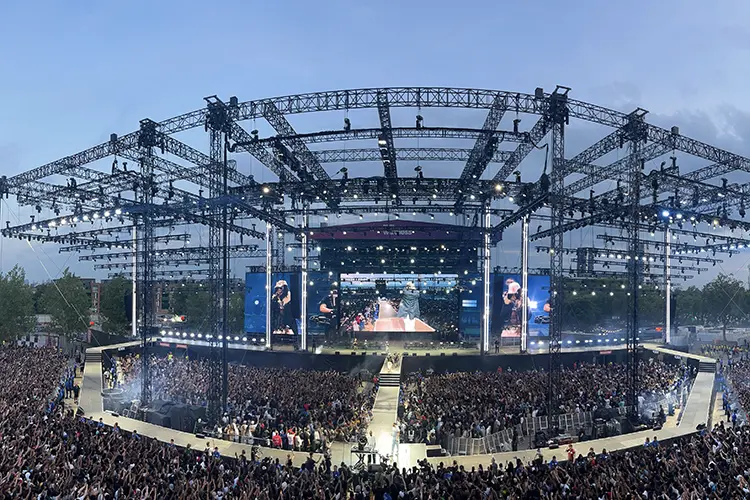
Canadian hitmaker and award-winning R&B superstar Drake hit the road in Europe this summer with lighting, video and rigging supplied out of PRG’s UK base in Longbridge, Birmingham, working closely with USA counterparts, PRG North America, in an impressive intercontinental collaboration to ensure the artist’s production enjoys full continuity and technical integration wherever in the world the show is playing.
The European tour started immediately after the 2025 Wireless Festival, staged in London’s Finsbury Park, where Drake became the first artist to headline each night of the 3-day event, performing different setlists and accompanied by multiple guest artists. PRG UK also supplied lighting and rigging for Wireless, a seriously scaled-up version of the original touring concept.
The first and second legs of the tour had already taken North America and Australia by storm earlier in the year, with lighting and video production supplied by PRG North America.
Creative originality
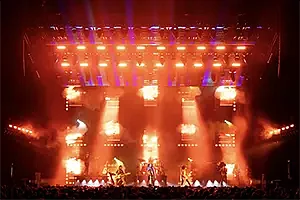
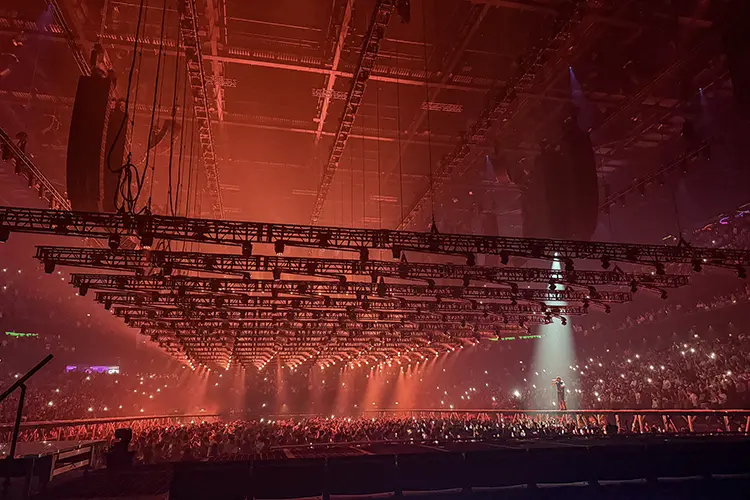
The concept, crafted by Matte Babel, features two ‘bare’ stages connected into a 360° environment by elevated transparent acrylic walkways running around both sides of the arena, with the audience on all sides and even in the middle. This layout gives Drake maximum proximity to his fans and began taking shape last year.
Matte Babel, who joined Adel “Future” Nur on Drake’s management team in 2017 and oversees Brand, Marketing and Creative, explained that collaboration is essential when working with an artist of Drake’s calibre. The best ideas come from understanding who the artist is and what they want to accomplish, making creative direction a shared process.
After 2024’s massive “It’s All a Blur” North American tour —whose production included robots, dancers, lasers, flying props and a three-story Virgil statue— Matte wanted to take things in the opposite direction. He pitched the idea of stripping everything back to Drake himself.
Inspired by minimal, raw, gallery-like spaces where lighting brings the art to life and the audience’s reactions generate the emotional atmosphere, Matte wanted a show that was simple, different and memorable —something truly unexpected.
Club atmosphere
Matte’s vision began with the lighting. To keep the floor completely clear, all technical elements had to be suspended above the arena, prioritizing lighting and audio while requiring a different approach to video due to weight restrictions.
He envisioned a giant, constantly evolving lighting rig that could engage the audience throughout the show. During this process he encountered the work of Nonotak —the Japanese duo known for high-precision kinetic light installations— whose creations closely resembled what he had in mind.
Nonotak contributed insights as consultants while Guy Pavelo, Drake’s long-time technical director, worked to find a practical touring solution for Matte’s kinetic lighting concept.
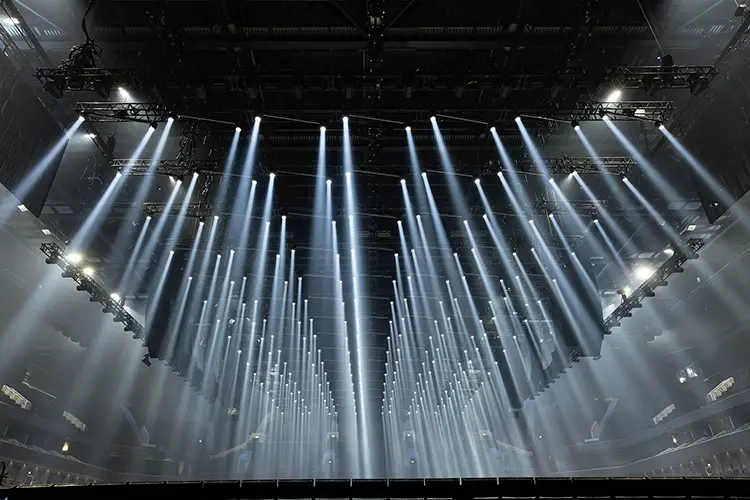
After extensive discussions with a manufacturer, Guy found a way to make the spinning lighting bars technically feasible for touring. The result: over 300 spinning and resetting light fixtures integrated into a system of 16 automated trusses.
This bold visual approach, including completely open stages at each end of the arena with maximum viewing angles, created a refreshingly different playground for Drake —an artist known for seeking the most intimate and democratic experience with his fans.
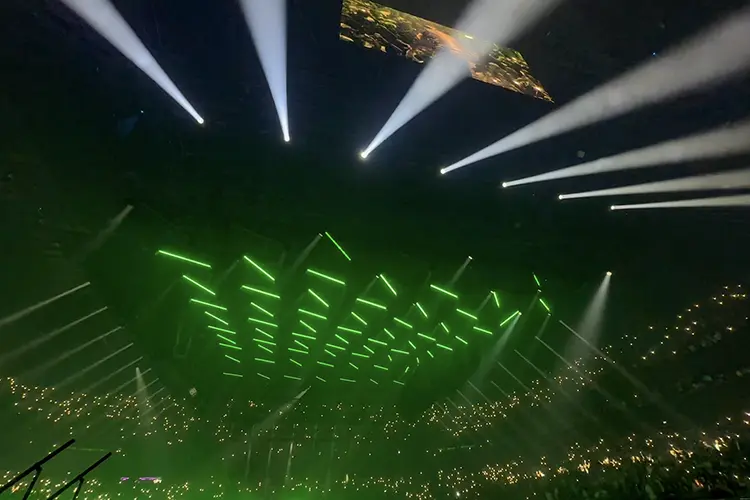
New York-based lighting designer John Torres joined the project, bringing his theatrical background to help shape the poetic narrative of the lighting. His task was to interpret how the kinetic rig should move and support the emotional arc of the setlist.
Assisting John with lighting programming before the tour were Kelley Shih and Eric Christian, with Danielle Elegy as associate designer.
Spinning lights
On the road, the lighting director is Guy Pavelo, who ensures that John Torres’ design is reproduced consistently around the world while also serving as touring technical director. Guy has worked with Drake for 15 years.
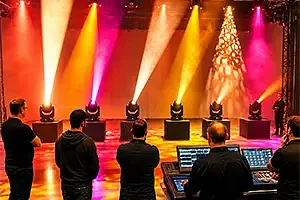
The production features a massive mothergrid —180 ft by 50 ft— supporting 16 pre-rigged 70 ft trusses specially modified by PRG. Each truss includes seven 10 ft spinning sections mounted on Claypaky Panify 2 motorised platforms, customised by PRG to be tour-ready.
In total, 112 “spinners” each carry two Martin VDO Sceptron linear strips and two GLP Impression X5 Compact moving lights, totalling 1,180 fixtures in this kinetic zone.
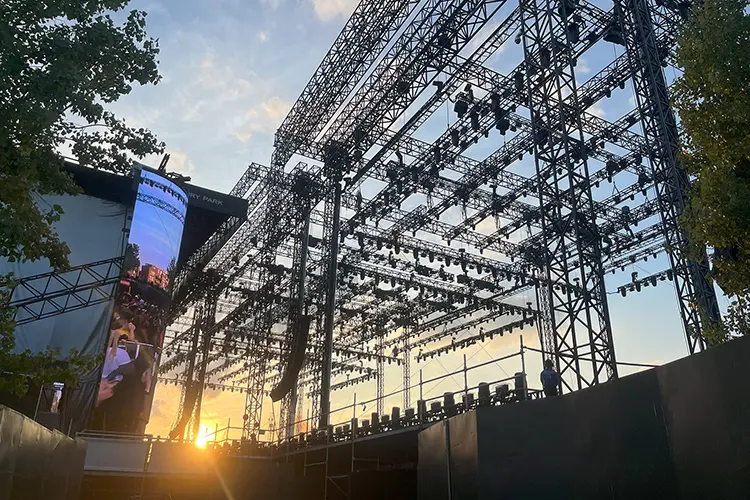
Each truss is flown using three TAIT 1-ton NAV hoists and can move into different configurations, sometimes lowering so close that fixtures skim just above the audience’s heads. TAIT Navigator sequences were developed by Sydney Rush together with Guy, John and Matte, with initial programming by TAIT’s Doug Sager.
The entire system is controlled from Guy’s grandMA3 console, revealing a whole new dimension of automation when the spinners come to life.
Bursts of light
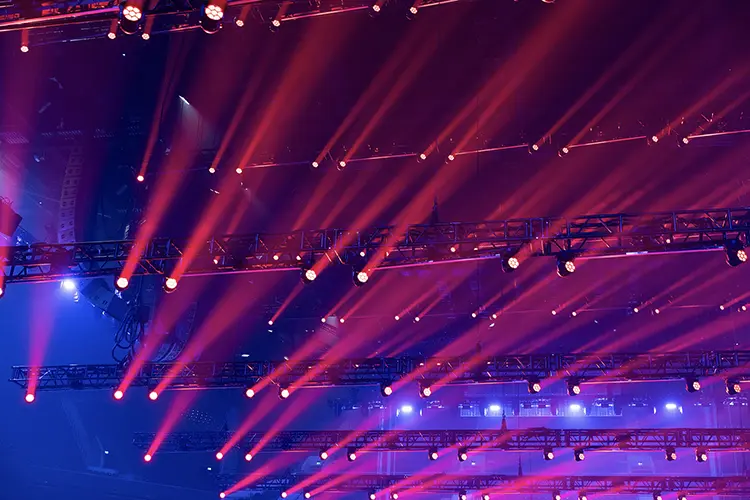
Sixty-four JDC1 strobes are spread across the mothergrid, their appearance changing dramatically depending on the height and configuration of the moving trusses.
Four additional audience trusses —two 100 ft and two 70 ft— carry 68 Ayrton Veloce moving lights and 13 JDC1 strobes each, perfectly placed to light positions along the runways and stages.
Followspots include two units on the main structure, two on the long audience trusses, and four in the bleachers, all run via PRG’s Ground Control Remote Follow Spot system.
Minimalist stages
The stages at each end of the arena are mirror images, each featuring a grilled surface with a sub-deck one metre below, housing 62 JDC1 strobes for powerful flash-through effects.
The remainder of the lighting is embedded at floor level: 25 JDC1 Bursts at the rear, 22 GLP Impression FR10 LED Bars in two rows (front and rear), and 10 Astera Titan Tubes around each stage’s front edge.
Around 200 Titan Tubes illuminate the runway, mounted under TAIT-built decking in custom brackets. They are battery-charged in their cases during the afternoon and run wirelessly during the show, controlled from Guy’s grandMA3.
Under control
Two hundred universes of lighting data are fed into Guy’s grandMA3 full-size console, from which he controls both lighting and video feeds.
Eight MDG theONE hazers and numerous fans are used to shape the atmosphere —a complex art in such a large open-plan arena.
The lighting crew of 14 is supervised by PRG North America’s Ronnie Beal, who praised the strong support from PRG UK’s team under project manager Yvonne Donnelly, in coordination with Jon Morrell from PRG North America in Los Angeles.
Visual magic in every frame
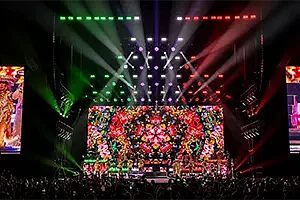
Video plays a different role in this show, departing from typical stage-mounted screens. With Drake wanting to stay close to the audience, six IMAG screens were positioned to ensure clear sightlines.
The video direction is led by award-winning camera director Colleen Wittenberg, winner of the 2024 TPi Award for Video Specialist of the Year. She joined the production for Wireless and continues on the SSS4EU European tour.
Colleen’s live mix uses feeds from four Grass Valley LDX 135 cameras with 99x long-zoom lenses positioned on mezzanine levels around the arena, plus an LDX 86c on Steadicam with a 24x lens. Additional coverage comes from four Panasonic PTZ-150 and two PTZ-130 robo cams.
SSS4EU is Colleen’s first 360° touring video-direction project —a challenge she has embraced with enthusiasm. Her mission: enhance the story, keep Drake visible at all times, and convey his energy on screen in sync with what’s happening in the arena.
Quick thinking
Colleen uses a Grass Valley Karrera 2M/E switcher (two M/E buses and two Aux channels). She works alongside engineers Randy Ice and Braxton Carico and a crew of eight video technicians, including PRG UK's video crew chief Colin Mudd.
Her mix feeds six PRG M-Box video servers (three live, three hot backup) running the V5 software version —the first rental units to do so. Guy triggers content to the screens via his grandMA3.
Colleen praised PRG UK for their responsiveness, especially when handling last-minute technical needs while travelling between countries.
The Wireless challenge
For PRG UK’s Yvonne Donnelly, the biggest challenge was replicating the unique 360° rig in an outdoor environment for Wireless Festival —the first show of the SSS4EU leg. Three ground-support systems and extensive calculations were needed to safely build a structure capable of handling so much dynamic loading.
Up to 140 crew members from Wireless and PRG worked to complete the build in just three days. Yvonne collaborated closely with PRG North America’s Jon Morrell throughout.
“We all enjoy challenges, and the teamwork and determination that enabled us to deliver the full Drake experience for fans at Wireless were truly inspiring,” she said.
The tour schedule is extremely tight, with multiple back-to-back shows. Production manager Joseph Lloyd oversees the European run, supported by 32 trucks —three of them leapfrogging duplicate rigging and stage elements for efficiency. Audio is supplied by Clair Global.
For the earlier Australian leg, production manager Aaron Siebert oversaw operations with lighting and video flown in from PRG North America. Paul Lovell-Butt production-managed the North American leg (and co-managed Australia with Aaron). Aaron has since returned to TAIT, while Joseph oversees the tour until it returns to the USA.
Photos: Dylan Swann