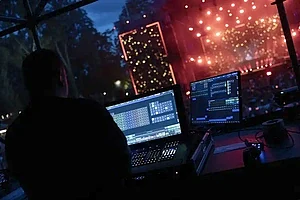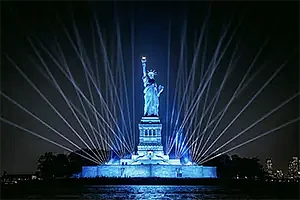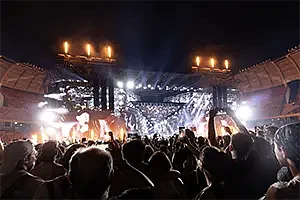
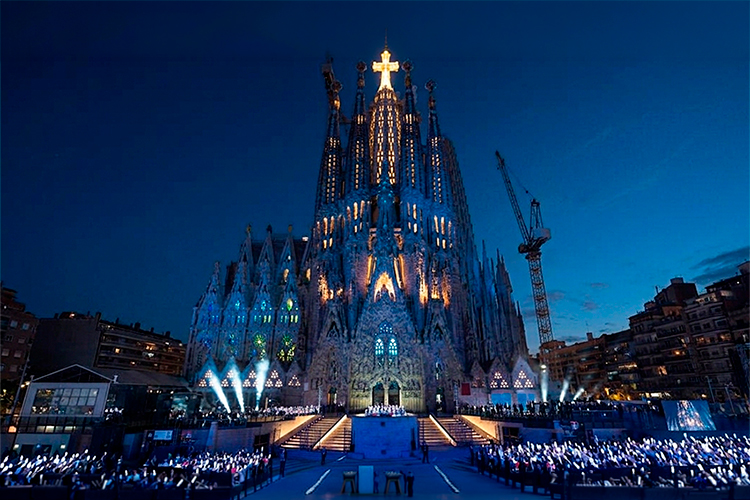
Robe and Astera provided the solutions used to address the challenges presented by both the interior and exterior of the basilica. With lighting design by Juanjo Saunier and creative and artistic direction by Igor Cortadellas, the blessing and inauguration ceremony of the Tower of Jesus was brought to life.
Light became the guiding thread of a production conceived to engage in dialogue with the architecture, the music and the symbolic character of the basilica.
The completion of the Sagrada Família’s Tower of Jesus represents one of the most significant recent milestones in the basilica designed by Antoni Gaudí. The blessing and inauguration ceremony celebrated the completion of the central tower, which rises to a height of 172.5 metres, through a production in which lighting, music, architecture and audiovisual content formed part of a single narrative.
The lighting design was developed by Juanjo Saunier under the creative and artistic direction of Igor Cortadellas. The concept was conceived as a visual narrative in which every technical decision had to respond both to the significance of the occasion and to the particular characteristics of one of the world’s most recognisable architectural spaces.
Robe and Astera contributed to a project that presented very different requirements inside and outside the basilica: from the discreet integration of luminaires in areas with complex access to the long-distance projection of light onto the cross crowning the tower.
Light as the guiding thread
The creative starting point was to use light as the principal narrative element. Rather than simply illuminating the building or accompanying an audiovisual production, the aim was to construct an emotional journey that progressed alongside the music and gradually directed the audience’s gaze from the interior of the basilica towards the Tower of Jesus.
“The guiding thread and central language of the entire event was light. Through it, we developed a visual narrative designed to generate different emotions and sensations throughout the ceremony,” explains Juanjo Saunier.
One of the key aspects of the design was to convey the impression that the light originated in the heart of the basilica. As the ceremony progressed, it had to rise from the interior of the building until it reached the cross, visually connecting the scenes taking place inside with the exterior illumination.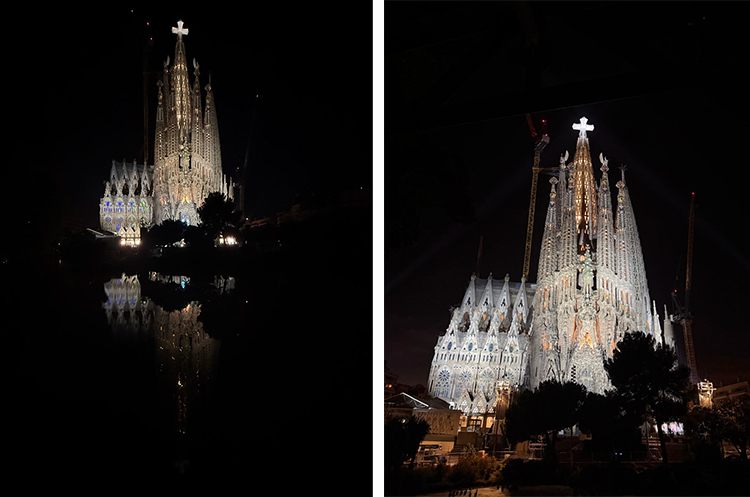
Interior and exterior: two scales within a single narrative
The project was structured around two areas of work with very different constraints.
Inside the basilica, one of the principal challenges was logistics. The Sagrada Família is a constantly active space, with restricted-access areas, complex positions and the limitations inherent to a building that remains under construction. The luminaires had to be lightweight, efficient, energy-efficient and capable of delivering high output without interfering with the operation of the basilica or altering the perception of its architecture.
Outside, the challenge was determined by the monumental scale of the building. The lighting had to interact with the façade, the urban surroundings and the presence of the audience, while maintaining conceptual continuity with the light emerging from the interior and extending outwards.
Astera in the Transept: integration and wireless control
For the scenes staged inside the basilica, the design employed a range of Astera solutions due to their compact form factor, wireless operation and integration capabilities.
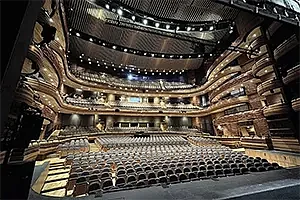
In the Transept, 76 HydraPanels and 24 QuikSpots were used to illuminate the orchestra. The entire system was controlled wirelessly using LumenRadio’s CRMX protocol, a decision that simplified installation in a space with significant architectural and cabling constraints.
The HydraPanels were selected for their rectangular form factor and their ability to be integrated into the radial composition of the space. Their positioning created a succession of vertices and concentric beams across the tiered seating on either side of the orchestra, visually extending the light from the centre towards the outer edges.
 |
 |
|
The QuikSpots were installed around the upper perimeter. From these positions, they provided the intensity required to create backlighting for the orchestra and precise frontal illumination of the conductor. In a ceremony also conceived for audiovisual production and broadcast, control over the direction, uniformity and quality of the light was particularly important.
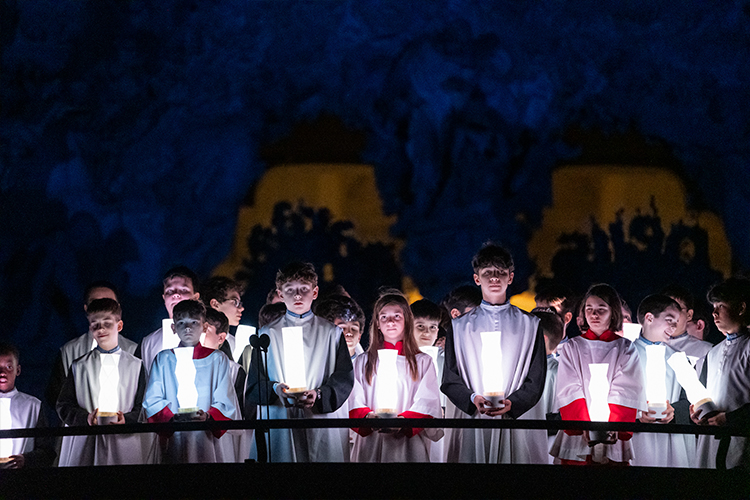
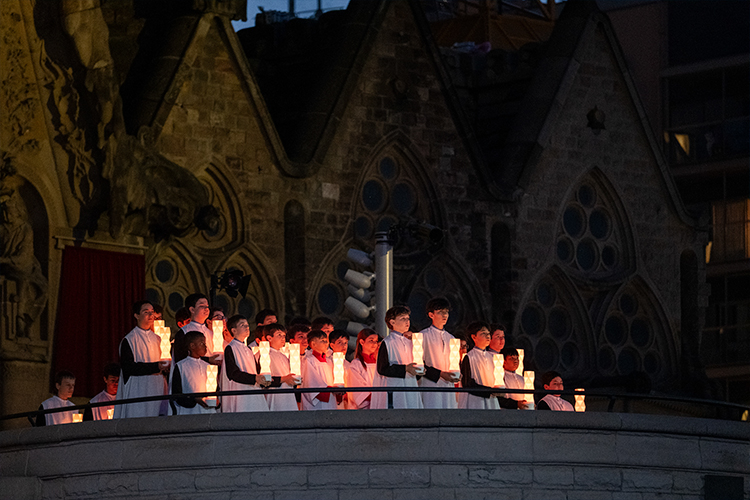
The AX3 fixtures, meanwhile, played a prominent role in the opening sequence featuring the children’s choirs. Their compact size allowed them to be incorporated into the scene as small lanterns or candlesticks, helping to create a more intimate atmosphere.
“Their versatility allowed us to visually transform them into lanterns or candlesticks, providing a magical and intimate light for the children at the beginning of the show,” says Saunier.
Robe iForte LTX meets the scale of the façade
While the interior scenes required integration, flexibility and precision, the exterior lighting called for fixtures capable of performing reliably over considerable distances.
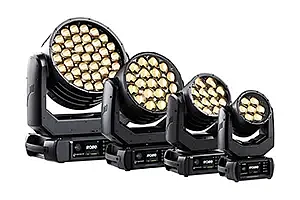
From the earliest stages of the project, Juanjo Saunier proposed using Robe iForte LTX fixtures to illuminate the façade and the upper elements of the basilica. In the designer’s words, this part of the installation required “heavy artillery”: luminaires with sufficient power, reach and stability to meet the demands of a production with no margin for error.
One of the most demanding elements was the illumination of the cross located at the top of the Tower of Jesus. The light was projected from 12-metre-high truss towers installed outside, at a distance of approximately 195 metres.
The initial plan called for the use of four luminaires. However, the output achieved during testing made it possible to obtain the intended result using only two Robe iForte LTX fixtures.
In addition to achieving the necessary reach, the design had to preserve the definition and consistency of the beam on a surface located at a considerable distance and exposed to the conditions of an outdoor installation. For Saunier, the choice of these fixtures was also linked to the robustness and reliability required for a ceremony of particular technical, institutional and symbolic importance.
Technology in service of architecture
Beyond the number of luminaires or the complexity of their installation, the project stands out for the way in which the technical resources were integrated into the ceremony’s overall narrative.
The lighting was not intended to compete with the architecture or impose itself upon the symbolism of the occasion. Its purpose was to accompany the music, direct the audience’s gaze, reinforce the perception of the different spaces and establish visual continuity between the interior of the basilica and the tower.
For Juanjo Saunier, one of the decisive moments came when he saw the fully illuminated façade for the first time and confirmed that the different layers of the design were working together as intended.
“At that moment, I was able to relax a little and think: ‘Wow, this is going to look incredible’,” he recalls. Taking part in the blessing of the Tower of Jesus was, in the designer’s words, “a privilege and deeply moving”, as well as an opportunity to contribute to an event connected with one of the great icons of world architecture.
Project credits
- Creative and artistic direction: Igor Cortadellas, Igor Studio
- Lighting design: Juanjo Saunier
- Lighting programming: Gustavo Omedes
- Technical production: Pere Capell, AP7 | Technical & AV Production
- Audiovisual production: Alba Audiovisuales