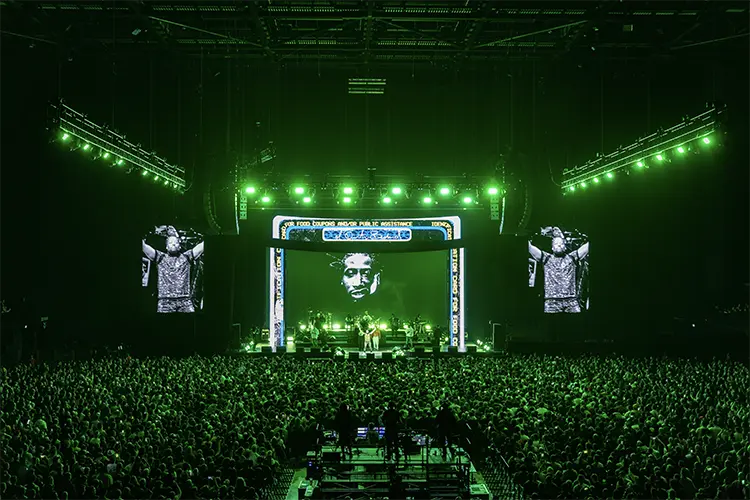
Wu-Tang Clan’s journey through Europe with The Final Chamber European Tour presented an ambitious technical and cultural challenge: creating a stage production worthy of the band’s historic legacy.
Billed as the group’s last European tour, it had to pay tribute to more than three decades of history while feeling alive, modern, and monumental from every seat in the house. The answer came through a meticulously crafted lighting design featuring 79 GLP JDC Burst 1 strobes and 36 impression X5 Bar 1000 battens.
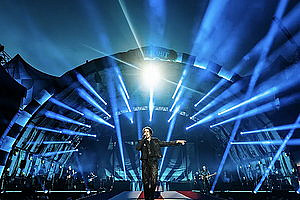
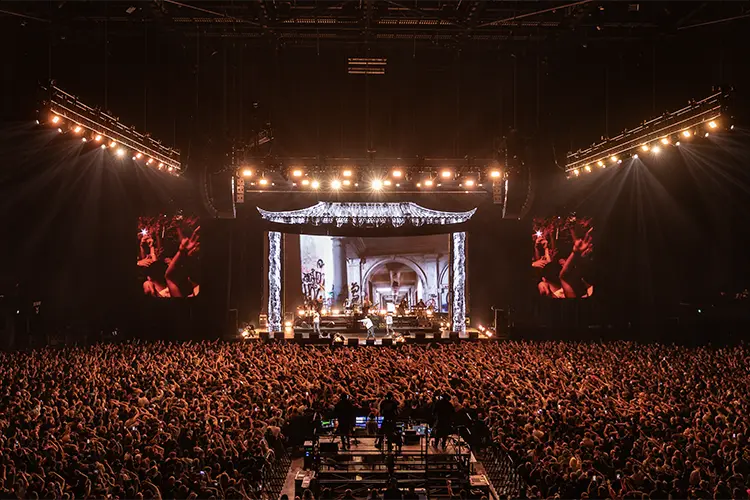
Lighting designer Ben Walton led the design, working under the creative direction of Jen Bui, with Jack Cannon serving as lighting director and programmer. Inspired by the Shaolin temple philosophy that permeates Wu-Tang’s identity, the production concept demanded a visual universe of strong linear architecture, atmospheric depth, and explosive energy. A curved LED screen and a archway-like stage structure formed the centerpiece of the stage. It was up to the lighting to extend that universe outward, filling the arenas, framing the performers, and enveloping the audience.
 |
 |
The design approach was built on the same pillars that make Wu-Tang's music so powerful: simplicity, space, weight, and intention. Jen Bui had the vision for a grand temple-like stage environment, built with curved LED and scenic elements. My role as lighting designer was to extend that world beyond the screen and fill the surrounding space with layers of light, atmosphere, and scale, says Walton.
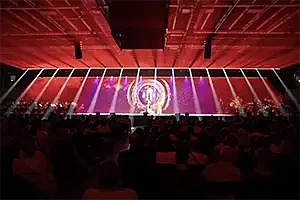
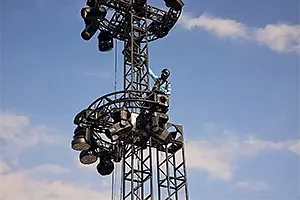
The lighting rig was supplied by PRG UK. The 36 impression X5 Bar 1000 units were arranged to create a linear frame around the proscenium LED support. Meanwhile, the 79 JDC Burst 1 strobes were deployed across the stage floor surrounding the artists and band, as well as along the stage and audience trusses. This combination provided Walton with two distinct yet complementary tools: one ideal for architecture and the other ready to deliver raw impact.
"The impression X5 Bar 1000 fixtures were key to that", Walton explains. "We used them to trace architectural lines within the rig. We achieved sharp framing, blinder hits, and bursts of light capable of defining the temple shape, projecting the visual language beyond the LED, and creating atmosphere both overhead and within the scenic arches and portals. The brightness and clarity of the X5 Bar 1000s were remarkably effective: they maintained solid graphic definition while filling the space in a very sculptural way".

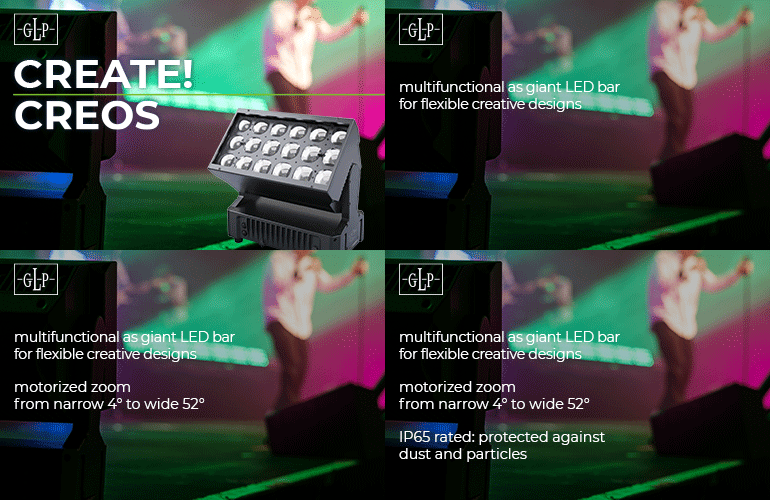
The impression X5 Bar 1000 is a linear LED batten packed with 18 x 40 W RGBL LEDs. It incorporates GLP's iQ.Gamut color calibration algorithm, a color management engine that locks output to a specified white point and translates control commands into consistent, precise color across every fixture in the rig. Its square optics offer a tight minimum beam angle of 4.4 degrees, opening up to a 63-degree wash. GLP's fast, patented tilt movement and seamless pixel pitch integration between units make it ideal for designs grounded in clean geometry.
We needed a moving batten to generate walls of light projecting from the sides of the LED, and the only fixture with the right color and photometry was the impression X5 Bar 1000. We also required a high-intensity strobe that could maintain high color quality at low levels. We ran the JDC Burst 1 at a 20 percent cap on maximum intensity and the color came out incredibly rich, notes Jack Cannon, lighting director and programmer at Cann Light.
The JDC Burst 1 provided the other half of the visual language. It is a hybrid LED strobe built on the legacy of GLP’s JDC1 and inspired by the IP-rated technology of the JDC2; the fixture combines a 12-segment controllable white strobe tube with two RGBW LED panels and 185-degree motorized tilt, delivering the punch needed to flood an arena. At lower levels, the RGBW plates output a wide gamut of rich colors and delicate pastel tones unmatched by conventional strobes.
 |
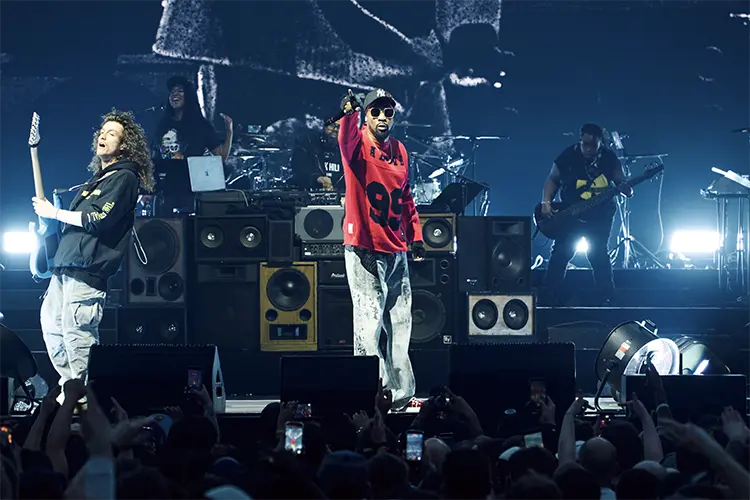 |
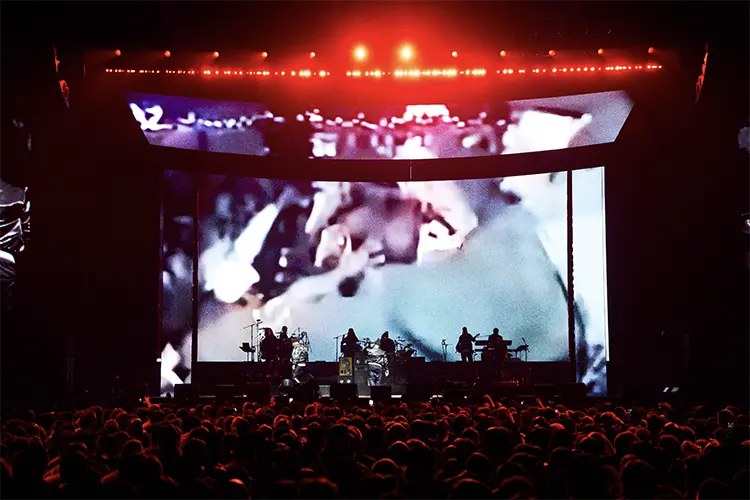
"The JDC Burst 1 gave us the opposing, yet equally important layer: impact, energy, and physical presence", indicates Walton. "We distributed them on the floor and along the stage and audience structures so the light would punch through the stage and submerge the audience in the show. The JDC Burst 1s helped create that sense of dimension, brightness, and shared energy throughout the whole venue".
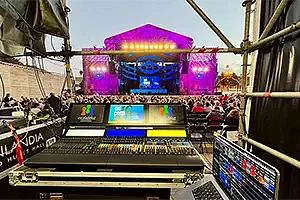
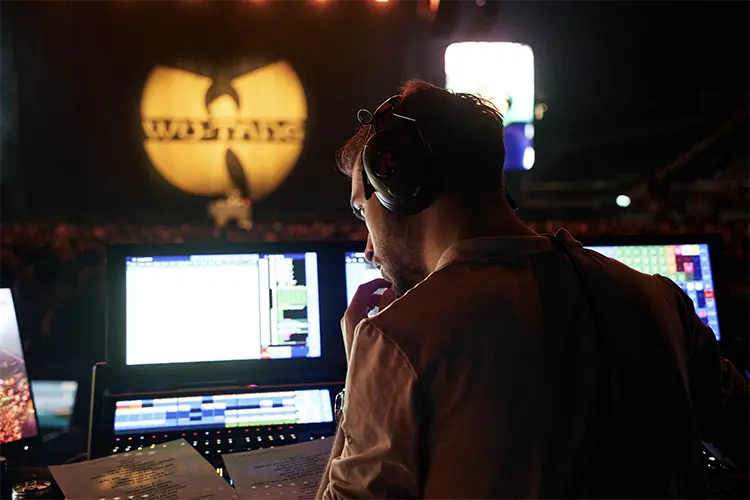
This ability to reach out and fill the room was even more crucial given that the show was operated entirely manually—busked without timecode—across a setlist drawn from dozens of tracks in any order. In such an environment, fixture choice takes on added significance.
Operating a live show, I look for fixtures that respond clearly to a single bump, but also reward subtlety when building transitions, sequences, texture layers, or color evolutions. The JDC Burst 1 is perfect for that because it can alternate between a punchy burst of energy and high-precision accents without feeling like a one-trick strobe. The X5 Bar 1000s completed the rig by giving me a tool that is as scenic as it is dynamic: fast, readable, and flexible enough to cover high-power peak moments as well as smaller, sculpted compositions, comments Cannon.
For Walton, the ultimate success of the production came down to intentionality: finding the right tools and letting the show flow. The designer emphasizes that what he is most proud of is that the design stayed true to its purpose without cluttering the visual language, using light to create space, atmosphere, energy, and connection in a way that supported the group's legacy and stage presence.