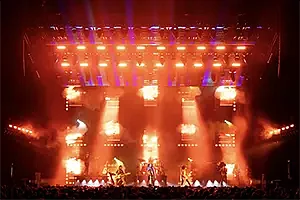



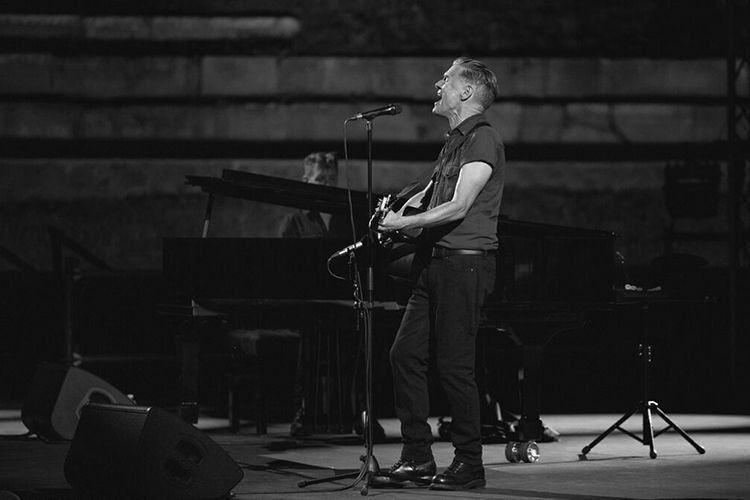
Bryan Adams stands alone with his acoustic guitar in the ancient amphitheater of Pompeii, where Pink Floyd once made history. No band, no effects, no in-ear monitoring. Just his voice, his guitar, a piano, and stone walls that have carried sound for more than two millennia. It is the pure essence of his music.
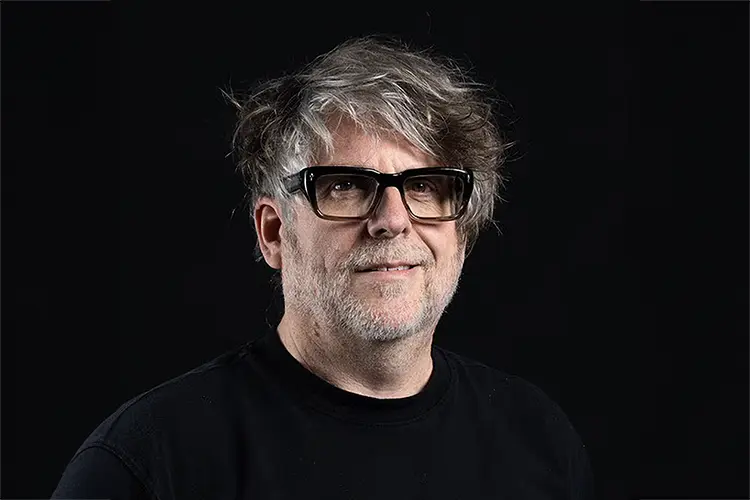
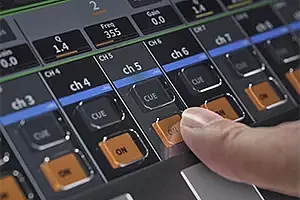
At the mixing desk, engineer Stefan Holtz works with a locally rented digital console: no luxury analog gear or complex processing racks in sight. But this man, who has mixed top German artists such as Die Toten Hosen and Westernhagen for two decades (and Die Ärzte in recent years), remains calm. His philosophy: everything starts at the source.
“People want to feel as if Bryan were standing in front of them without a microphone”, explains Stefan, who has been with Adams since 2023, working on both the Bare Bones concerts and the full-band tours. “The moment the audience hears the engineer’s intervention, the magic is gone. The technology must disappear”.
The art of reduction
Bare Bones is not a conventional tour; it consists of a handful of unique and carefully selected concerts. In 2025 there were only five or six shows, including Rome in January, the Faroe Islands, Iceland, Scotland, and finally Pompeii in July. These concerts reveal something intimate: how Bryan Adams creates his songs, just his voice and guitar, sometimes with piano. “That’s how he writes”, explains Stefan. “He wants to share that raw, intimate creative moment with the audience”.

For these highly selective dates, the team deliberately relies on local production. “We bring almost nothing except the microphones and two guitars”, says Stefan. The grand piano, the console, and the sound system are provided on site. Does that sound risky? Not to him: “Get the source right, and any mixing console will work”.
And at the source, at the very beginning of the signal chain, there has been one constant for decades: Neumann microphones.
A voice and its harmony
Bryan Adams’ sonic connection with Neumann.Berlin goes back decades. In the studio, the Canadian artist used an M 49 until 1993, then switched to a U 87. On stage, he started with a KMS 140, later moving to a custom-modified KMS 104.
In early 2025 came the next evolution: the KMS 104 Plus.
We tested it, and Bryan, the monitor team, and the front-of-house agreed instantly: it’s a big step forward. The windscreen filter is more effective, there are fewer pops, and its tone fits Bryan’s voice perfectly, recalls Stefan.
Those decades of experience pay off on stage. “Bryan is one with this microphone”, observes Stefan. “He knows the cardioid pattern by heart, instinctively senses how far to pull back and when to turn his head. It has become his instrument”.
For the Bare Bones concerts, Adams chooses classic over-ear wedges instead of in-ear monitors—a choice that creates intimacy and connection but also presents its own technical challenges. “It’s not always easy in these acoustically precious venues for the wedges to respond evenly”, admits Stefan. Nevertheless, despite its simple cardioid pattern (unlike its hypercardioid sibling, the KMS 105), the KMS 104 Plus handles feedback beautifully: “Bryan has an impressive volume—that’s our advantage. I wouldn’t want to try it with a delicate voice”, he adds.
Precision in the details
For the grand piano, Stefan uses four MCM 114 systems: one ORTF pair near the hammers for articulation and brightness, and two additional MCM 114s inside the soundboard for added warmth and body.
Beyond their natural and balanced sound and focused cardioid pattern, the MCM system’s mounting options and touring compatibility are key for Stefan: “With MCM, you work very quickly. But what captivates me is its modular construction with four separate parts that I can swap independently. If a clip gets wet, I just replace it. If a cable fails, I replace it. I don’t need a new mic”.
The magnetic mounts make placement on the piano easy, and their versatility never ceases to impress him:
With Die Ärzte, I now use nine MCMs on drums. The MCM 114 works beautifully—trombone, tuba, acoustic guitar, accordion. One microphone for everything, and it always sounds perfect.
Unlike many lavalier microphones, the MCM system impresses with its natural character, free from the typical harshness of upper mids.
Adams’ acoustic guitar is captured with a KM 185; its hypercardioid pattern elegantly rejects the wedges and, combined with the built-in pickup, achieves the perfect balance between immediacy and natural detail.
Capturing the moment
“Playing Pompeii and not recording it should be illegal”, joked Stefan before the concert. So, they recorded the performance with the same care as the live mix. For ambience, he chose pairs of KMR 81 and KM 185 shotgun microphones on both sides of the stage. “They’re a bit more neutral than other options”, he explains. “Applause sounds like applause, not like frying onions”.
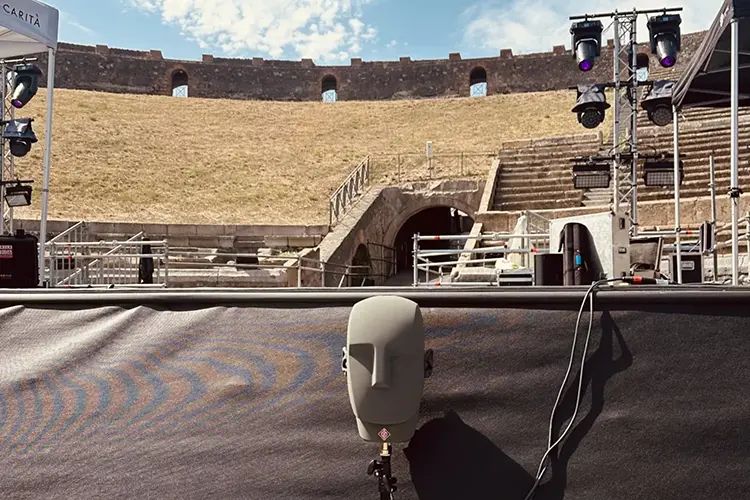
A KU 100 dummy head placed in front of the stage captured the binaural experience. In larger concerts with in-ear monitors, Adams’ team also feeds this signal into the monitoring mix, but it serves another purpose: for Adams, it’s an invaluable reference that allows him to listen back to the show later from an audience perspective.
Closing the circle
Whenever possible, Stefan extends his trust in Neumann technology to his monitors. Before the three 2024 shows at London’s Royal Albert Hall, he worked with a full Neumann KH speaker system.
Although it cannot match the sound pressure levels of a concert PA, it translates convincingly: “With the big KH 420 combo and the KH 870 subwoofer, you get an incredibly close-to-live experience with amazing resolution”.
This consistent commitment to Neumann technology for the critical components of the signal chain gives Stefan unshakable confidence:
It takes a lot of stress off me because I can trust my sources, no matter what console powers up or how the PA is set—those variables I can’t always control.
For Stefan Holtz, the circle is complete: if you want it to be excellent, make it Neumann. Reflecting on his choices in Pompeii, his verdict is simple: “We’d do it exactly the same way again!”