
"I see the statue in the marble and chip away until I set it free", it is said that Michelangelo stated. The Renaissance genius was expressing a deep desire that has driven creatives of all kinds throughout history: to remove the external layers of expectations and reveal new possibilities.
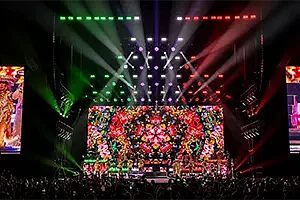
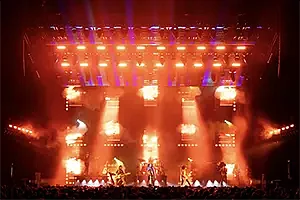
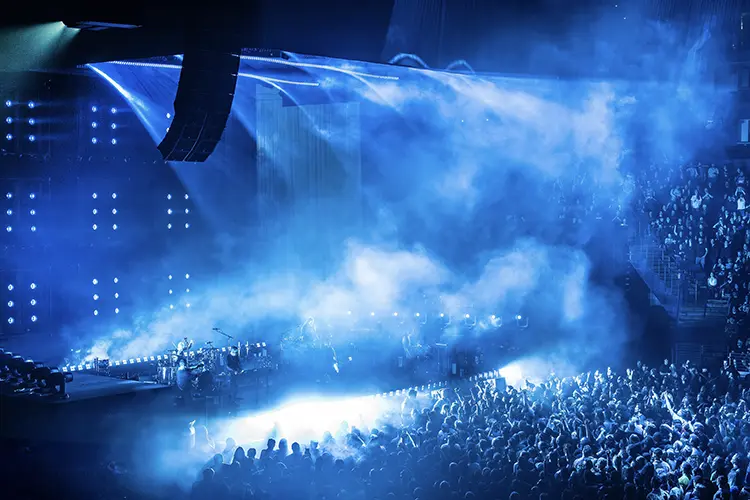
This sentiment is beautifully reflected in Nine Inch Nails' Peel It Back tour, a name that could not be more fitting, which concluded its 38-city global summer run on September 19 at the Kia Forum. (The tour will begin a second North American leg on February 5 in New Orleans.) Universally acclaimed by critics, who praised its "notable artistic ambition", the tour presents a four-act show that boldly unveils new ideas both in music—such as a reimagined soft take on the unsettling "Ruiner"—and in visuals, with a 3D cubic set, three stages, and layers of light often emerging from the deck itself.
The result of an intense collaborative effort involving lighting designer Paul (Arlo) Guthrie; Todd Tourso and Mel Roy of MTLA; and Cory Fitzgerald of Silent House, the stage production strips away familiar concepts to immerse the audience in a transcendent visual journey.
The journey begins at the 360° B stage, located in the center of the arena floor, where Trent Reznor performs A Minute To Breathe lit by CHAUVET Professional OnAir Panel soft white lights, before transitioning to a full-fledged visual blitz on the main stage.
Guthrie, NIN's longtime designer, explained how the concept came together: Since 2017, we had an anti-technology and no-video design aesthetic, so we decided to go for a larger scale production for 'Peel It Back'. Todd, Mel, and Cory initially floated the idea of two cubes. Over six months and after experimenting with different materials, we evolved it into the A stage and B stage concepts, with scrims on the A stage for Act 2 of the four.
"Using projection and fairly minimal lighting, we created the 3D layered effect that was the core of the second act, aligned with the songs Trent chose to live in that world", continued Guthrie. "When we returned to the A stage for Act 4, I used the PXL Curves to create sheets of light and curtains to add dimension to the bare stage".
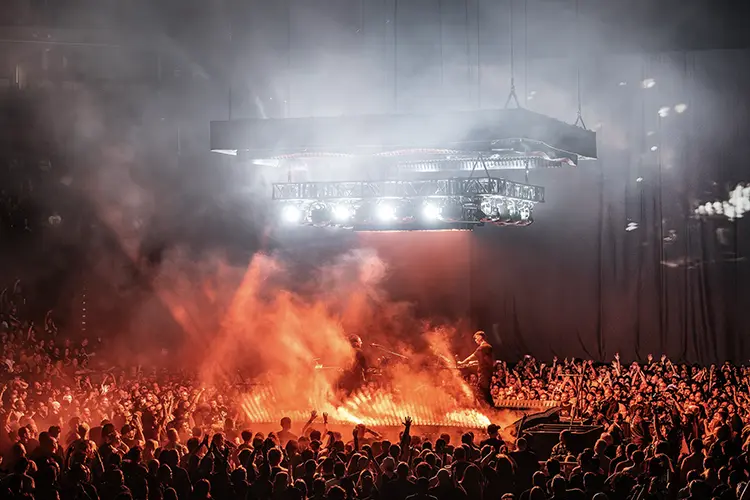
Guthrie notes that the 171 COLORado PXL Curve 12 units in his rig, supplied by Upstaging in the USA and Neg Earth in the EU, are at the heart of the design on all stages. "They are the foundation of the design and provide that linear look that defines the aesthetic of the show", he said of the CHAUVET Professional fixtures. "I use them in the entire rig. There are parallel lines of them over the A stage for backlighting and overhead lighting. Then there are 21 mounted on rotators for panning and creating different shapes in the air. They're also used for audience lighting and defined the B stage deck".
"I was able to map them and, using a TouchDesigner patch developed by Kyle Meredith, control them directly with my finger from an iPad", continued Guthrie, who operated the complex, multifaceted show without timecode. "They provided sheets of light, wave chases, cage structures, footlights, wash lights, and house lights… they worked at full capacity".
By constantly changing the geometric shapes created with his PXL fixtures, as well as adjusting brightness levels, dark spaces, and strobe effects, Guthrie skillfully created different moods on stage.
Fortunately, I have a wide variety of tools at my disposal, which allows me to give each song its own visual identity. Each of the four acts of the show has its own set of surprises that evolve constantly and reveal new elements, he noted.