

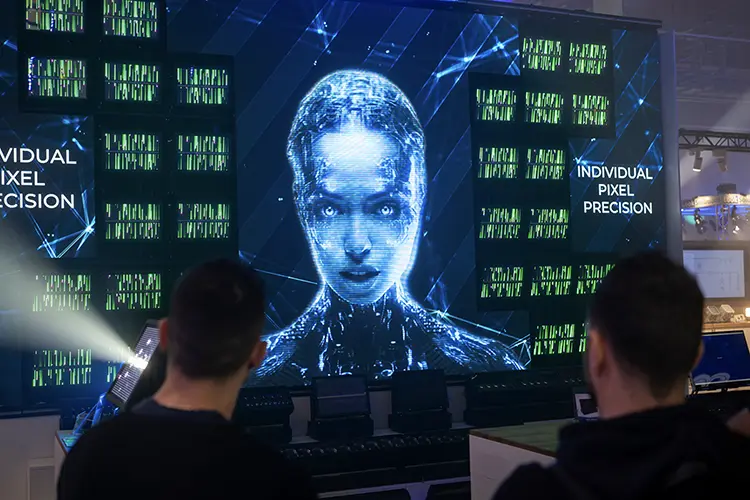
Artificial intelligence (AI) is much more than a new technology: it is radically transforming the functioning of multiple sectors. In the event industry, enormous opportunities for application are emerging, from personalization to automation.
With the central theme FutureScapes: Worlds of Experience between Immersion and AI, Prolight + Sound 2025 (from April 8 to 11) examines AI-based technologies and their potential for the event sector. Fair participants will enjoy a series of inspiring activities dedicated to the influence of artificial intelligence in the realm of events.
Highlights of the AI program
On the Main Stage (Hall 11.0), renowned experts will deliver speeches that provide new perspectives on this highly relevant topic. For instance, Dr. Uve Samuels explains in AI: The Stage is Yours how AI revolutionizes the customer experience and how companies can develop their own AI products (April 8, 12:00 PM). Sven Ortel presents in Entertaining Change the fusion of AI, game engines, and mixed reality combined with innovative storytelling (April 9, 12:00 PM). Vickie Claiborne examines the influence of modern technologies such as AI on creative processes in Empowering Creativity in the Age of Advanced Technology (April 10, 12:00 PM). Dr. Steffen Ronft demonstrates in From Data to Emotion how AI technologies, together with event psychology, can specifically target emotions (April 10, 4:00 PM).
In the Image Creation Hub (Hall 11.0, E05), a panel of experts will debate the legal challenges and perspectives regarding AI and copyright (April 9, 12:00 PM). Marko Massinger will present in this area the OBSBOT TAIL 4K HDR-PTZ camera, powered by AI, which automatically captures people and objects (April 9, 2:00 PM).
In the new Special Area MusicOneX (Hall 11.0, E50), producer and rapper Aufmischen will demonstrate in AI in Music Production how AI can optimize the processes of composition and mastering (April 8, 12:00 PM, Production Island). The talk AI for Mobile DJs will offer insight into the opportunities and challenges that AI presents for DJs and their future role in the industry (April 8, 12:15 PM, Mobile DJing Stage).
AI – Shaping the future of the event industry
The growing role of AI in the event sector implies a profound transformation, encompassing everything from automated work processes to innovative creative possibilities. The following article by Dr. Uve Samuels provides an overview of current AI trends, its potentials, and the developments that will pave the way for the future.
AI as the driving force of the event industry
AI can be applied in multiple ways in the event sector, whether through personalized experiences for attendees, automated processes, or data-driven services. Three essential drivers are changing the way events are designed:
- Personalization: Each visitor receives offers that are tailored exactly to their tastes. Whether it’s a personalized T-shirt, an individual photo, or even a video with a celebrity, the event transforms into a unique experience that aligns with each person’s personality.
- Individualization: It goes a step further by offering products and experiences specifically designed according to each person’s needs. A notable example is the planning of a personalized route at the fair, tailored to the visitor’s interests and preferences.
- Dematerialization: It takes event experiences into the virtual world. Whether through a meeting in the metaverse or the digital transmission of values such as intellectual property (IP), physical barriers fade away and new, revolutionary possibilities emerge.
The event industry faces a crucial decision: to remain passive or actively participate in this transformation.
AI trends in the event industry
AI in event planning
Automated customer interactions are fundamental: interested parties can get information about an event through chatbots and receive personalized recommendations. In addition, AI drives the creative process in event planning and enhances efficiency.
AI in the workplace
The automation of repetitive tasks lightens the workload for employees, for example, by informing organizers of changes in processes or event status, such as registration control or attendee monitoring. Likewise, AI-assisted communication can optimize the structure and tone of emails, improving customer service.
AI for events and meetings
AI-based matchmaking connects participants based on their interests, so that people with similar affinities can interact at an event. For example, integrated platforms can be implemented to facilitate dating, organize carpooling, and coordinate blind dates, making the entire process more intuitive for users. Additionally, AI-assisted translation enables accessible events for international participants, as it can simultaneously translate content into up to 20 languages.
AI for ideation and research
Generative AI facilitates content creation and event planning, allowing for the generation of songs, graphics, or videos. Data analysis provides valuable insights to optimize events, by evaluating everything from social media posts and emails to visitor flow, which helps gauge an event’s success.
AI in event marketing and sales
The use of AI tools is essential for content creation, particularly for developing texts, images, and videos for precise and up-to-date posts. AI-assisted targeting enables personalized communication, as crawlers that analyze the web can identify individuals and segments to which tailored stories can be sent. In addition, AI-based solutions optimize the sales funnel through dynamic pricing, determining the optimal price for each user and offering discounts or special offers based on their search behavior.
AI disruptors in the event industry
Various AI-driven platforms are already setting trends in the sector:
- Gaming and E-Sport: Virtual events and community building (e.g., Fortnite)
- Streaming Services: Netflix and Amazon Prime personalize content for their users
- Event Management Tools: Platforms such as Whova, Eventtia, and Cvent support digital and hybrid events
- Virtual Festivals: Brands like Jägermeister invest in online events to reach their audiences
These disruptive changes demonstrate that AI has already taken hold in the event industry. Artificial intelligence can optimize numerous aspects of events and provide significant contributions. Three practical examples illustrate this impact:
- Intelligent Lighting Planning: With the help of AI, the lighting of an event can be controlled efficiently. Machine learning algorithms optimize both the placement of light sources and their adaptation throughout the event, creating a tailored atmosphere in every situation.
- Sound Optimization: Acoustics also benefit from AI-assisted planning. The use of machine learning allows for the dynamic adjustment of speaker positioning and control, ensuring that sound is optimally expressed at every phase of the event.
- Interactive Fan Experiences: AI also enables rewarding concert attendees based on their social media reach. The most active fans could, for example, enjoy a brief appearance on stage or see their clips on the event’s giant screens, representing a true highlight for the community.
Potential of AI for the event industry
AI can enhance both in-person and digital events:
|
In-person events |
Digital events |
|||
| Support through AI | An AI can optimize all logistical planning and setup. | Connecting people at an online event (for example, a mentor and a mentee at a conference) can create a new experience. | ||
| Employment through AI | Startups can be grouped together in their own booth during a fair. | An avatar can read chat messages and moderate. |
Additionally, through brainstorming and creative methods such as bisociativity (linking concepts that were previously unrelated), new AI-assisted business models can be developed in each company.
Development of in-house ai solutions for events
The event industry can create its own AI applications by following these steps:
- AI Model: Strategy, training, and optimization of AI systems.
- AI Product: Development of real added value for customers.
- AI-Based Business Model: Monetization through B2B/B2C strategies.
- AI Startup: Scaling and expansion of the company.
The Exponential Innovation Institute offers expertise and guidance to companies in this process.
Conclusion and outlook
The event industry is only in the early stages of the transformation driven by AI. Those who develop their own solutions early on can benefit in the long term. AI enables hyper-personalized communication by analyzing user data and automatically delivering appropriate content.
For the success of AI, it is essential to have access to attendee data. For example, the development of “Unidy” can function as a central platform that collects user data from various services and utilizes AI in marketing and sales.
Why AI will not replace human work
Despite all the advances, AI will not completely replace human beings in the event industry. Creativity is a key factor: while AI can identify ideas based on patterns, humans are capable of creating something radically new, developing solutions outside of existing frameworks. Additionally, empathy and interpersonal relationships remain exclusively human traits. There is also debate about whether AI will destroy or create jobs; in the event sector, AI will undoubtedly generate many roles and professional areas.
Recommendations for companies
Companies should actively take advantage of the opportunities offered by artificial intelligence (AI) to strengthen their competitiveness and open new business opportunities.
A fundamental first step is to develop specific skills and resources, for example, through internal training and development teams that prepare employees for the AI transformation. It is also advisable to create dedicated structures for AI integration, including the designation of a specific role for AI experts, which will facilitate the consolidation of know-how within the organization. Creating in-house AI solutions and products is also key, as it allows for the optimization of internal processes and offers these solutions to external parties or customers, generating additional revenue.
Finally, continuous employee training is essential: reskilling and upskilling, through participation in hackathons and bootcamps, can mark a turning point and sustainably strengthen AI knowledge within the company.
AI is a revolution with long-term effects. The event industry has the opportunity to be a pioneer and become a driving force for innovation. Those who use AI strategically will not only be able to optimize their events, but also transform the entire industry.