
For years, growth in the audiovisual business was easy to understand: more inventory meant more capacity, more projects, and usually more revenue. Companies with more LED screens, more audio systems, or more technical infrastructure held a clear advantage. The professional rental business operated under a logic deeply tied to hardware.
But the industry has been entering an uncomfortable contradiction for some time now: there has never been so much demand for audiovisual technology, and at the same time, it has never been so difficult to protect margins.
Pricing pressure has become a recurring topic within many companies in the sector. Especially in corporate events, trade shows, hybrid events, or recurring technical production, where many operators acknowledge that competition has intensified to levels that would have been difficult to sustain just a few years ago.
The problem is not simply that there are more companies. The real shift is that much of the hardware is no longer perceived as a differentiator.
A decade ago, having access to certain LED solutions, production systems, or broadcast infrastructure represented a huge barrier to entry. Today, the market is far more saturated, access to professional technology has become democratized, and many clients compare quotes as if hardware were already a commodity. And that completely changes the rules of the business.
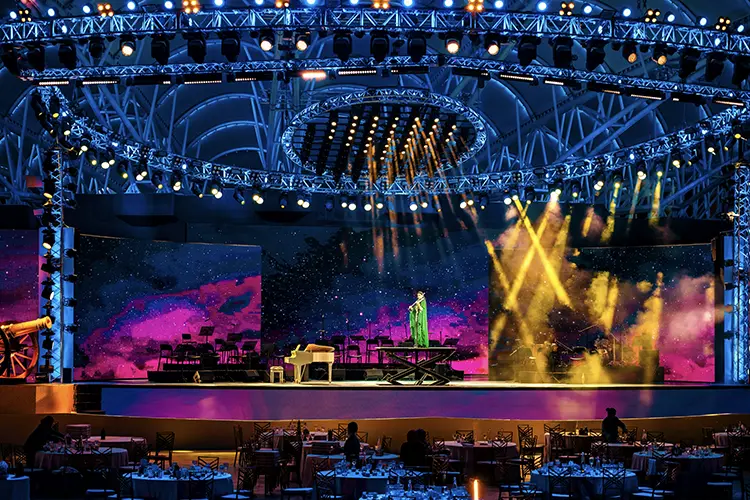
LED perfectly illustrates the commoditization of the market
Few areas reflect this transformation better than the LED screen market. For years, investing in LED technology was considered a guarantee of growth. Demand was soaring, margins were high, and access to products remained relatively limited. Today, the landscape looks very different.
The massive arrival of Asian manufacturers, the gradual decline in prices, and the growing number of operators with technical capabilities have created enormous pressure on rental rates. The number of LED manufacturers exhibiting at trade shows such as ISE or InfoComm has multiplied over the last decade, reflecting both the tremendous growth — and the saturation — of the market.
Many companies have continued investing millions in technology renewal while the market progressively reduced the perceived value of the equipment.
The result is a dangerous paradox: companies with more technology than ever before and, at the same time, greater difficulty monetizing it.
Some operators already privately admit that certain projects barely generate profit once transportation, technical staff, setup, logistics, storage, and depreciation costs are taken into account.
And the problem is not limited to LED. It is also beginning to spread to segments such as corporate streaming, PTZ cameras, standard audio systems, and hybrid solutions, where clients increasingly perceive fewer real differences between providers.
Rental remains a highly investment-intensive business
The difficulty in protecting margins also has a significant financial component. Audiovisual rental continues to be a business heavily dependent on CAPEX: renewing inventory requires constant investment in technology that becomes obsolete increasingly faster.
At the same time, structural costs continue to rise. Energy, financing, transportation, storage, and specialized technical profiles are all considerably more expensive today than they were a few years ago. However, many pricing structures have barely evolved at the same pace.
This is creating an increasingly visible imbalance between investment and return. In some segments, hardware is beginning to behave more like a rapidly depreciating asset than a true competitive advantage.
The consequence is clear: depending solely on equipment rental is becoming increasingly risky.
Clients are no longer looking only for technology
As hardware loses its ability to differentiate, corporate clients have started to value other factors.
Capabilities such as responsiveness, international coverage, technology integration, remote support, permanent technical operation, or the possibility of fully outsourcing audiovisual management are becoming increasingly important. In other words, clients are no longer simply looking for an equipment supplier. They want to reduce complexity and minimize operational risk.
This shift is pushing the industry toward a far more service-oriented model.
It is no coincidence that many audiovisual companies are strengthening areas such as AV integration, permanent support, remote monitoring, automation, hybrid production, content management, or recurring technical operation contracts. Because this is where margins still exist while hardware begins to lose them.
Profitable business is beginning to shift toward services
The difference between both models is becoming increasingly evident.
Traditional rental depends on one-off projects, high inventory utilization, and intense pricing pressure. Managed services, on the other hand, allow companies to build much more stable and predictable relationships.
Many companies are now seeking to become an operational extension of the client instead of simply supplying equipment for a specific event. This is where models linked to permanent technical operation, 24/7 support, remote management, corporate contracts, or long-term technology integration emerge.
This shift completely transforms the financial logic of the business. Recurring contracts reduce seasonality, stabilize revenue, and generate relationships that are much harder to replace through simple price comparison. That is why the sector is beginning to compete less on inventory and more on operational capabilities.
Major operators have been adapting for years
 Large international companies understood this shift earlier than much of the market. Encore, for example, evolved from the traditional hotel audiovisual model into a company much more focused on integrated experiences, hybrid events, and global production. Equipment remains part of the business, but it is no longer the core of its value proposition.
Something similar is happening with PRG (Production Resource Group), which in recent years has strengthened areas linked to virtual production, automation, XR, technology integration, and international support for major tours and broadcast productions.
Solotech has also accelerated a clear diversification strategy, increasing its presence in AV integration, sports, broadcast, and permanent installations to reduce dependence on traditional rental.
Even companies such as Diversified already represent an even more radical evolution: businesses where the core activity revolves around digital infrastructure, integration, media systems, or managed services, leaving rental in a far less central role.
The biggest risk: getting trapped in no man’s land
Part of the audiovisual sector is currently facing a complex situation. Especially mid-sized companies that spent years growing through constant hardware investment and now face a market where the return on that investment is much slower.
Many companies can no longer compete on price with smaller, leaner operators. But they also have not yet developed enough value-added services to clearly differentiate themselves.
That middle ground is probably the most uncomfortable place in today’s market. Because competing solely on price is becoming increasingly dangerous. Especially in a context where clients continue demanding more flexibility, more integration, and more support while still pressuring budgets.
An industry that can no longer survive solely by renting technology
The audiovisual rental business will continue moving millions in equipment, screens, and technical production. Demand for technology will continue to grow, driven by hybrid events, immersive experiences, digital retail, corporate environments, and live production.
But the model that allowed companies to grow simply by accumulating inventory is beginning to run out of steam. Technology has become democratized, hardware loses differentiation capacity every year, and pressure on margins is now a structural part of the industry. This forces a transformation that goes far beyond renewing equipment or adding new product lines. The real shift is strategic: moving from being a technical supplier to becoming an operational partner for the client.
The companies best positioned for the future will probably not be those with the most square meters of LED or the largest number of racks in storage, but rather those capable of integrating technology, service, operations, and business expertise into a single value proposition.
Because the problem is no longer obtaining equipment. The market is full of technology.
The real value now lies in who knows how to turn that technology into a solution the client does not want — or cannot afford — to replace.