

When entering a concert arena, theatre or any major live production, it quickly becomes clear that today’s lighting systems are expected to do far more than simply illuminate a stage.
They must be quick to install, simplify maintenance and operate reliably under increasingly demanding production schedules.
This evolution has transformed not only the fixtures themselves, but also the infrastructure that supports them. Cabling is no longer a passive and largely invisible component. It has become a fundamental part of system engineering, with a direct impact on installation efficiency, reliability and long-term performance.
Power distribution in LED systems
One of the first consequences of this transformation concerns power distribution. The rapid adoption of LED technology has led to a wide variety of fixture architectures, each with different power requirements.
Two-core cables remain suitable for simple luminaires, while three-core versions are commonly used where a protective earth connection is required. Four-core constructions simplify RGB installations, while five-core cables provide a practical solution for RGBW systems and other multi-channel luminaires.
These configurations help reduce the number of cable runs, keep installations more organised and simplify future servicing. Selecting the correct number and cross-section of conductors also helps control voltage drop, streamline maintenance and create infrastructures that can be expanded as the system evolves.
Integration of power and control
The next step is to integrate power distribution and control signals. Moving heads and intelligent luminaires require both a stable power supply and reliable DMX communication.
Traditionally, these two services were distributed through separate cables, increasing installation complexity, the number of connectors and the potential points of failure.
Hybrid cables make it possible to carry power and DMX signals within a single jacket. In addition to reducing installation time, they simplify cable routing, reduce the mechanical stress associated with repeated assembly and dismantling, and help improve overall system reliability.
For rental companies, touring productions and system integrators, reducing the number of cable runs can also lead to simpler logistics, more compact inventories and greater efficiency when preparing equipment.
Flexibility and mechanical resistance
The mechanical performance of the cable is another decisive factor. In indoor installations, flexible Soft PVC jackets facilitate handling, coiling and frequent use.
Outdoor applications and touring productions, however, present additional demands. These environments require compounds capable of resisting abrasion, oils, humidity, temperature changes and potentially harsh weather conditions. For these applications, NBR rubber jackets provide greater mechanical and environmental protection.
Solutions for LED power and DMX signals
This design philosophy is reflected in the range of lighting cables developed by Tasker.
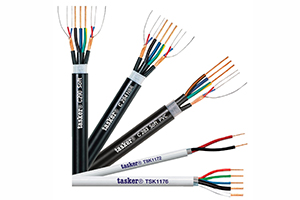
The TSK1170–TSK1176 LED power cable family covers applications ranging from basic power distribution to RGB and RGBW systems, through dedicated two-, three-, four- and five-core constructions.
For intelligent luminaires, the C283 hybrid model combines one 110 Ω DMX pair with a 3 × 1.5 mm² power cable. The C284 adds a second DMX channel while retaining the same power section.
For applications requiring greater current capacity, the C290 integrates two DMX lines with 3 × 2.5 mm² power conductors.
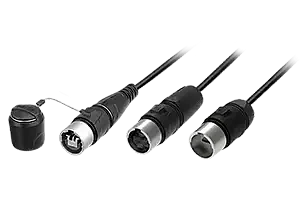
All three models can be supplied with Soft PVC jackets for indoor installations or NBR jackets for outdoor environments and more demanding applications. They are also available as factory-assembled solutions, such as the NKDN83 series, equipped with Neutrik connectors designed for outdoor installations.
Cabling as part of system design
As professional lighting continues to evolve, cable selection requires electrical performance, mechanical durability and installation efficiency to be considered as part of the same design process.
System performance no longer depends solely on the intelligence or power of its luminaires. It is also determined by the quality, configuration and reliability of the infrastructure used to power, control and connect them.
Tasker continues to develop new materials and cable configurations, as well as customised solutions designed to meet specific installation requirements. The company states that it can manufacture bespoke cables with production and delivery times that generally do not exceed 20 working days.
Its catalogue includes more than 5,000 products, with technical data sheets available through the Tasker website.