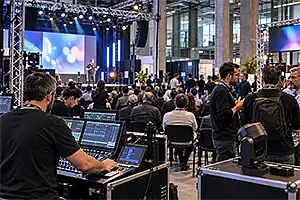



Artificial intelligence, connected workplaces and the evolution of the Asian audiovisual market shaped InfoComm Asia 2026, held over three days in Bangkok.
The sixth edition of the event took place from 15 to 17 July at the Queen Sirikit National Convention Center (QSNCC), bringing together 6,638 professionals from 77 countries and regions. International visitors accounted for 44.2% of total attendance, reflecting the event’s increasingly regional reach.
A significant proportion of attendees held positions related to technology investment, planning and decision-making. More than half of those in management roles were at manager level or above, while one in three held director-level positions or higher.
Represented sectors included corporate, education, government, healthcare, hospitality, retail, broadcast and live events.
Representatives from around 3,800 organisations attended the show, including companies, public bodies, educational institutions, healthcare organisations and technology integrators. This broad mix provided an indication of how Pro AV technologies are expanding into areas increasingly connected with digitalisation, automation and data analysis.
 Among corporate end users, more than one in eight held C-level positions such as CEO, CIO or CTO, while over one third were members of senior management.
The Invited Guest Programme also brought together more than 60 senior technology buyers from 12 countries. According to figures provided by the organiser, these professionals represented nearly US$73 million in approved budgets for projects scheduled over the following 12 to 18 months.
The opening session included representatives from Thailand’s National Innovation Agency (NIA), the Thai Association for Educational Communications and Technology, and the Thailand Convention and Exhibition Bureau (TCEB).
Technology professionals from companies and organisations including AVI-SPL, Shen Milsom & Wilke, LANG AG, ESCO Group, Singapore AI Association, the Association for Audiovisual & Educational Technology Management Australia, the Ho Chi Minh City Digital Transformation Center and the Ho Chi Minh City Computer Association also attended.
Artificial intelligence moves from discussion to application
Artificial intelligence was one of the main themes of InfoComm Asia 2026. Rather than being presented as a standalone technology, AI was increasingly embedded in collaboration platforms, videoconferencing systems, meeting room solutions, LED displays, automation tools and immersive environments.
Demonstrations highlighted a move towards systems capable of automating camera framing, improving voice capture, managing devices, adapting spaces to their users and analysing how rooms and resources are used.
The progressive adoption of AI also presents new challenges for integrators and technology managers, particularly in areas such as interoperability, privacy, cybersecurity, data management and the maintenance of increasingly automated systems.
More than 20 new products for the Asian market
The exhibition featured more than 20 global or regional launches aimed at the Asia-Pacific market.
Manufacturers including aegis Multimedia, Aimicot, Audio-Technica, Bose Professional, WyreStorm Technologies, Colorlight, IQBoard, Lumens, Newline, Rocware, Yamaha and Yealink presented new solutions for corporate collaboration, education, digital signage, broadcast, control rooms, unified communications and smart workplaces.

The technologies on display reflected several of the trends currently shaping the Pro AV market: automation, AI-based processing, remote management, IP connectivity and platforms capable of integrating audio, video, control and collaboration.
In this context, the value of new solutions depends not only on their technical capabilities, but also on their ability to integrate with existing infrastructure and simplify day-to-day operation.
Buyers with active projects
The Invited Guest Programme facilitated meetings between manufacturers, integrators and buyers with planned projects in sectors including corporate, education, government, healthcare, hospitality, broadcast and live entertainment.
Around 700 scheduled meetings took place over the three days. Beyond the figure itself, these sessions provided insight into some of the region’s main investment priorities, including meeting room upgrades, hybrid collaboration, space digitalisation, intelligent signage and the modernisation of audiovisual infrastructure.
Education focused on AI, broadcast and connected spaces
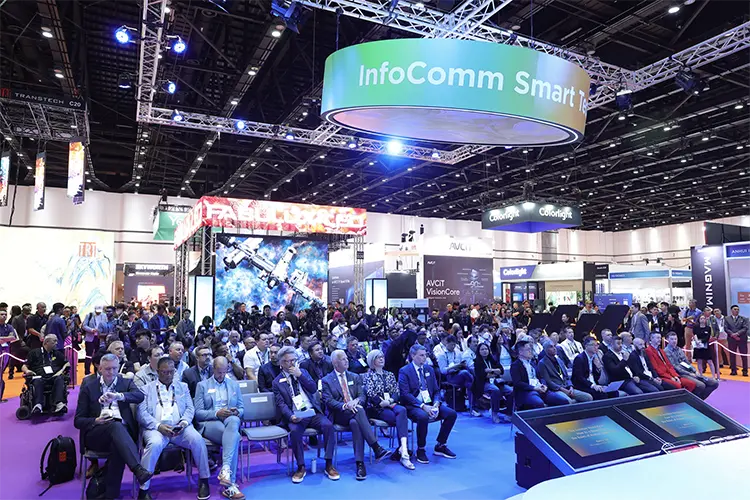
The InfoComm Asia Summit attracted 1,664 attendees, approximately 25% of the event’s total audience. The programme featured 37 sessions delivered by 60 international speakers.
Topics included the application of artificial intelligence in audiovisual systems, workplace transformation, the evolution of education technology, immersive experiences, broadcast innovation and the design of integrated systems.
Attendance at these sessions highlighted the need to support the adoption of new technologies with training in system design, operation, management and maintenance.
A connected office as a practical demonstration
One of this year’s new features was the Smart Workplace Experience, an installation developed with UDD Technologies that recreated a connected office environment.
The space integrated AI-assisted meeting rooms, automation, unified communications, digital signage, control systems and collaborative tools.
The demonstration allowed visitors to assess these technologies within a recognisable working environment, rather than as isolated products. It also illustrated the growing convergence between Pro AV, information technology, building management and user experience.
Professional exchange and new partnerships
InfoComm Asia 2026 also included initiatives such as AVIXA Xchange LIVE, InfoComm Asia 101, Discovery Tours, themed exhibition tours and exhibitor demonstrations.
These activities were designed to encourage knowledge exchange and help visitors interpret a market in which audiovisual manufacturers, software companies, network providers, IT specialists and integrators are increasingly converging.
Three partnerships were also formalised during the event with the Ho Chi Minh City Computer Association, AV Connect Vietnam and the Association for Audiovisual & Educational Technology Management Australia (AETM).
The 2027 edition moves to Kuala Lumpur
The organiser announced that the next edition will take place from 28 to 30 July 2027 at the Malaysia International Trade and Exhibition Centre (MITEC) in Kuala Lumpur.
The move places the show in one of Southeast Asia’s most active technology markets, particularly in areas such as data centres, digital infrastructure, artificial intelligence and smart buildings.
David Labuskes, CEO of AVIXA, commented on the change of venue:
Bangkok has been an extraordinary partner to this community, and bringing InfoComm Asia to Kuala Lumpur in 2027 demonstrates our continued commitment to the region and to the growth of the Asia-Pacific Pro AV community.
Ekta Shetty, Senior Sales Director at Shure, added:
We are very excited about the move to Malaysia. Being closer to Singapore will give us access to a different mix of partners and distributors, while also increasing our visibility among end users across the region.