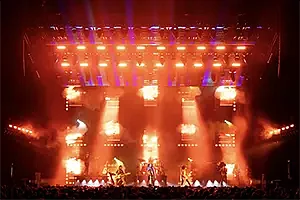


The highly anticipated launch of Ed Sheeran’s The Loop tour has already seen an impressive run of stadium concerts, beginning in New Zealand in early January and continuing in Australia, while the production is set to continue across South America and the United States later this year.
In a show of this scale, Sennheiser’s Spectera takes centre stage in the global star’s audio system, dramatically reducing RF setup time, solving major workflow challenges and delivering a clear improvement in audio quality, according to monitor engineer and RF technician Dave White.
Years of Sennheiser evolution, now with Spectera
White has been working with Sheeran since 2014 and is a seasoned Sennheiser user. When he started, it was just Ed on stage with his guitars and a loop pedal, but as the shows grew and became more complex, and the number of musicians increased, so did the equipment list. That means more audio channels and more RF.

We’ve gone through quite a few generations of Sennheiser products over the last 12 years. We always keep updated to get the best sound quality we can and work with new equipment when it’s appropriate. Over the years, we moved from Sennheiser’s 2000 Series to Digital 9000, before switching to Digital 6000 for the ‘Mathematics’ tour, recalls White.
With each change, there was a noticeable difference in sound quality, and smaller bodypacks, such as the SK 6012 transmitter, also proved advantageous. “I love small things; I don’t want to see technology, I just want it to work”, White continues. “For the stadium tour, we moved to theatre-style micro bodypacks with the SKM 6000, and the result was very good for us. It was a highly scalable system: our main setup for the ‘Mathematics’ tour included 16 channels of Digital 6000 and 16 channels of 2000 Series IEM, while for fly-pack shows we reduced the configuration to four channels of each system”.
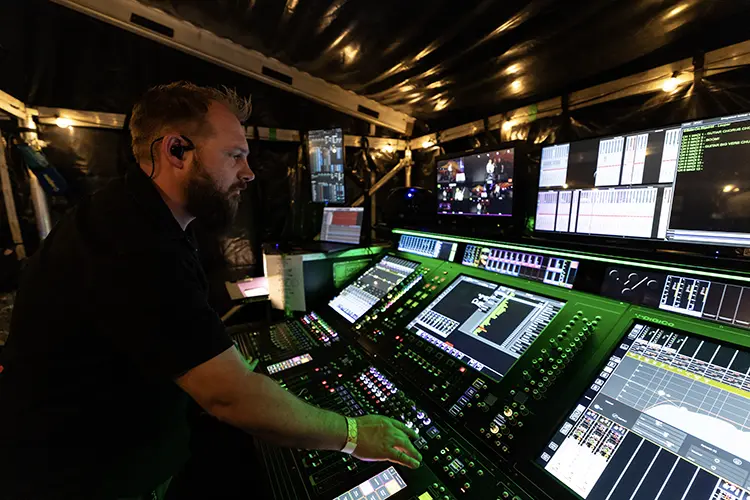
When White heard about Spectera, he was excited. At last, a product had been developed that would not only reduce the number of transmitters and receivers required on stage, but also solve issues caused by artists moving between stages, which could otherwise create difficult transitions in and out of coverage. The promise of an off-the-shelf product that did what he needed was too tempting, and he couldn’t wait for its release.
One show, two stages, no awkward transitions
We had seen a few small demos and I knew that, with the stage design of ‘The Loop’, Spectera would be perfect for us. We are covering a huge area; Ed is on the main stage and then moves seamlessly to a B stage. If we were managing that with standard analogue IEMs, it would be quite a complicated system with lots of switching and overdriven amplifiers to achieve even coverage. It can be done, but with Spectera it is plug-and-play and designed for this job. I’m pretty sure giving a pre-pre-release product to a major artist for a global tour could have been stressful for the Sennheiser team, but I knew it would work well. They are very good at what they do, he explains.
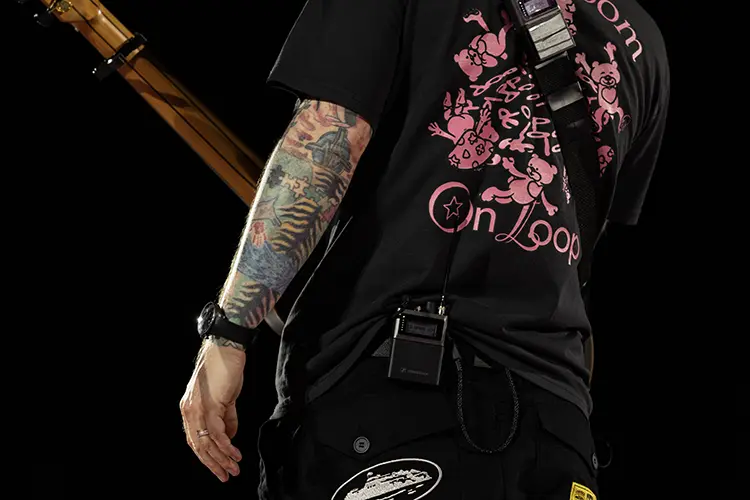
Sennheiser’s reliability and quality have allowed White to focus on refining his setup, while the constant evaluation of new technologies ensures the team always has the best tools for the job. However, unless there is an issue requiring immediate attention, White does not change equipment during a tour cycle, so the move to Spectera took place at the beginning of this year.
A change the whole team could hear
“Integrating a new technology, especially one that is completely new, requires a significant amount of testing, so for the move to Spectera we spent a lot of time comparing IEMs and tuning the system for the handheld microphones and guitar packs”, White continues. “The big difference with Spectera is that, although on paper the dynamic range and volume response should be the same, they are not. Audibly, you get much greater depth of dynamic range. Ed seems happy with the technology and, in terms of how the show works moving forward, the transition was very smooth. The technicians are happy too, and said: ‘now we can actually hear things’. There is definitely a depth and clarity we didn’t have before”.

White points out that testing a new product divides the professional audio industry. “Some engineers like me love using the latest technology, while others prefer to wait until every possible test has been completed”, he says. He highlights that Sennheiser’s testing covers all the areas of resilience required for the equipment, especially personal devices such as IEMs and wireless transmitters.
FOH perspective
The move to Spectera has also made a strong impression at front of house, where sonic transparency, dynamic range and consistency are essential in a show built almost entirely around Sheeran’s live vocal and guitar performance.
“Working with Spectera has been fantastic so far”, says FOH engineer Simon Kemp. “Moving from 6000 to Spectera has been a real sonic improvement. The sound of Ed’s guitars has become even more transparent and the dynamic range helps him move from very soft, delicate songs to powerful, in-your-face moments”.
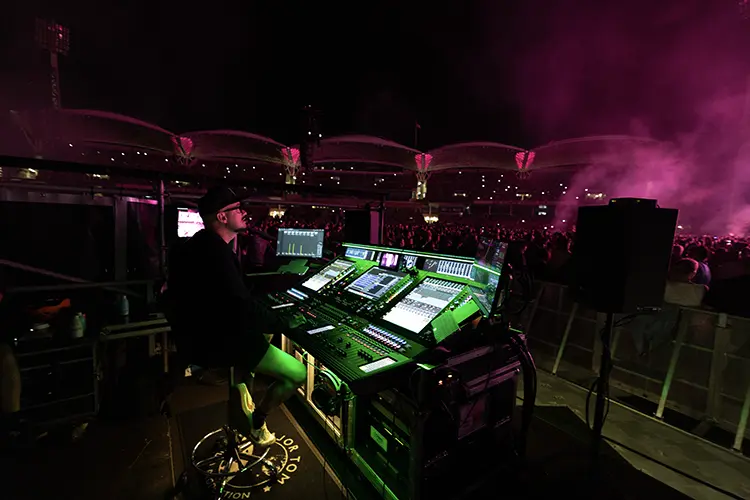
Kemp also highlights how the system handles the highly percussive nature of the artist’s playing style. “Ed uses the guitar for percussion and kick drum-style rhythms, and the pack has been excellent at handling that while maintaining a very transparent sound”, he explains.
For Kemp, reliability is just as important as sound quality. “Ed’s show is unique and places huge demands on any wireless system; one of the key aspects is maintaining total reliability even in the most extreme outdoor conditions”, he explains. “So far, we have had no problems. We have finished shows literally pouring water out of the guitar and microphone, and the system still kept working without any failures”.
He adds that the vocal chain is exposed in a production of this kind.
We are using the MM 445 capsule, which suits Ed’s voice. The show has no playback or auto-tune; it is a singer-songwriter alone in a huge stadium. There is nowhere to hide, so I have been very impressed by the clarity the microphone delivers, combined with a digital signal chain from the transmitter all the way to the speakers. We have achieved clear, present vocals throughout the stadium.
Singing in the rain, still holding RF
There is one thing all engineers agree on: water absorbs RF energy. RF can drop significantly when a bodypack is placed on a performer exposed to rain and humidity. These extreme conditions can be challenging, not only because of liquid ingress and its effect on electronics, but also because humidity can affect the strength of RF signals between packs and receivers or transmitters. White found that, using Spectera, this was not a problem; even in the Auckland downpour, the equipment kept working.
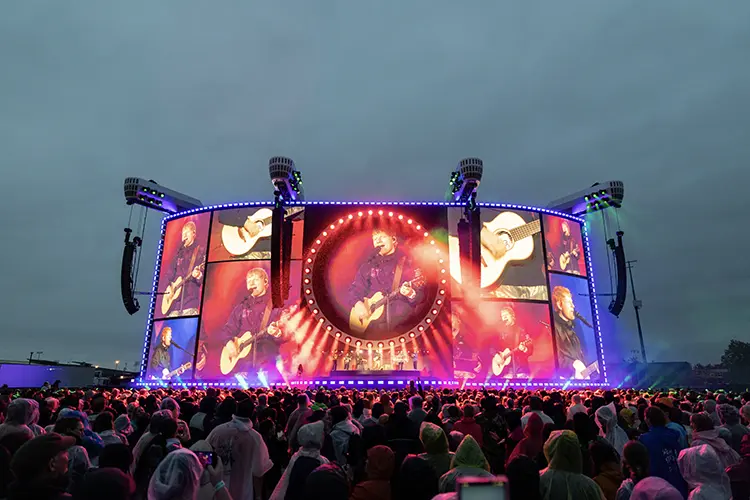
“The packs have been resilient. We started this tour in Auckland and the only way I can describe it is that the rain was biblical; it just didn’t stop. It’s the first time I’ve seen Ed perform in a raincoat”, he exclaims. “We had no failures at all with the handhelds or the bodypacks. We had five guitars fail due to water ingress, which seemed reasonable, but we had no RF problems. You can hardly find a harsher environment than here in Australia. One minute it is 40-45 degrees and the next there is torrential rain”.
Another challenge for RF is LED screens in stage design, and White is grateful for the robust coverage offered by Spectera. For The Loop tour, he uses Spectera DAD antennas over media converters, which provides the best coverage.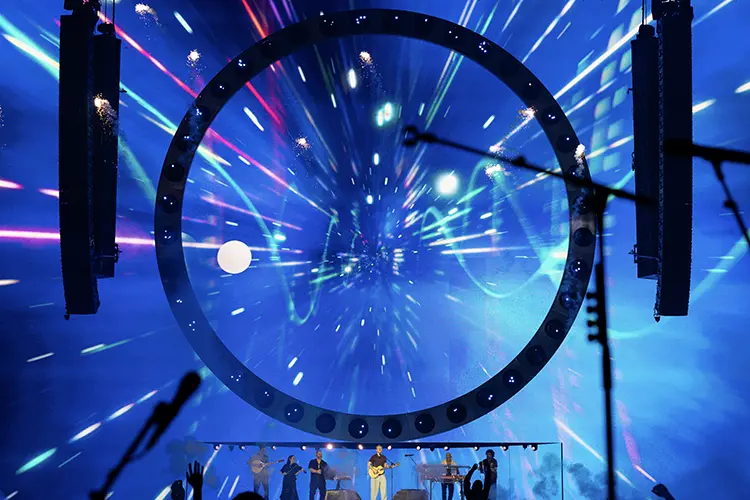
Less time coordinating, more time finessing
“We are using 11 antennas. We have Stage Left side hangs, Stage Right side hangs and B stage for each resource”, White explains. “We have a 50 by 18-metre video screen; in fact, the whole stage is one big video screen, and we have a set of antennas upstage just to cover that area. Pretty much every port is used on every Spectera unit, but that means we have seamless hand-off and perfect coverage from backstage to halfway down the stadium”.
When designing the system, Spectera’s workflow helped reduce White’s workload. The software offers remote access and virtual setup for Windows and Mac OS, while the 1U base station provides up to 32 simultaneous I/O and completely flexible configuration.
I must admit that, when they released this technology, I felt a little like my RF coordination knowledge had become obsolete. This innovation has shown that, in the future, understanding intermodulation and frequency mapping is going to become somewhat redundant. If you have 30 channels, for example, with a standard narrowband system, you would have to calculate and tune each one individually. With Spectera, you select a centre frequency and it does everything for you. You don’t have to worry about intermodulation or about fitting in 30 channels: you simply say ‘this 6 or 8 MHz block is mine’. I think it will make wireless technology much more accessible for people who were previously wary of RF. With standard narrowband carriers, a lot of things can happen and, if you don’t understand the basic maths behind it, it is very easy to get confused. With Spectera, the wireless system becomes much simpler. As long as there is a block of spectrum available, you know the system will work without problems, says White.

Wideband systems like Spectera are designed to reduce the workload of RF engineers like White. As pressure on wireless continues to grow, Sennheiser is offering solutions that not only work better in increasingly congested RF conditions, but also simplify the workflow. For White, this means less time coordinating and setting up, and more time finessing.
“We currently use three Spectera base stations over three RF carriers for the show, one of which is a complete backup”, White says. “I only need to find three 6 or 8 MHz gaps in the frequency spectrum. Before, that would take me half an hour to coordinate, but now I’m down to seven minutes, even if I go slowly. It’s very fast!”
More flexibility for complex stage setups
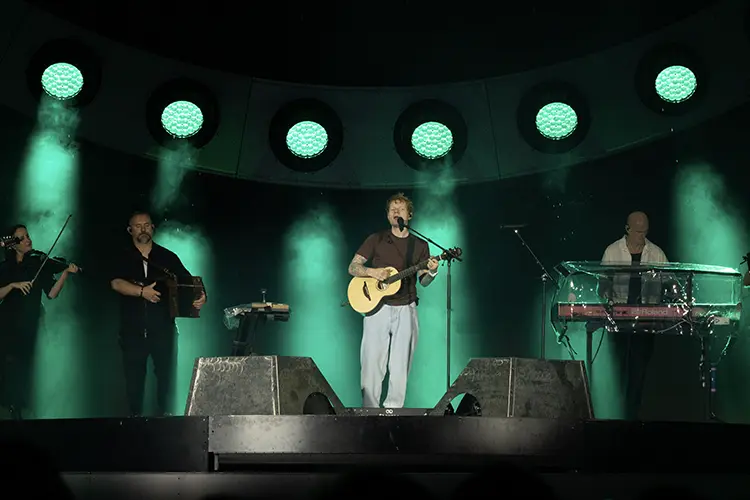
White uses Spectera for all of Ed’s vocal microphones and guitars, as well as for regular collaborators Beoga. The Irish folk band co-wrote the hits Galway Girl and Nancy Mulligan and have been performing as part of the tour. The Spectera system has been useful for Eamon Murray, the band’s bodhrán player. For him, adding a Spectera bodypack provides a completely mobile solution, not only for the acoustic sound of the bodhrán, but also for the sampled sounds that trigger snares and kick drums offstage.
“It has been interesting working with Beoga; they are not your typical rock or pop band. They have two accordions, a bouzouki, fiddle, keyboards and the bodhrán”, White explains. “Eamon uses a snare trigger on his bodhrán connected to a Roland trigger, whose signal is sent to a Spectera bodypack and from there to a trigger rack located offstage, where the sample is generated before returning to the system. We do the same with the kick pedal, so he can combine kick and snare sounds with the natural sound of his drum without losing mobility. In reality, the only thing he needs to carry with him is the kick pedal. Beoga’s sound is different from that of a conventional band, and Spectera has been useful for us because most musicians need at least one instrument output and one IEM input. Since Spectera works as a transceiver, we can work with around half the number of bodypacks we would need with any other system”.
Monitoring Spectera is also simple with WebUI, Sennheiser’s web-based monitoring interface. WebUI offers remote control and access to essential functions such as battery status, IEM volume, RF status and much more. As White explains, these tools are essential in a system of this size.
“I like WebUI because it gives you more live data, so that’s what I use”, he says. “I have every channel and I watch it throughout the show. If there is a problem, I need to be able to see whether it is a Spectera issue or an instrument issue, and I need to identify that very quickly. So I’m watching the back end of the Spectera units to check the RSSI levels and everything else that is happening. Another benefit of Spectera’s flexibility is that I need fewer spare bodypacks. Any bodypack can receive any stream, so if something fails in one of Ed’s bodypacks and his dedicated spare is not available for whatever reason, a technician can give him another bodypack, I pick up that MADI stream and the switch happens in seconds”.
New for 2026 is the Spectera handheld, which White has also been beta testing. For him, a handheld microphone was the missing piece of the puzzle. As part of that process, White and the team have been in close contact with Sennheiser’s development teams, providing direct feedback on both hardware and software as the system continues to evolve in real touring conditions.
Marcus Blight, Technical Application Engineer at Sennheiser, has been White’s main technical contact, with additional support from Peter Craig and Pierre Morant from Sennheiser’s Relationship Management department.
“Spectera has made my life in RF much simpler and more manageable, as well as reducing freight costs”, White admits. “On the last tour, our entire RF system for the in-ears, combiners and amplifiers occupied a 32U rack. Now we have completely eliminated that rack and replaced it with three Spectera units integrated into our current monitoring system, together with the chargers. This has not only reduced freight costs, but also greatly simplified and optimised the setup, which is where the industry should be heading. It is a very good system”.
Long-term trust, built on performance and support
Good equipment is only one of the factors in White’s ongoing relationship with Sennheiser. The team behind these products works tirelessly to ensure that every user has the best possible experience.
Clarity and reliability have always been present with Sennheiser. The working relationship is another important aspect. If a problem arises, there is an enormous amount of knowledge within the company and they are always happy to help us or answer our questions. I have learned a huge amount from them. Part of my job is to stay up to date with everything happening in the industry, and we have always been clear that, although we love working with Sennheiser, if a better product appeared, we would probably switch. Ultimately, our responsibility is to give the artist the greatest stability and the best possible audio quality. And the reality is that, for the last 14 years, Sennheiser has been the brand that has provided that best. They also continue to release innovative, high-quality products. That is one of the reasons we have worked with them for so long and why we are delighted to continue this relationship, he concludes.
Photo credit: Mark Surridge