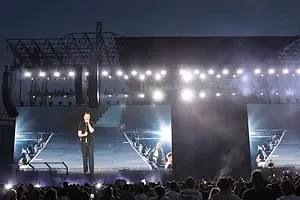
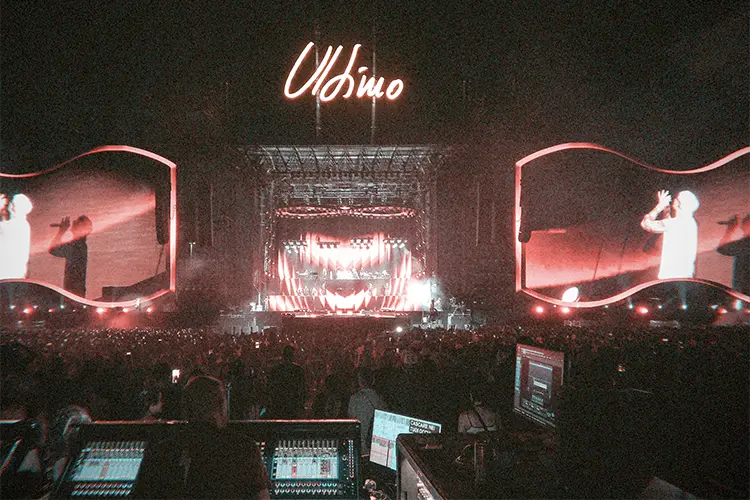
This summer, exactly seven years after his first stadium concert, Ultimo performed for 250,000 people on the Tor Vergata plain, southeast of Rome. The show La Favola per Sempre sold out in three hours and became the largest ticketed concert ever held in Italy.
Ultimo is the stage name of Niccolò Moriconi, a Roman singer-songwriter who released his first single in 2017, won the newcomers category at the Sanremo Music Festival in 2018 and, in July 2019, drew more than 63,000 people to the Stadio Olimpico. At 23, he became the youngest Italian artist to headline a stadium concert. For the Tor Vergata performance, the audience area was divided into six zones, one for each of his albums, and the setlist included 29 songs.
A venue built from scratch
The Tor Vergata plain has no permanent event infrastructure: no power supply, access roads or equipment load-in routes. It had previously hosted massive gatherings, most recently more than one million young people during the Jubilee of Youth, held in August 2025 with Pope Leo XIV, a free event with no tickets required.
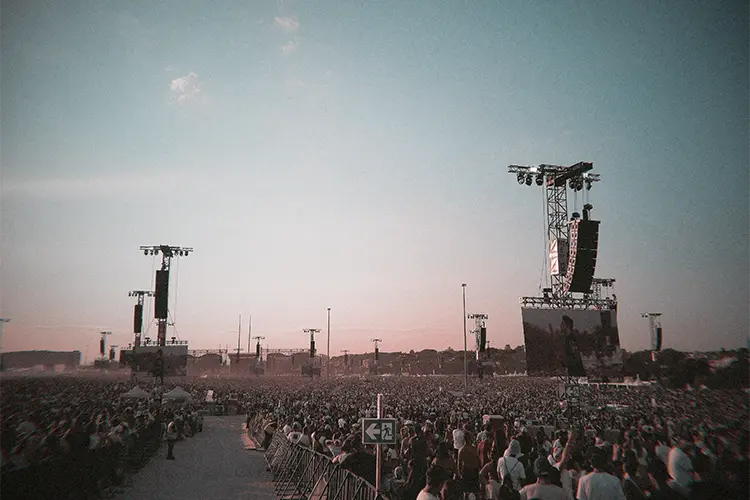
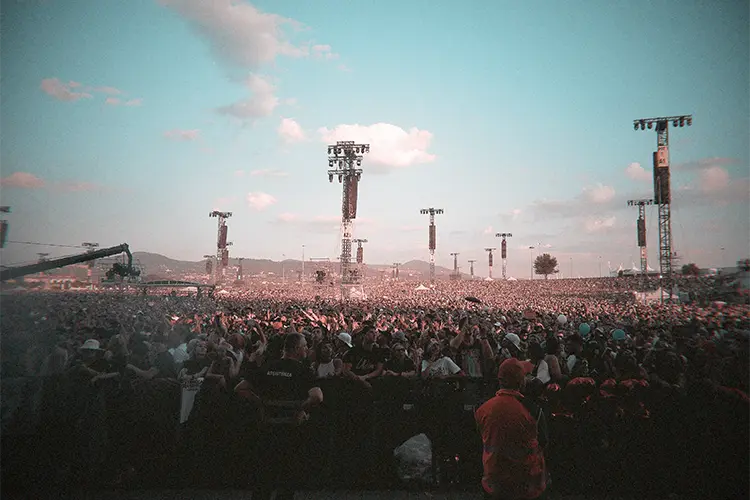
For this concert, all the infrastructure had to be installed from scratch: a 140-metre stage supported by 34 towers reaching heights of up to 33 metres, 2,500 square metres of LED screens and a network of delay towers distributed across the audience area. The Policlinico Tor Vergata university hospital stands directly behind the stage.
FOH engineer Andrea Corsellini initially brought in Agorà, an L-Acoustics Certified Provider, to produce a preliminary simulation of the venue's acoustic coverage. He subsequently commissioned the Italian company to develop and deliver the project.
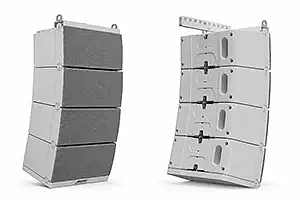
Agorà selected the newly launched L1 system with CS1 subwoofers for the main PA, K1 and K2 for the nearer delay lines and V-DOSC for the most distant areas. The company is also collaborating with Vivo Concerti and the University of Rome Tor Vergata on a research programme investigating sound propagation and the acoustic impact of an event of this scale.
Tor Vergata represented the largest ticketed event in Agorà's history. The artist's particular focus on sound gave the audio system an unusually high priority within the overall production, allowing the company to propose L1 for both the main PA and the sidefills.
Corsellini tested the system beforehand at Agorà's facilities and presented it to the artist's management team. Agorà has worked with L-Acoustics since the V-DOSC era and participated in the L1 pilot phase, making this concert its first real-world production of this magnitude with the brand's new flagship system.
L1 and CS1: cardioid low-frequency control to protect the hospital environment
The project presented two conflicting requirements. The main PA had to deliver the power and impact needed for the largest concert ever held in Italy while respecting noise limits behind the stage, where the hospital is located, and around the venue perimeter.
 |
 |
Although Ultimo's repertoire is primarily pop, his concerts feature significant low-frequency energy. The artist's team established one overriding objective: to achieve uniform, consistent sound from the front rows to the furthest delay positions.
Cardioid low-frequency control provided the solution to both requirements. L1 and CS1 feature a cardioid architecture delivering up to 26 dB of rejection towards the stage, with a choice of cardioid, supercardioid and side-rejection presets. "With its cardioid pattern, coupled with the CS1 subs, it helped us a lot with the challenge of noise control", explains Remo Scafati, Agorà's FOH assistant.
The characteristics of the venue presented another major challenge. "The venue and the audience were huge, and the site wasn't equipped from an infrastructure point of view", says Scafati. "The design and preparation took a lot of time and effort".
Loading in materials and moving equipment across the plain were slow processes. These difficulties were compounded by summer weather conditions ranging from extreme heat to sudden storms.
Soundvision predicts coverage and sound dispersion across 580 metres
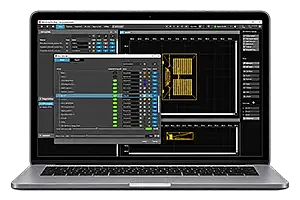
Agorà modelled the entire installation using L-Acoustics Soundvision software.
With the hospital imposing strict limits on sound energy projected behind the stage and the final delay line positioned approximately 580 metres away, Soundvision made it possible to predict acoustic coverage throughout the venue before rigging began.
Antonio Paoluzi, responsible for designing the delay system, also developed his own software to recalculate delay times according to variations in temperature and humidity.
The design was divided into two projects, both for system management reasons and because the number of amplified controllers exceeded the maximum supported by a single LA Network Manager session.
Soundvision is a very precise tool for predicting coverage and delay times, and it proved useful in anticipating coverage challenges across the different areas of the venue, explains Paoluzi.
The main system: L1, CS1 and K1
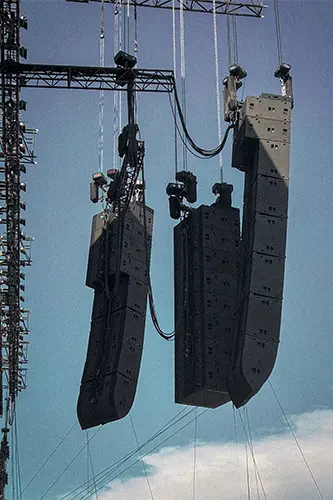
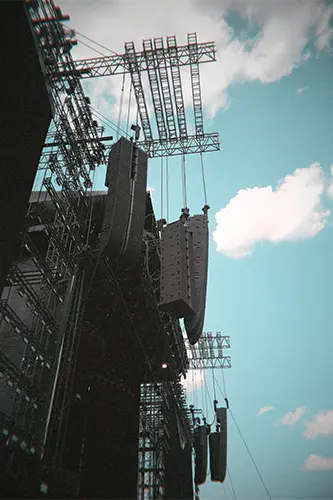
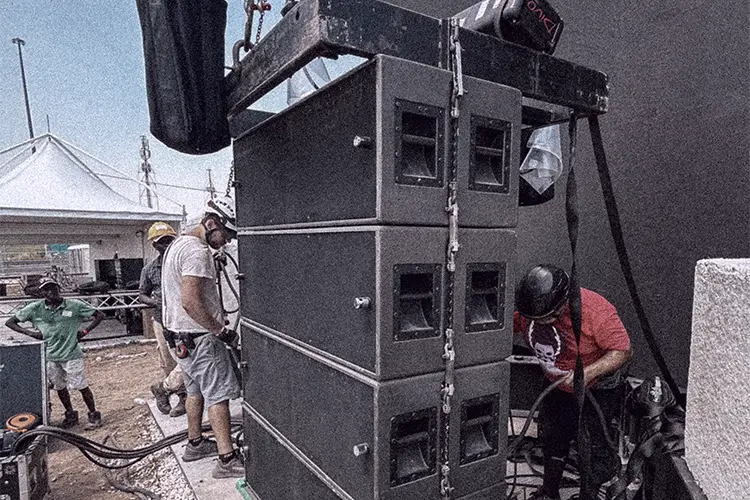
The main system was built around four flown L1 arrays: two main and two side arrays. Each incorporated an L1D at the bottom to provide near-field coverage, with CS1 subwoofers flown above.
Each main array comprised two CS1, five L1 and one L1D, while each side array included four CS1, three L1 and one L1D. In addition, eight more CS1 were flown centrally, and 63 KS28 were ground-stacked in groups of three, arranged in an arc across the front of the stage.
Front-fill coverage was provided by Kara II and A15 distributed across the width of the stage, with an additional K1 array extending coverage to one side. On stage right, another side system comprising 14 L1 covered a large VIP grandstand. The entire system was driven by LA7.16 amplified controllers.
Nine delay lines with K1, K2 and V-DOSC
The delay design comprised nine positions extending progressively towards the rear of the venue.
The nearer lines used K1 and K2, while the positions further back employed K2 and then V-DOSC at 460 and 520 metres from the stage. The final line, positioned approximately 580 metres away, returned to K1 to complete the coverage. KS28 subwoofers reinforced the low frequencies at each delay position, while Kara II provided coverage for the grandstands.
The entire system operated over Milan-AVB, with primary and secondary networks implemented through a star-topology Luminex infrastructure consisting of a central hub and ten primary and ten secondary nodes. Each tower was equipped with an L-Acoustics LA-RAK II AVB rack and an LS10 switch.
An Optocore network supplied AES signals to the amplified controllers, with automatic failover as a backup system. Given the scale and complexity of the installation, Agorà added an analogue feed as a third layer of redundancy for critical failure scenarios.
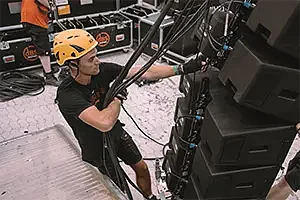
The biggest operational challenge was the delay system. Given the enormous size of the venue, the intense working schedule and the extreme heat, getting all the equipment into place and properly optimised was far from easy, but the final result made the effort worthwhile, explains Valerio Motta, Agorà's technical manager.
The technical team
Antonio Paoluzi was the system engineer responsible for the delay chain, while Luca Nobilini was in charge of the main system.
Agorà also received support from Tom Laveuf, L-Acoustics regional application engineer for EMEA South, throughout deployment, system tuning and the concert itself.
What we achieved for this historic concert was only possible through great teamwork and remarkable technical expertise, says Corsellini, who also highlighted L-Acoustics Source Intelligence as a real game changer.
 Instagram
 Facebook
 LinkedIn
 X
 YouTube
 TikTok