


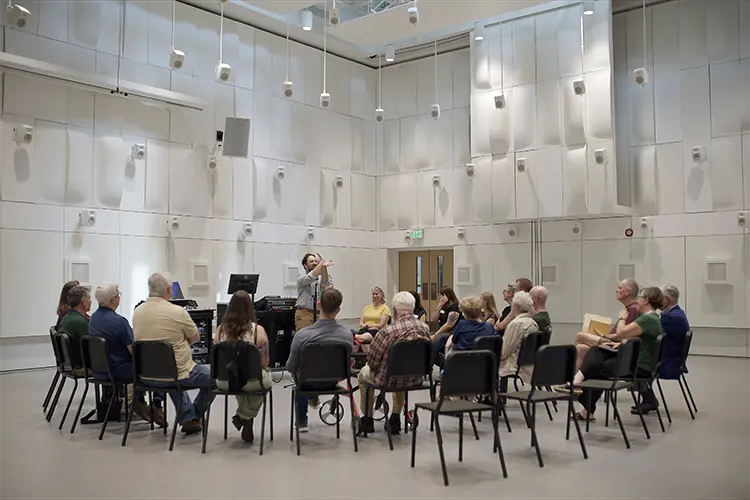
Eichler Hall, home to the College of Music's large ensembles, is now also one of the largest immersive audio environments in US higher education, supporting composition, teaching and multidisciplinary research.
Michigan State University's College of Music has transformed Eichler Hall into one of the most ambitious immersive audio environments in higher education, installing a Genelec Smart IP loudspeaker system designed for composition, performance, teaching and multidisciplinary research using Ambisonics technology.
The approximately 200 m² hall is used for rehearsals and performances by the university's orchestra, band and choir. With the new system, it can also function as a spatial audio environment capable of creating a 360-degree listening sphere and positioning and moving sounds in three-dimensional space.
The installed system comprises 143 Genelec 4430AW Smart IP Installation Loudspeakers in white and two Genelec 7382A Smart Active Subwoofers. The network infrastructure is also ready to accommodate additional loudspeakers.
The project was made possible through the support of Ed and Wanda Eichler, who also funded the creation of Eichler Hall.
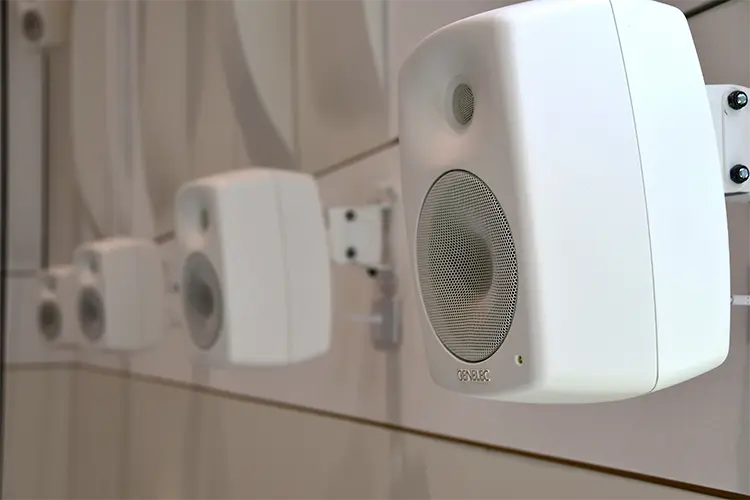
Why Smart IP?
The project was led by Anthony T. Marasco, Assistant Professor of Composition and Technology at Michigan State University, with system design and technical consulting provided by Tanner Upthegrove of Electroacoustics, LLC.
During the planning phase, Upthegrove recommended using Genelec Smart IP technology as the foundation of the system. According to Marasco, this decision helped expand the hall's capabilities and simplify the installation, as the technology enables audio, electrical power and control signals to be delivered through a single network infrastructure. It also facilitates the individual management and optimisation of each loudspeaker.
The system operates over a Dante network, with Cat 6 cabling throughout the hall. This configuration eliminated the need to install separate electrical infrastructure to power more than 140 loudspeakers, significantly reducing the complexity of the project, according to Marasco.
Installation and commissioning
The system was installed by Michigan State University staff, including Tom March, College of Music Facilities Manager; Justin Baker, Director of IT; and the university's Infrastructure Planning and Facilities team.
Work began during the winter break with the installation of data cabling. Once the spring semester ended, loudspeaker installation began, and by mid-June the entire system was in place. Tanner Upthegrove then worked with Anthony T. Marasco and the university team for several days to configure and commission the system.
They used Genelec Smart IP Manager software to check network connections, verify audio routing and adjust the acoustic response of each loudspeaker. This process was particularly important for loudspeakers whose location or proximity to certain architectural elements affected their acoustic performance.
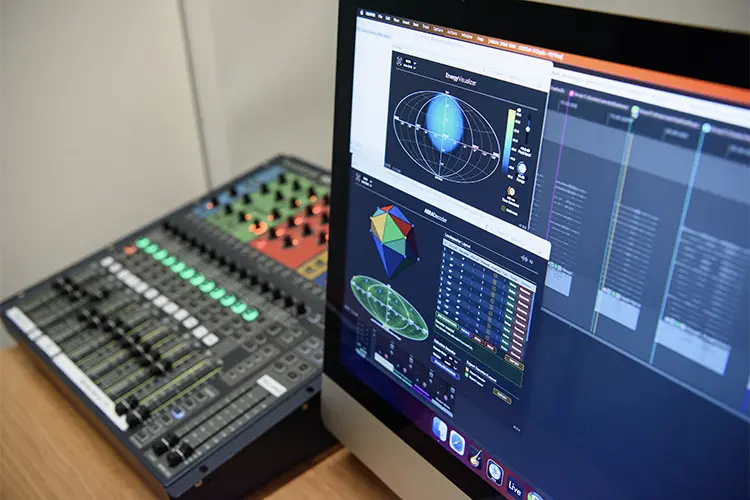
According to Marasco, the software made it possible to analyse each loudspeaker and create equalization profiles tailored to its position within the hall. These settings were stored directly in the loudspeakers themselves, making configuration and optimisation easier.
Upthegrove also highlights how Smart IP Manager simplified the control of equalization, sensitivity and other loudspeaker functions, both individually and by zone, without the need for an external digital signal processor (DSP).
The installation uses a Danish Audio Devices AX Center interface as the central component of the system, alongside a Mac Studio serving as the main audio production workstation.
The infrastructure also includes Dante Virtual Soundcard, an RME Digiface Dante 256-channel interface and a Behringer X32 mixing console, allowing analog audio sources and live instruments to be integrated. Meanwhile, REAPER and Max are used to manage multichannel routing, composition, Ambisonics processing and the development of custom spatial audio applications.
A laboratory for students across disciplines
The Immersive Sound Design course, taught by Anthony T. Marasco and open to students across Michigan State University, explores immersive audio applications in areas such as music composition, video games, storytelling, themed entertainment and museum experiences.
Previously, Marasco had to assemble and dismantle a temporary 7.1.4 sound system for each session. With the new installation at Eichler Hall, students now have access to a permanent environment where they can experiment directly with spatial audio and develop more complex projects.
According to Marasco, the system allows students to position sounds at specific points in space and move them above or around the audience, as well as combine Ambisonics recordings with independently positioned mono or stereo sources. It also makes it possible to design virtual acoustic environments that could not exist in a real physical space.
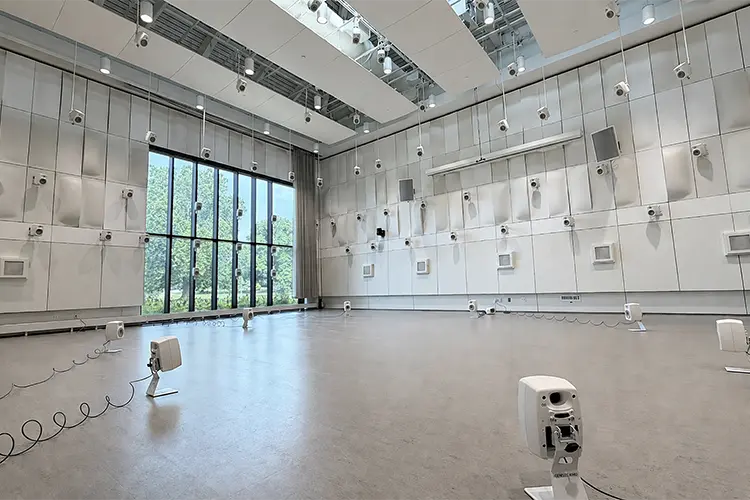
The course already attracts students from game design, engineering and communications, while the college hopes to expand its reach to other disciplines, including film and journalism.
In addition to its educational role, Eichler Hall is expected to host concerts, workshops, guest artist performances and immersive audio events. The hall will also serve as a multidisciplinary research platform, with potential applications in acoustic and sonic ecology, health and wellness, simulation, manufacturing processes and occupational safety training.
Recreating acoustic spaces and moving sounds
One of the system's main capabilities is the recreation of real or imaginary acoustic environments through impulse response (IR) modelling. This technology makes it possible to simulate how sound would behave in different spaces without performers or listeners having to be physically present in them.
During demonstrations at Eichler Hall, the system has recreated environments as varied as a Scottish mausoleum and a railway tunnel, reproducing their acoustic characteristics within the hall.
Marasco also highlights the installation's ability to create a natural sense of sound movement. As an example, he describes the playback of Ambisonics field recordings in which listeners hear a bird singing above them before perceiving it flying around the room.
Thanks to the loudspeaker distribution and spatial processing, sound is perceived as a source present within the environment rather than being associated with individual loudspeakers.
Finally, Genelec worked with the university during the procurement process to ensure that the large number of loudspeakers required for the project could be secured and delivered within the planned schedule.
 Instagram
 Facebook
 LinkedIn
 YouTube
 TikTok