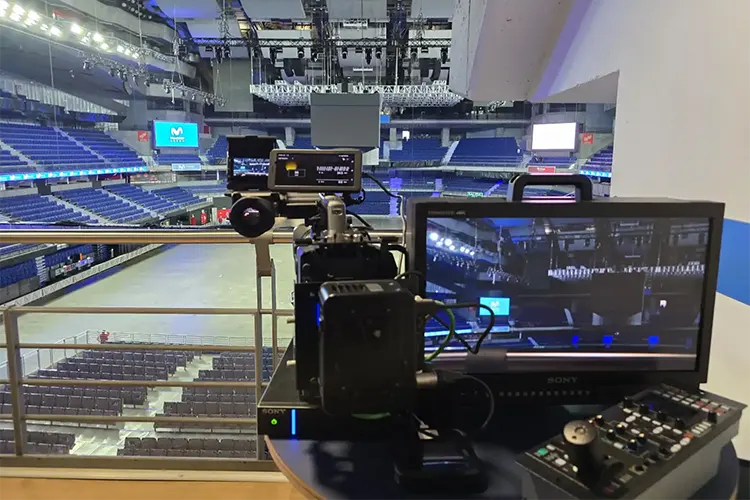
Telefónica, in collaboration with Sony, has carried out a pioneering 5G connectivity trial at Movistar Arena, achieving multi-gigabit-per-second speeds thanks to the use of the 26 GHz band, also known as the millimeter wave (mmWave) spectrum.
Telefónica is the only operator in Spain with 1,000 MHz of spectrum in this band, a capacity equivalent to the bandwidth of up to ten 5G operators using today’s 3.5 GHz technology. This enables the company to offer significantly greater capacity than conventional 5G networks.
This pioneering pilot project in Spain has demonstrated how the technology can simultaneously support the intensive usage demands of thousands of people attending an event, while also enabling professional applications that require the real-time transmission of large volumes of data, such as multiple video feeds for the live television production of sporting or music events.
One of the key milestones of the trial was the use of an innovative configuration known as Heavy Uplink, a network optimized for uplink bandwidth and designed to deliver exceptionally high upload speeds. At Movistar Arena, upload speeds exceeding 1.8 Gbps were achieved, the highest ever deployed on a commercial 5G network in Spain. This capability is critical for applications such as live video broadcasting and remote audiovisual production, even in extremely high-traffic environments. Such performance is only possible thanks to Telefónica’s extensive spectrum holdings in the 26 GHz band.
The pilot was conducted in collaboration with Sony, which tested the operation of a 5G audiovisual transmission system based on technologies including the CBK-RPU7 remote production unit for ultra-low-latency HEVC video encoding. The 4K (Ultra HD) images captured by the HXC-FZ90 camera were encoded at up to 100 Mbps and transmitted over the 5G network via Sony’s PDT-FP1 portable data transmitter before being decoded by the NXL-ME80 media processor.
Leonor Ostos, Director of Product and Service Development at Telefónica Spain, commented:
This deployment in the 26 GHz 5G band at Movistar Arena demonstrates our commitment to next-generation networks. This technology enables use cases that involve managing large volumes of data in real time, enhancing both professional applications across industries and the connected experience for audiences attending mass events such as concerts and major sporting events. This achievement also reflects our determination to be the best gateway to digital technologies, strengthening our position as an innovative and competitive company focused on delivering more and better services to our customers.
For his part, Rob Thorne, Head of the Networked Live category at Sony Professional Europe, said:
5G promises greater flexibility for live event production; however, bandwidth and architectural limitations have slowed its adoption until now. By combining the mmWave 5G technology deployed at Movistar Arena with Sony’s unique HEVC solution, we are demonstrating that 5G is now capable of meeting the high-quality and low-latency requirements demanded by today’s live production environments.
This pilot in the millimeter-wave spectrum marks another step in Telefónica’s leadership in transforming sports entertainment through the deployment of 5G television production solutions. The company has already achieved significant milestones, including automated ultra-low-latency broadcasting in stadiums such as Abanca-Riazor in A Coruña and Riyadh Air Metropolitano.
Another notable example of this capability was the production of the Acciona Open de España golf tournament, where in 2021, for the first time in a professional European tournament, a 5G network was used to connect drones and wireless cameras.