On Broadway’s biggest night, Sennheiser’s Spectera became a key partner in the production of the 79th Tony Awards.
Deployed by Firehouse Productions for the live broadcast from Radio City Music Hall on June 7, Spectera powered the largest broadcast deployment in its history in the United States, with superstar P!NK at the center of the production, helping bring Broadway’s biggest night to millions of viewers around the world.
This milestone follows Spectera’s debut at the 2025 Tony Awards, when Cynthia Erivo used a single Spectera bodypack to simultaneously transmit a lavalier microphone signal and receive stereo in-ear monitoring during her memorable entrance from an upper-level dressing room, through backstage corridors and stairwells, and onto the main stage. That venue-spanning performance provided an early demonstration of the system’s seamless coverage and bidirectional capabilities.
The 79th Tony Awards demonstrated Spectera’s ability to meet the demands of a large-scale broadcast production, supporting handheld microphones, headsets, lavaliers, instrument wireless systems and in-ear monitoring throughout a fast-paced show where technical requirements can change in real time.
Most notably, P!NK relied on Spectera throughout the evening for her complete wireless setup, including a headset, lavalier, in-ear monitoring and a handheld microphone equipped with a Neumann KK 204 capsule. Using a single, low-profile Spectera SEK bodypack, the system seamlessly supported her dramatic aerial entrance, her star-studded performance of Lady Marmalade from Moulin Rouge! The Musical, audience interactions, introductions throughout the broadcast, and a tribute to Chicago celebrating the 30th anniversary of the Broadway revival.
Spectera microphones were also used in other performances throughout the evening, including appearances by the casts of Schmigadoon! and Two Strangers (Carry a Cake Across New York), as well as for wireless instrument transmission during the In Memoriam segment.
We recently used Spectera for in-ear monitoring at our show in San Diego. Since the Tony Awards combined in-ear monitoring and headset microphones for some performances, it was an obvious decision to use the transceiver. The functionality of the Spectera system allowed us to constantly monitor the bodypacks, make changes remotely and lock volume levels so they could be placed inside costumes without worrying about settings being accidentally changed during complex dance sequences. Spectera is a game changer in terms of system management and functionality, comments Jon Lewis, P!NK’s Monitor Engineer.
The production team used two Spectera Base Stations to provide coverage throughout Radio City Music Hall. In total, Spectera carried the equivalent of approximately 60 audio channels within just 12 MHz of spectrum while operating alongside numerous traditional wireless systems on the same stage.
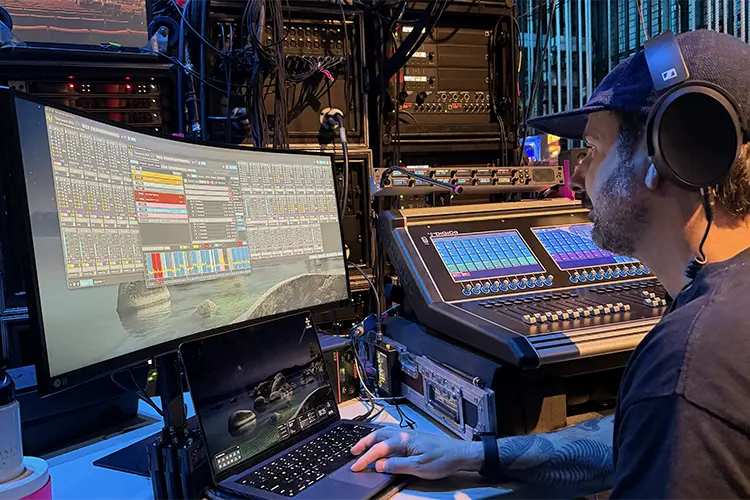
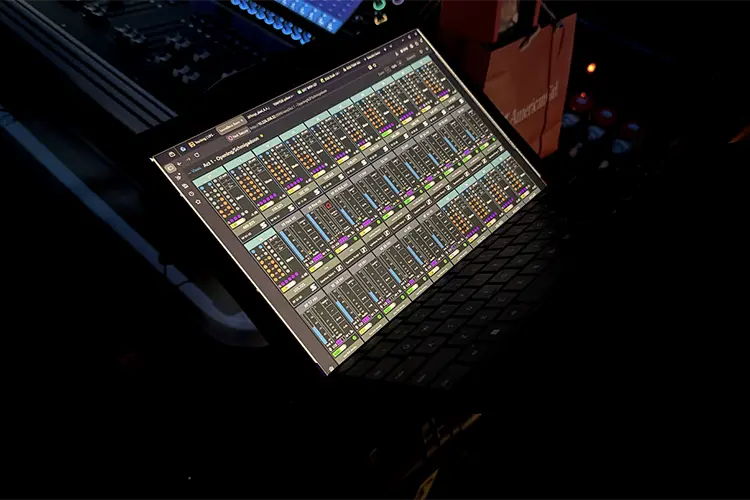
Wireless monitoring, coordination and control for the production were managed entirely through SoundBase, regardless of brand, providing the RF team with centralized visibility of a complex and constantly evolving wireless ecosystem.
“Spectera is going to change the game”, said Justin Milner, RF Technician for the 79th Tony Awards. “It brings a completely different mindset. Everything from spectrum management to transmitter deployment and antenna deployment is easier, faster and more robust than narrowband systems”.
Scott Hoskins, RF Coordinator for Firehouse Productions, explained that the system’s flexibility proved valuable in a production environment where requirements can change right up until airtime.
We were able to adjust microphone capacities and add more in-ear channels without worrying about additional frequency management. The ease and flexibility of EtherCON-based antennas greatly expand our ability to modify coverage areas on the fly, as well as reach remote locations where a traditional coax-based system would require additional hardware, he explained.
Coverage throughout Radio City Music Hall remained reliable during rehearsals and the live broadcast. “The Spectera carriers have been rock solid all week”, said Hoskins. “We deployed four antennas on the first base station and three on the second, achieving excellent coverage throughout the venue”.
Milner added: “With the limited spectrum availability today, this opens the door for productions to significantly expand their RF requirements for every show”.
Thanks to extensive coverage in one of the country’s most challenging RF environments, flexible infrastructure and the ability to simultaneously support microphones and in-ear monitoring on the same wideband carrier, Spectera enabled the production team to adapt quickly to the evolving requirements of the broadcast during both rehearsals and the live event.
Combined with SoundBase for wireless management, the team was able to monitor both Spectera and conventional wireless systems from a single platform. Hoskins emphasized: “The ability to view all of our systems together, regardless of brand, has been a tremendous advantage”.
The team also benefited from SoundBase Pro’s new Remote View feature, which enables customized dashboards across multiple devices—including smartphones, tablets and laptops—allowing monitoring from anywhere in the venue without requiring additional software licenses.
Monitoring during rehearsals and the live broadcast was carried out using Sennheiser HD 480 PRO headphones. “It was a pleasure listening to every microphone transmitted through Spectera on the HD 480 PRO headphones”, said Milner. “Everything sounded fantastic”.
The 2026 Tony Awards broadcast also served as a preview of the upcoming Spectera SKM handheld microphone, with pre-production units used throughout the ceremony by P!NK and other performers.
Looking ahead, Hoskins believes technologies like Spectera will be essential as live productions continue to evolve. “The reduction in physical space and RF spectrum requirements that Spectera provides will help us keep pace with increasingly complex productions”.
Spectera gives production teams the flexibility and scalability they need to meet today’s RF challenges while preparing for the demands of future broadcasts, concluded Greg Simon, Director of Technical Applications Engineering at Sennheiser.