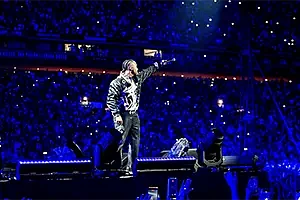
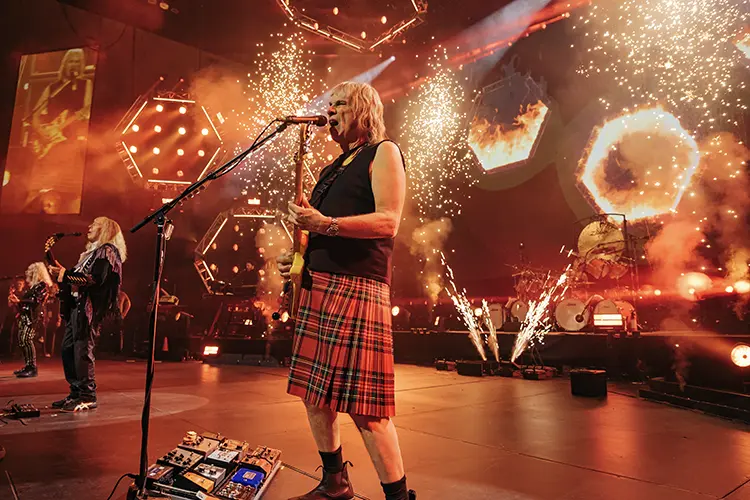
One of the most eagerly anticipated releases this autumn is Spinal Tap II: The End Continues. In this mockumentary-style comedy, once again directed by Rob Reiner, the band reunites after a 15-year break to deliver one final concert.
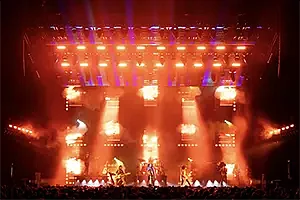
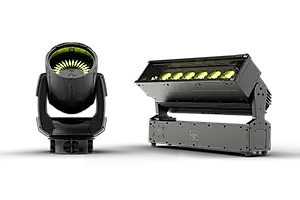
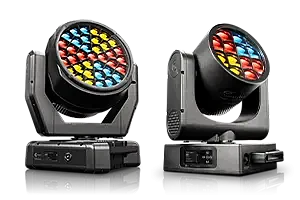
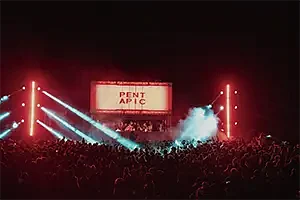
When the action moves to New Orleans, it is for this concert—held at the city’s Lakefront Arena—that lighting designer Mike Baldassari and his programmer Mike Appel tasked 24 of GLP’s original JDC1 hybrid strobes with a multitude of roles, including the creation of a specific color palette for each of the band’s iconic songs.
The convergence of the concert and film worlds is familiar territory for Baldassari, who can point to work in theatre—including Broadway—concert touring (Neil Young and Alice in Chains), and an extensive portfolio of top-level film and television projects—including Rock of Ages—over four decades on the creative front line. “Being able to take the atmosphere of a concert and capture it on film is exciting”, he says. Having grown up with the hair metal bands of the 1980s was an additional incentive for wanting to be involved in this project.
His inspiration on this occasion stemmed from a combination of geometric shapes, and that is where the rectangular-format JDC1s came into play. Production designer Michelle C. Harmon had mentioned that the band was inspired by a concert they performed at London’s Royal Albert Hall in 1992. “When I saw it on YouTube, I noticed some small hexagonal shapes in the background that immediately caught my attention”, Baldassari comments. From that six-sided geometry, he began to play with numbers.
The band is made up of three members, which translated into a layout of three pods stage left, three stage right, and three more overhead, further reinforced by the symbolic connection of the number 666 with heavy metal. Added to this was an iconic form from 1980s rock and roll—the silver hexagonal gel frames for PAR cans—which confirmed that the hexagon was the right element on which to base the design, complemented by the use of circles and visually enhanced by the contrast of the JDC1’s rectangular format.
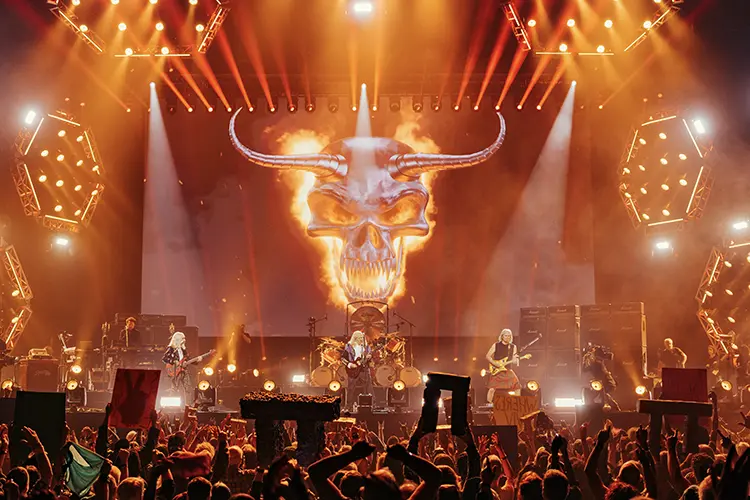
Baldassari and Appel faced challenges not only due to the tight schedule, but also because of significant weight restrictions at the venue, which had been compromised following Hurricane Katrina; as a result, the massive video wall backdrop was entirely ground-supported by a five-storey-tall structure.
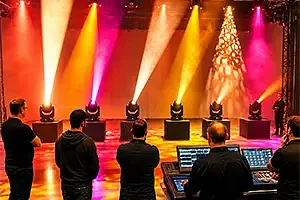
The two worked through a week of previsualization from their respective bases in New Jersey and Florida, using a gaming program called Parsec to share computer screens and program on a grandMA3. The show was built in Vectorworks 3D and the JDCs were operated in full pixel mode. “There are many things I love about them”, he noted. “First of all, the strobes are not just white, and within this style of music it was very important that each song had its own palette. Another great advantage”, Baldassari added, “is that just 24 fixtures, strategically distributed across the entire stage, were sufficient. Even on a rig of that size, only 24 JDC1s create enormous impact”.
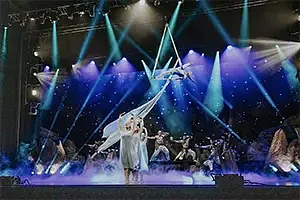
The iconic Stonehenge—assigned a turquoise color palette on the JDC1s—required a full day of shooting. In Spinal Tap II, the band once again performs at the actual Stonehenge, this time with a correctly scaled 6-meter-tall replica that was flown in upstage (with minimal clearance), re-recording the song alongside Elton John and other guests to revive and correct the classic mistake made in Spinal Tap I (when they received one that was only 18 inches tall).
Mike Baldassari also highlighted the fixture’s tilting function: there were moments when it was facing the audience, others when it up-lit the band and then fired across the front. There is a moment when Stonehenge descends and two JDC1s are positioned right in the center, between the two legs of Stonehenge. You could tilt them back and forth, but I made them do a little ‘happy dance’, and because they were in full pixel mode, Mike was able to give them a nice sparkle. What makes them such a great fixture is that they work beautifully in wide shots as well as in close-ups, because they can have an internal shimmer; it’s fun to see them up close.
Finally, he stressed that, with control of refresh rates being so critical in film, he would always opt for the guaranteed flicker-free performance of a branded LED such as GLP, rather than accept a substitute.
“I wouldn’t put anything I wasn’t sure of on a film or television production without control of the PWM, especially when shooting with smoke and haze, where any flicker becomes immediately apparent”.
And once again, the GLP fixtures performed reliably. Supplied by local New Orleans vendor Ray Ziegler of RZI Lighting, they did not miss a beat.
Photos courtesy of: Bleecker Street/Kyle Kaplan