

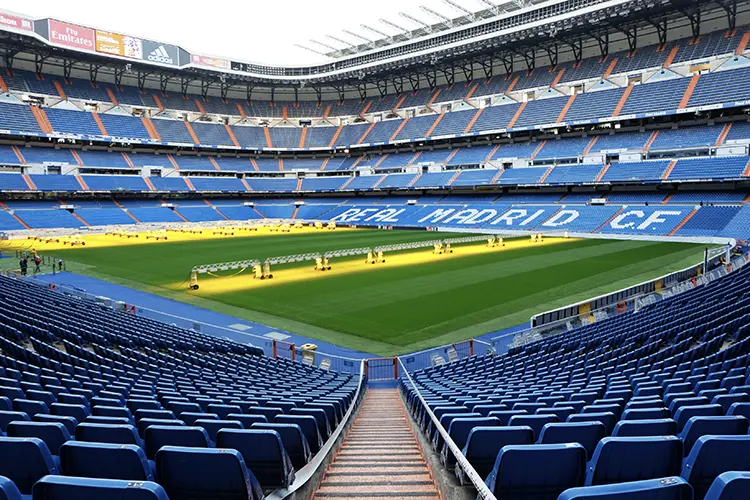
Stadium audio has evolved from a public address system into critical infrastructure. For years, sound in sports venues was approached from a functional logic: announcements, safety, and little more. Today, that approach no longer holds up in the current context.
The stadium is a complex entertainment environment where sport, spectacle, dynamic content, and intensive commercial exploitation coexist. In this scenario, audio no longer accompanies—it defines.
The problem is that many venues still carry a technical legacy that falls short. Centralized systems, uneven coverage, and poor intelligibility remain common, especially in stadiums built or renovated before the technological leap of the last decade.
In several large-capacity European venues, for example, it has been observed that upper tiers showed clearly insufficient intelligibility values due to distance from sources and reflections from the roof. The solution in these cases has not been to increase level, but to completely redesign the system.

Key technology
The leap is not about being louder, but about sounding better where it matters. Technological evolution has moved in a very specific direction: control. Control of coverage, dispersion, phase, time, and network.
Today, design relies on prediction tools that allow system behavior to be modeled before installation. This has been key, for example, in renovation projects where centralized systems have been replaced by ring-based distributed configurations. In these cases, prior modeling has made it possible to optimize the position of each emission point and precisely adjust delays, achieving substantial improvements in uniformity and STI values without increasing overall sound pressure levels.
At the infrastructure level, audio over IP has completely transformed the architecture of these systems. Protocols such as Dante, AVB, or Milan enable scalable and redundant networks—essential in installations where service continuity is critical. This is combined with high-capacity DSP matrices that allow multiple zones, content streams, and operational scenarios to be managed in real time.
From cluster to distributed system
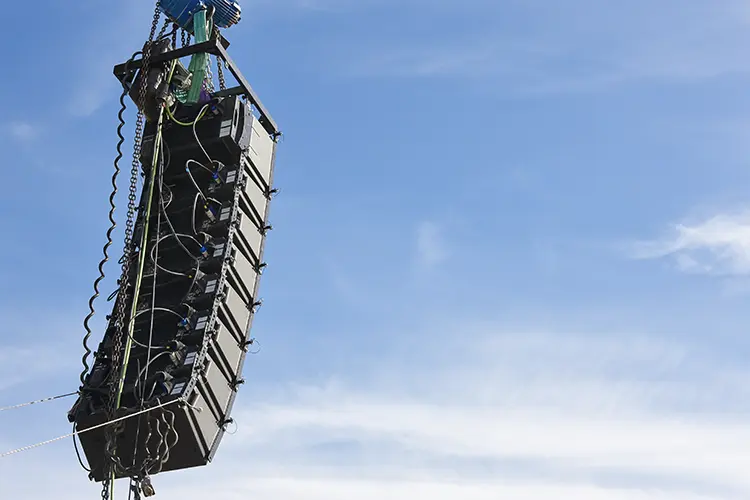
The centralized model is losing relevance in modern stadiums. For years, large clusters attempted to cover vast areas from distant positions, creating coherence issues and excessive reliance on delays.
The current trend is clear: bring sound closer to the spectator. In several recently renovated European stadiums, the shift to ring-based distributed systems—combined with under-roof proximity reinforcement—has significantly reduced perceptual differences between lower and upper tiers. The result is not only technical but perceptual: spectators receive more stable, clearer, and less aggressive sound.
This approach responds to a physical reality: the shorter the distance between source and listener, the greater the control over the outcome.
Intelligibility: the real KPI
In stadiums, quality is not measured in SPL but in understanding. Intelligibility is the key metric, both from an experiential perspective and due to regulatory requirements.
The challenge is evident in open or partially covered venues, where crowd noise raises the baseline level and reflections complicate message clarity. In indoor arenas, the problem changes form but not substance: long reverberation times and multiple reflections create environments where definition quickly degrades.
In this type of venue, the most effective solutions have combined systems with highly precise directivity control and more aggressive zoning strategies, reducing the accumulation of acoustic energy and improving clarity for both speech and musical content.
Spatial audio: utility over rhetoric
Spatial audio is beginning to enter stadiums, but as a tool, not as spectacle. Its real application is far from the more commercial narratives.
In some next-generation venues, especially in Asia and the Middle East, it is being used to enhance the localization of sound events, improve coherence between image and sound on large displays, and allow greater flexibility in content distribution. This does not imply a fully immersive experience, but rather a functional use of spatiality to improve communication. The value lies in control, not effect.
Integration with the AV system
Audio is no longer a standalone system: it is a layer within an AV/IT architecture. Its integration with video, control, and network is total.
In newly built stadiums, this approach is addressed from the design phase. The audio system is developed in parallel with the venue architecture and audiovisual infrastructure, enabling optimized placements, anticipated signal paths, and guaranteed synchronization with large-format video systems.
In existing venues, this integration is usually more complex, but equally necessary. Coordination with LED displays, centralized control systems, and broadcast environments requires precise latency management and a robust network architecture.
Business impact
A deficient audio system is not only heard poorly—it limits the stadium’s exploitation capacity. Sound quality influences spectator attention, communication effectiveness, and overall event perception.
In multi-purpose stadiums, especially in the United States, this relationship is even more evident. Venues designed to host both sports and concerts incorporate permanent systems with sufficient headroom and flexibility to adapt to different scenarios. This reduces dependence on external infrastructure and facilitates the scheduling of additional events, expanding revenue streams.
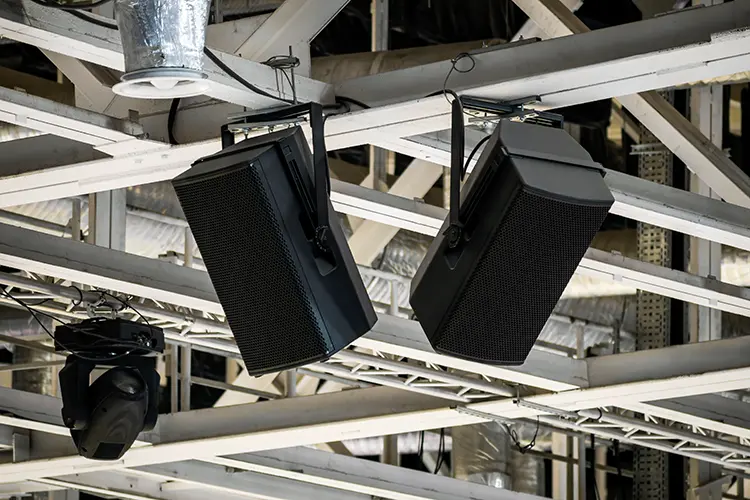
In addition, the development of zoned systems in VIP and hospitality areas is enabling segmented communication, adaptation of content to different audience profiles, and improved experience in high-value zones.
ROI
Investment in audio is beginning to be measured in return, not cost. This shift in approach is key. A well-designed system allows:
- improving the spectator experience
- increasing the effectiveness of commercial communication
- expanding the uses of the venue
- reducing operational incidents
Ultimately, it turns audio into an asset that directly contributes to the stadium’s profitability.
Decision-making
Upgrading stadium audio is no longer about replacing equipment—it is about redefining the system. Current decisions must be based on much broader criteria than purely technical ones. Actual performance, flexibility, AV and IT integration, scalability, and return on investment are variables that are part of the analysis. This requires a cross-functional approach involving technical, operational, and strategic profiles.
Stadium audio has changed category. It is no longer a secondary element, but a determining infrastructure in the spectator experience and in the venue’s exploitation capacity. In an environment where everything is measured and compared, sound quality is not an added value—it is a requirement.