

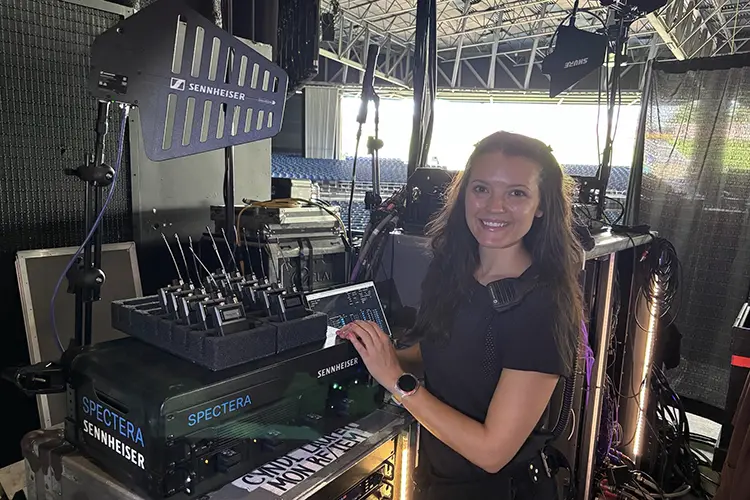
In the demanding world of live music, where technical precision is paramount, radio frequency (RF) coordinator Shannon Fitzpatrick has quickly become one of the rising stars in the industry.
For Cyndi Lauper’s farewell Girls Just Want to Have Fun tour, Fitzpatrick is not only tackling the complex RF challenges of a multi-city tour but also revolutionizing workflow by leveraging Sennheiser’s cutting-edge technology: the new Spectera system, which is laying the foundation for the future of wireless audio.
Fitzpatrick’s path toward studio sound was anything but conventional. Her passion for music began after a stint in a Led Zeppelin cover band and an internship at a recording studio, where she was often seen doing everyday tasks—cleaning studios and serving coffee. But it was a job prepping drums for a live concert that awakened her true calling.
I started to wonder why I was sitting in a studio when I had found a part of the industry that seemed so much better. And it was way cooler, recalls Fitzpatrick.
She transitioned from studio work to live production, learning the ins and outs of the craft on the road. In an industry often dominated by men, Fitzpatrick says her success was based on a simple philosophy: self-advocacy. “In this industry, you definitely have to stand up for yourself”, she says. “If you want to learn something, you have to tell people you want to learn it and do it. My motto is: Throw me into the fire, I’m ready!” Fitzpatrick has maintained this mindset throughout her career, working with legendary artists like Journey and on a recent tour with Halsey.
Fitzpatrick’s rise continued with high-profile tours, from a one-truck tour with Elvis Costello to the massive Game of Thrones in the Round production, which featured a 29-truck show. Despite the scale, the main challenges of live audio remained constant. On previous tours, she faced intermodulation issues and signal dropouts with the large amount of equipment required. Her daily workflow involved a meticulous and laborious process—manually walking the stage with multiple receivers to check coverage, a task she describes as inefficient and stressful.
As the world’s first bidirectional broadband digital wireless ecosystem, Spectera not only solves the technical challenges of RF coordination but also enhances the artistic experience for everyone on stage.
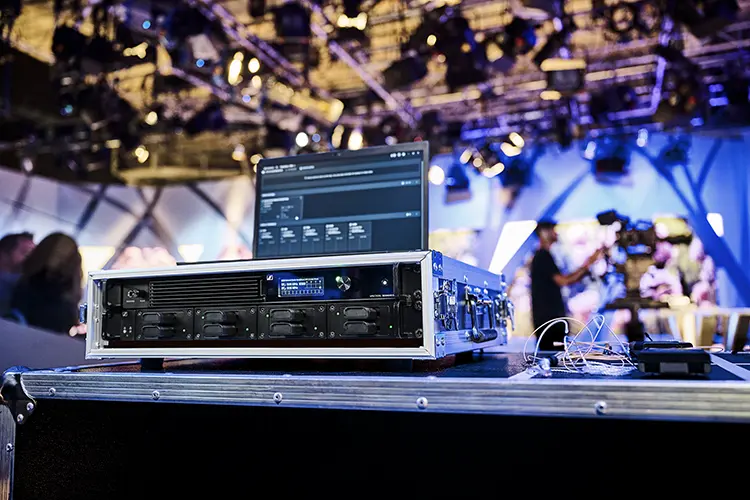
For Cyndi Lauper’s tour, Fitzpatrick began integrating Sennheiser’s Spectera—the world’s first bidirectional broadband digital wireless ecosystem—offering audio professionals unmatched capacity and flexibility. The results have been revolutionary, directly solving the challenges she previously faced. A single, compact Spectera base station replaced an entire rack of equipment, including antenna combiners and complex cabling.
It’s empowering to completely reinvent the process. I no longer have to carry the antenna combiner or the rest of the heavy gear. Thanks to Spectera, my job has become so much simpler!, she explains.
This system, which began shipping earlier this year, is the first to incorporate the new WMAS framework, approved by the FCC, placing Fitzpatrick among the first to adopt it. Her involvement reflects a forward-thinking vision and a clear commitment to the advancement of audio technology. By adopting this emerging standard at such an early stage, Fitzpatrick demonstrates the initiative and technical leadership that continue to shape the future of audio.
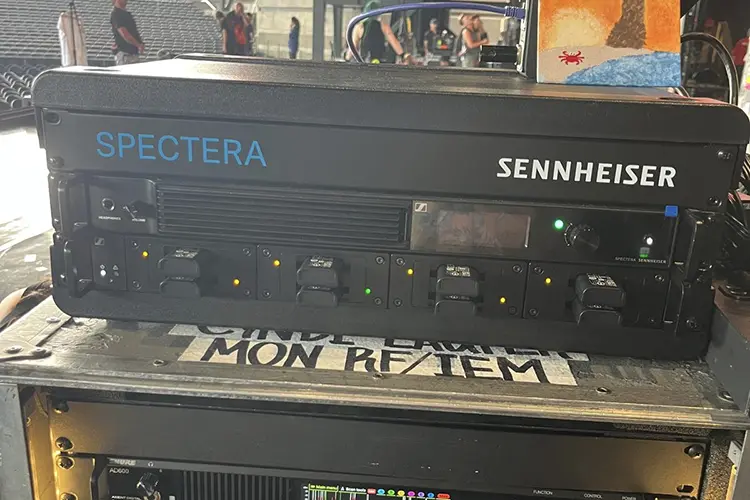
The system’s broadband technology allows frequencies to be placed even in the most complex environments without interference. “I set it up over a much higher noise floor than I’d ever be able to with a traditional system and didn’t have a single issue”, Fitzpatrick says about a challenging venue in Boston. Spectera also saves her a great deal of time.
The single-pack test function of Spectera has also saved her countless hours.
Instead of walking the stage with multiple packs on different frequencies, Fitzpatrick can now use a single pack to verify system coverage. She described the relief of this new process: “I’m going to sync this pack on a single frequency. I don’t have to sit there syncing every unit. I just change the battery, turn it on, sync it, and I’ve tuned almost all of them with one—it's amazing. I love that part. I save 30 minutes a day that I can dedicate to more important tasks”. On a tour production of this scale, where the crew only has limited time each day before the show to set up and test equipment, every minute counts.
The impact of the Spectera system is evident not only in its ease of use for Fitzpatrick but also in Lauper’s band’s onstage performance, as the musicians have noticed a significant improvement in the clarity and quality of their mixes. The backing vocalists were the first to switch and immediately praised the clean sound and low noise floor, describing it as “night and day” compared to their previous setup. Other musicians also noticed the difference, including the band’s bassist.
He commented that the way he can now hear gives him a sense of having more space for everything. He said he doesn’t need everything at full volume because he can distinguish what’s going on. Our percussionist felt the same way—she can finally hear and feels everything is in its place. I’m thrilled they love this solution!, Fitzpatrick shared.
By providing a reliable and crystal-clear audio signal, Spectera has not only solved the technical challenges of radio frequency coordination but has also elevated the artistic experience for everyone on stage. Ultimately, Fitzpatrick believes that the key for engineers is to trust their gear. When asked for advice, she simply says: “Just do it. Don’t be afraid”.
With the passion to create a memorably captivating experience for her audience, Shannon Fitzpatrick proves that with the right technology and unshakable drive, magic can be made.
“What I love most about my job is creating an atmosphere where people can escape. I feel that’s what we do: we offer a bit of magic that can’t always be explained. I love what I do—and I love what Spectera does too”.