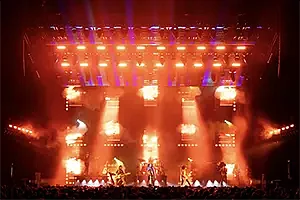

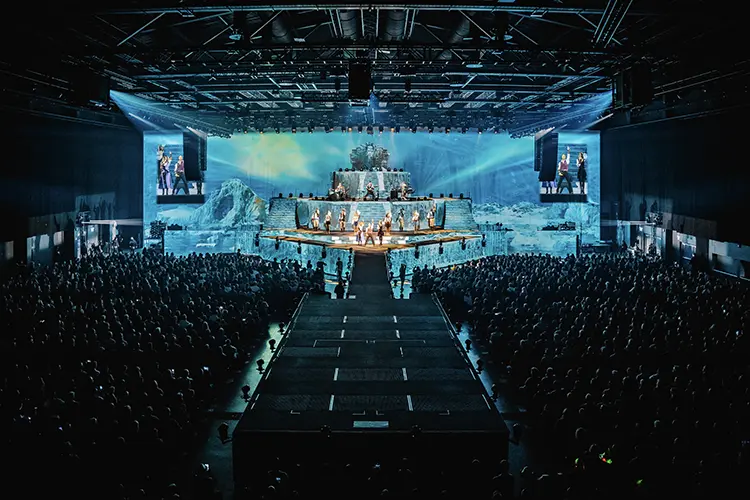
Swiss singer and producer DJ BoBo returns with a new tour, The Great Adventure, which will visit 28 European cities starting on May 1. As is tradition, he premiered the show with several sold-out concerts at Europa-Park Rust ahead of the official tour launch, and 2026 was no exception.
In Rust, his technical team —Andre Mussong (FoH), Benni Mengler (monitors) and Jens Bublitz (backline)— tested Sennheiser’s bidirectional wideband Spectera system.
As Mussong recalls, they first learned about Spectera through their Sennheiser contact Chris Kopp, and used the tour rehearsals to adopt it as their in-ear system. Mengler immediately highlighted the fast setup, easy frequency coordination and excellent audio quality.
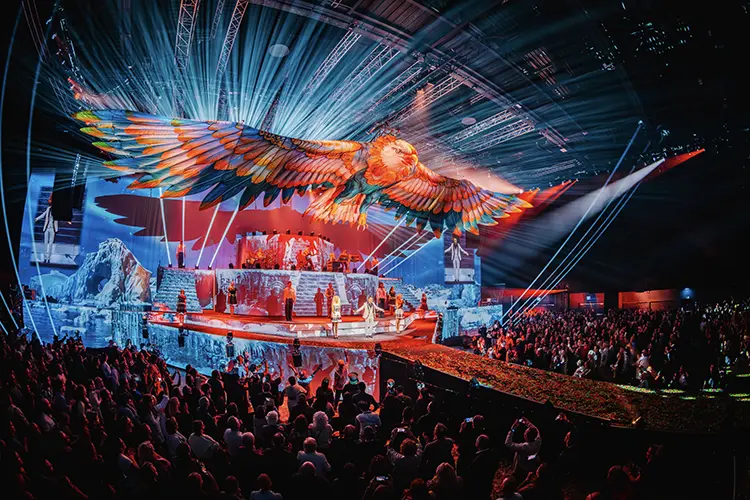
Everyone on stage uses Spectera SEKs: dancers, gymnasts, singers and band. We are running 26 Spectera SEKs as IEM receivers and one additional unit as a line transmitter for the acoustic guitar, which is used in two songs, explains Mengler.
Jens Bublitz adds that with the previous guitar transmitter, the guitarist would lose connection when moving to the B stage, so they used an additional SEK bodypack as an instrument transmitter. “Spectera performs much better in terms of RF signal transmission. I didn’t notice any loss in sound quality either—quite the opposite”, says Bublitz.
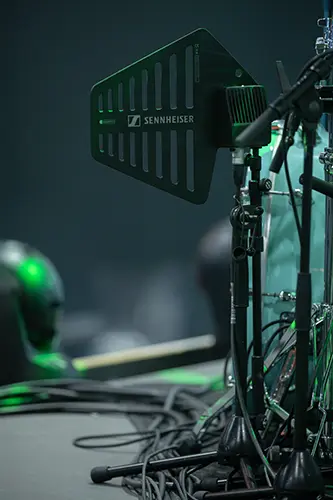
To cover the wide A and B stages, the IEM setup includes three DAD antennas: one in the monitor area on stage left, one on stage right near the band, and one on the B stage.

All in one wideband channel
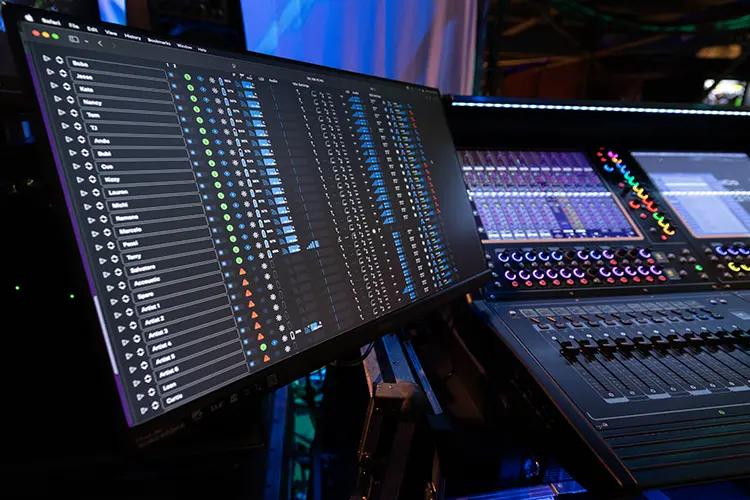
Mengler runs a total of 12 stereo IEM mixes (plus the acoustic guitar mic) via MADI at 96 kHz in a single wideband channel with a center frequency of 490 MHz. He uses “Live Low Latency” mode for the band and singers, while dancers and crew operate in “Live” mode. “Everything runs within a single 8 MHz RF wideband channel, so we are using the base station at 100%”.
Asked how Spectera has changed his monitor setup workflow, Mengler explains: “The most important thing for me is how quickly you can scan, set the center frequency and have all SEKs join the new setup simply by switching them on. There’s no need for infrared synchronization, and the Spectera WebUI is very clearly structured”.
 |
 |
Mengler also paid special attention to maintaining distance between the new digital and existing analogue equipment:
We use analogue SKM 2000 handheld microphones, some of them customized. If they are too close to digital transmitters, noise can occur in the analogue receiver. So we made sure the digital SEKs were worn on the opposite side of the hand holding the microphone or on the artist’s back to avoid interference.
Greater monitoring comfort
Mengler adds that “the band and crew felt completely relaxed even after several hours of listening with in-ears.
 This is one of the main differences we noticed with Spectera. We tried different modes to find what best suited our needs, and everyone is really happy with the sound. We combined Spectera with a KLANG immersive IEM processor, which opened up a whole new listening experience. For the band, Spectera made a big difference, which is why the production invested in it”.
Bublitz comments: “As a backline technician on the side position, I found the Spectera sound very pleasant, without the dropouts or ‘noise’ that sometimes occurred with our analogue gear. This allowed me to focus much better on the musicians’ tracks”.
For ambience, Mengler uses two different microphones on each side of the stage: a shotgun mic for narrow capture and a cardioid Sennheiser MKH 40 for wider pickup.
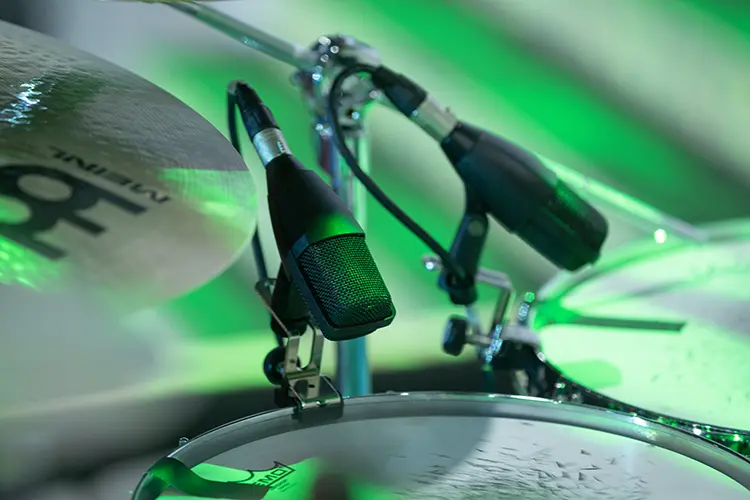
The drum kit was equipped with: one e 901 for kick drum, four MD 421 for toms, two e 905 on snare, one e 914 on hi-hat, and two MK 4 as overheads.
FoH system
FoH engineer Andre Mussong highlighted that artists feel comfortable with Spectera:
It gives them more confidence. With Spectera, artists can rely on what they hear and perform better. We also used Spectera for the acoustic guitar and it worked perfectly. We’re now looking forward to trying the upcoming handheld microphone. Being able to integrate microphones, instrument inputs and in-ears into a single wideband channel and one device will allow us to travel with a single 19”, 1U unit for one-off shows. A durable protective pouch for the SEKs used by dancers and artists would also be useful. For us as engineers, Spectera saves space and time. In addition, both sound quality and overall performance are top-notch. Spectera marks a new starting point for RF transmission in live entertainment.
Sennheiser wireless equipment and microphones
- 1 x Sennheiser Spectera base station with 3 x Spectera UHF DAD antennas
- 27 x Sennheiser Spectera SEK (26 x IEM, 1 x mic for acoustic guitar)
- 3 x Sennheiser EM 2050 twin receivers with 2 x Sennheiser AD 3700
- 6 x Sennheiser SKM 2000 handheld microphones with MMD 935 capsules (two standard, two decorated with black crystals, two gold-plated with gold-plated heads)
- Drums: 1 x e 901, 4 x MD 421 Kompakt, 2 x e 905, 1 x e 914, 2 x MK 4