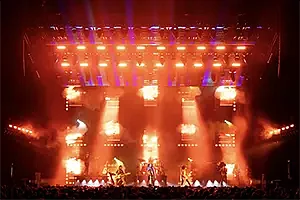




For Vanessa Paradis' 2026 tour, the audio team led by monitor engineer Matthieu Speck has adopted Sennheiser's Spectera wireless ecosystem, including the new SKM handheld transmitter.
The tour covers an attractive mix of major arenas, indoor venues and festivals, so the team was looking for a system offering reliable performance, stable RF and transparent audio—ultimately, one capable of inspiring complete confidence in the artist from the very first soundcheck.
The tour setup includes two Sennheiser Spectera Base Stations, complemented by a backup unit, and 28 SEK bodypacks. Two Spectera handheld transmitters are used for vocals, while the in-ear monitoring system operates at 96 kHz. Eight Neumann MCM 114 clip-on microphones capture percussion and the brass section, while four MKH 8018 stereo shotgun microphones capture audience ambience.
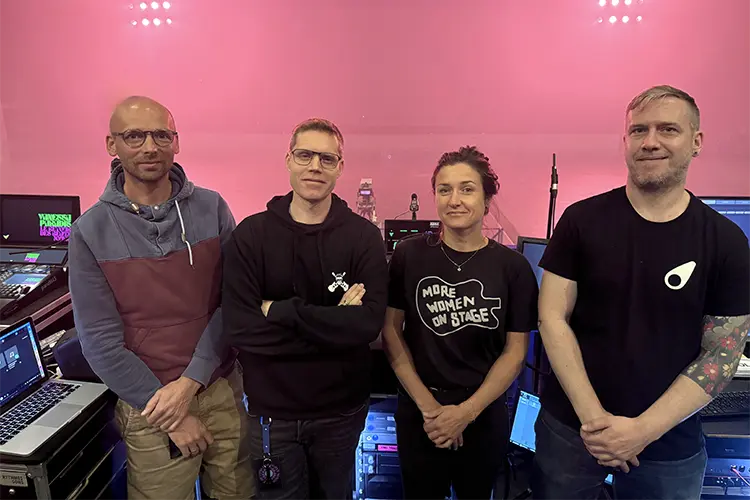
Alongside Matthieu Speck on monitors, Vanessa Paradis' audio team includes Julien Decarne (FOH), Nelly Robert (RF) and François Kerjan (sequencing).
Adecision driven above all by confidence
For Matthieu Speck, the main challenge was integrating a new technology into a high-level live production. In Vanessa Paradis' case, having performed with wired microphones throughout her career, switching to a wireless microphone represented a significant change.
Vanessa has sung with wired microphones throughout her career; this is the first time she has agreed to use a wireless microphone on stage. Quality and reliability are absolutely essential, says Speck.
This level of expectation defines the tour's approach. Spectera is regarded as a solution that safeguards the connection between the artist, the musicians and the production crew, ensuring continuity in an environment where every show presents its own unique challenges.
Simpler, faster RF management
One of Spectera's key advantages lies in its wideband technology (WMAS), which enables bidirectional audio and control data to be transmitted within a single RF channel using time slots. This replaces the traditional frequency coordination method and significantly simplifies system setup and operation.
"Sennheiser's WMAS technology replaces the traditional frequency plan. It's a stable and far more intuitive approach", explains Speck.
The time savings offered by wideband technology become particularly evident when systems must be deployed quickly, especially at festivals. Nelly Robert, the tour's RF engineer, benefits from a much simpler workflow for both RF configuration and the preparation of bodypacks and microphones. Eliminating repetitive manual synchronisation allows the team to focus on stage management, soundchecks and critical listening.
RF stability proven in real-world conditions
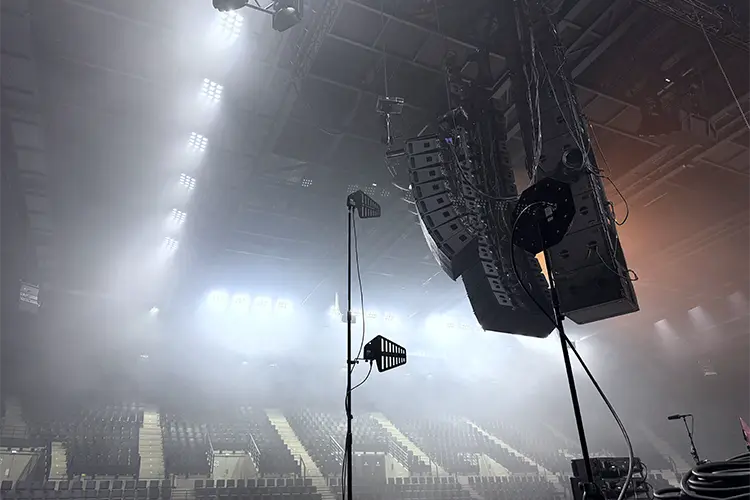
The tour uses the system in a wide variety of environments: large venues, festivals, coexistence with other wireless systems and constant venue changes. In this context, RF robustness is a critical factor.
Speck highlights the range and reliability he has already experienced throughout the tour: "Spectera's links are even more robust than we expected before the tour began. The range is outstanding—even at the very top of the Zénith in Lille, France, we were unable to lose the connection, whether using the SKM handheld transmitter or the SEK bodypack".
The system also operates flawlessly alongside the SK 6000, which is used for backline communications, confirming its ability to integrate into a complex RF architecture without compromising operational reliability.
Greater freedom for the musicians, total control for the engineer
On stage, ease of use plays a key role in the acceptance of a new wireless system. Thanks to the SEK bodypacks, musicians can make the most important adjustments themselves, reducing the workload of the technical crew.
This autonomy does, however, have its limits thanks to the Remote Lock function, which allows Nelly Robert to remotely lock critical functions during the performance. In this way, the system strikes a balance between user freedom and operational security: musicians enjoy greater convenience while the engineer retains full control over the essential parameters.
96 kHz in-ear monitoring: a new level of precision
In-ear monitoring is one of the areas where the difference is most noticeable. For Speck, audio quality now remains intact all the way through the entire signal chain.
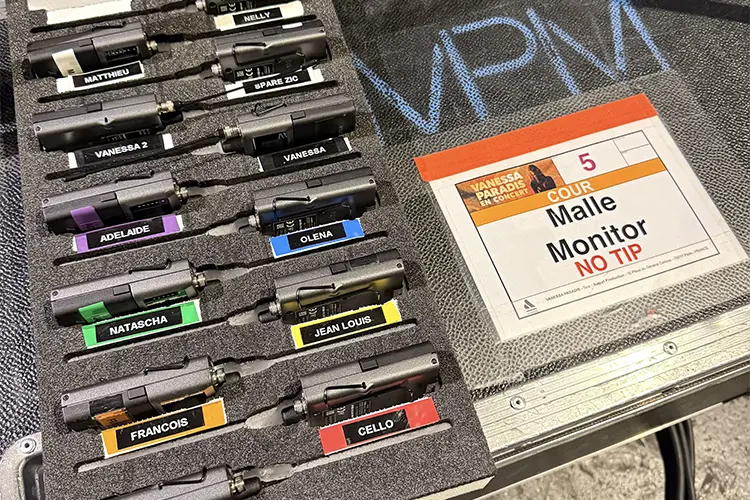
Before Spectera, the weakest link in the audio chain was the wireless transmission of the in-ear monitoring system. We're fortunate to have outstanding mixing consoles and high-performance tools at every stage, and now we can preserve that quality all the way to the end of the signal chain. It's a major step forward.
The 96 kHz digital transmission delivers greater definition and a more accurate stereo image. Speck compares this evolution to moving from standard-definition video to the sharpness and detail of 4K.
However, this transparency also brings greater demands: the system reveals absolutely everything it receives. As a result, precision is no longer simply a comfort for the artists—it also becomes a responsibility for the monitor engineer.
The MKH 8018 recreates the connection with the audience
For Vanessa Paradis, in-ear monitoring should never isolate her from the audience's energy. That's why ambient pickup plays an essential role, achieved through four MKH 8018 stereo shotgun microphones.
The audience seating areas are captured using two MKH 8018 microphones configured in narrow XY stereo, while the standing area is covered by another two MKH 8018 microphones set to wide XY stereo. This configuration recreates a natural and coherent sound image of the venue without compromising mix clarity. "I've never achieved such a coherent ambient pickup before—it has improved tremendously", comments Speck.
MCM 114 for Percussion and Brass
Instrument pickup is handled by eight Neumann MCM 114 microphones, used on congas, bongos, saxophones and trombone. These sound sources are particularly demanding due to their dynamics and frequency response, which is why FOH engineer Julien Decarne carried out extensive testing during rehearsals.
Combined with the SEK bodypacks, the MCM 114 microphones deliver accurate, detailed and musical reproduction without sounding harsh. This consistency throughout the signal chain—from microphone capture to wireless transmission and monitoring—directly enhances the musicians' listening experience.
The rental company's perspective: meeting real-world production needs
MPM AUDIOLIGHT, the technical supplier and rental company for Vanessa Paradis' tour, believes Spectera provides a practical response to the real-world needs of productions, sound engineers and technicians.
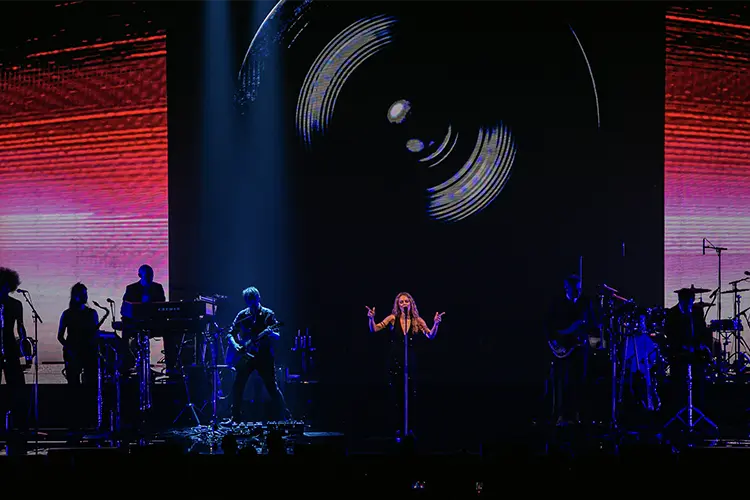
David Nulli, Chief Operating Officer of MPM AUDIOLIGHT, explains that investing in Spectera is part of the company's strategy to remain at the forefront of audio technology and reflects the confidence it has placed in Sennheiser products for many years:
"Spectera generated tremendous interest among our customers from the moment it was launched. Given the confidence we've always had in the quality of Sennheiser products, we had no hesitation in investing in the solution at a very early stage".
MPM AUDIOLIGHT also benefits from operational advantages, including faster warehouse preparation, simplified setup and more efficient deployment on site. These time savings give the crew greater peace of mind, allowing them to focus on the real challenges of each production.
David Nulli believes Spectera is set to become the new benchmark for the most demanding productions, thanks to its flexibility, reliability and alignment with the expectations of the high-end professional audio market.
The Pioneer Program: a direct link between real-world use and development
Vanessa Paradis' 2026 tour is part of the Spectera Pioneer Program. For Speck, the programme has established a direct dialogue between touring engineers and Sennheiser's development teams.
Thanks to the Spectera Pioneer Program, we maintain direct contact with the software development team. It has removed the barrier that traditionally existed between the brand's development engineers and the engineers and technicians working in the field.
This exchange, particularly through Discord, makes it easier to share feedback from the field, implement improvements and gain a better understanding of real operational requirements. The speed at which new software versions are released—such as version 1.3, which can be installed in just a few minutes—reinforces the impression that Spectera has been designed to match the pace of modern live productions.
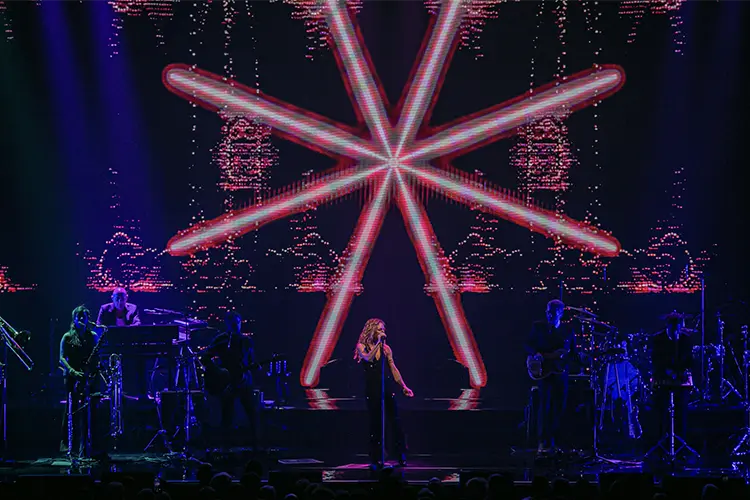
When technology becomes invisible
Ultimately, the most important validation comes from the artist herself. Vanessa Paradis was convinced from the very beginning by the sound quality of her in-ear monitoring system, confirming that Spectera had achieved its primary objective: building confidence. "Once you achieve that, you create trust. My goal is for Vanessa to enjoy being on stage—that's when I know I've done my job well", says Speck.
Julien Decarne also highlights Spectera's sonic performance: "Vanessa's voice is clear and precise. This allows me to maximise intelligibility and ensure that every word is perfectly understood by the audience".
On Vanessa Paradis' 2026 tour, Spectera stands out by streamlining the technical team's workflow, giving musicians greater independence and making the artist feel more comfortable on stage. In the world of live sound, it is precisely when technology becomes invisible that it demonstrates its true value.