


Tootsie’s Orchid Lounge, one of the most historic names associated with country music in the United States, has expanded its presence with a new venue in Panama City Beach, Florida.
The project is based on an unusual premise for a hospitality venue: bringing a concert-like sound experience to the establishment, while maintaining controlled and consistent coverage throughout its different areas.
The new venue draws inspiration from the renowned Tootsie’s Orchid Lounge in Nashville, but presents a different technical scenario. In addition to live performances, the system must accommodate a wide variety of uses throughout the day, ranging from dining and background music to sessions requiring higher sound pressure levels, while also extending coverage to the venue’s outdoor areas.
To achieve this, the production team selected a solution based on several systems from DAS Audio’s ARA Series. The design was developed by Mark Zuckerman, Production Director at Tootsie’s Orchid Lounge, in collaboration with DAS Audio and the company’s Senior Sales Engineer, Carlos Henao.
A hybrid system for different areas and sound pressure levels
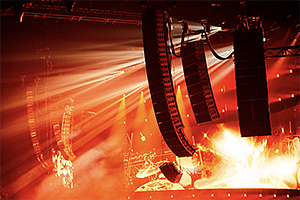
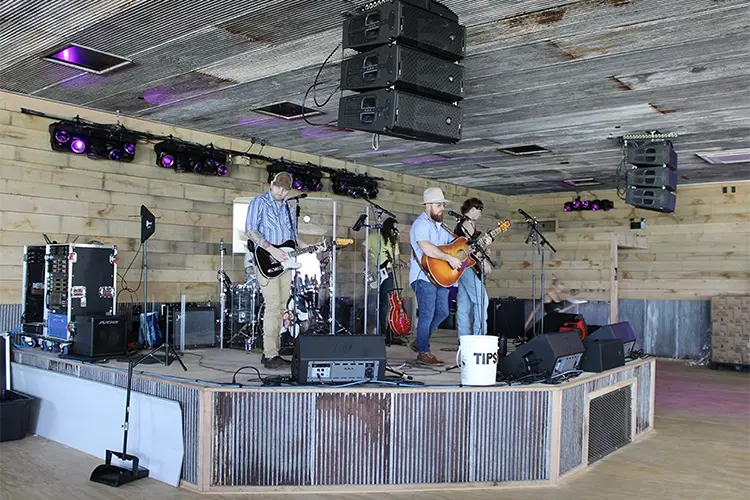
The installation combines SARA-100 line arrays as the main system with SARA-SUB and LARA-SUB subwoofers for low-frequency reinforcement. These are complemented by ARA-M210 stage monitors and ARA-P28 point source systems, used as front fills and to extend coverage to the outdoor areas.
This combination allows the installation to adapt to an increasingly common requirement in hospitality and entertainment venues: a single system must provide intelligibility and balance at moderate levels for much of the day, while also delivering sufficient dynamics and sound pressure levels when the space operates as a live music venue.
SARA-100 is a compact, powered line array designed for medium-sized installations and events where consistent coverage is a priority. The system features a symmetrical architecture and is designed to achieve high sound pressure levels while maintaining a relatively compact format.
At low frequencies, the use of cardioid systems is particularly important. SARA-SUB uses an 18-inch and 15-inch configuration designed to reduce rearward radiation; DAS specifies up to 14 dB of rear attenuation between 40 and 80 Hz. This feature helps control low-frequency build-up on stages and in areas not intended for the audience, which is especially relevant in installations with multiple areas of use.
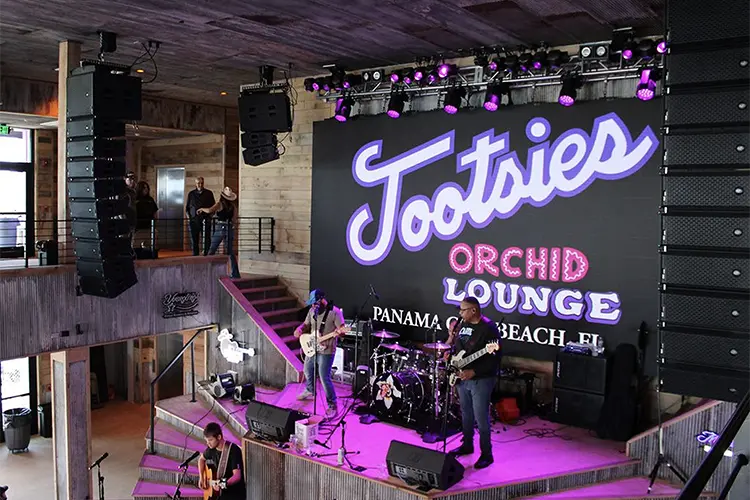
The ARA-P28 systems complete the coverage in areas where the main system requires additional support, while ARA-M210 systems handle stage monitoring. The latter feature a 2 x 10-inch configuration with a 3-inch compression driver and an asymmetrical vertical dispersion pattern designed specifically for monitoring applications.
From restaurant to concert without changing systems
One of the project’s most interesting aspects is its operational approach. Tootsie’s was not simply looking to install a PA system for performances, but rather to create an infrastructure capable of supporting the different situations that occur at the venue each day.
According to Mark Zuckerman, the goal was to allow guests to dine, converse or attend a performance while enjoying a consistent sound experience. The system also needed to accommodate everyone from local musicians to touring artists and provide coverage throughout the venue’s outdoor areas.
From an integration perspective, the project demonstrates the growing convergence between installed audio and solutions traditionally associated with touring. Entertainment venues with regular music programming increasingly require systems capable of operating as permanent infrastructure without sacrificing the performance, directivity and dynamic capacity required for live productions.
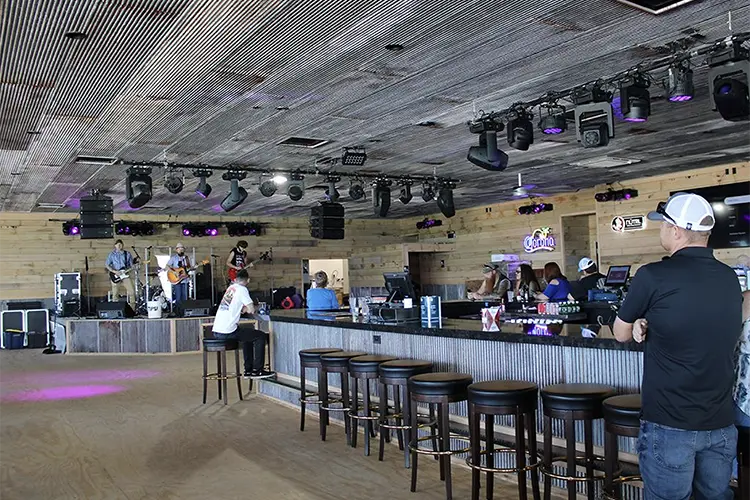
In Panama City Beach, this philosophy translates into an architecture that combines a main system, cardioid low-frequency reinforcement, front fills, outdoor coverage and monitoring within a single technology family.
The installation reflects a growing trend in hospitality and entertainment: viewing the audio system not as an auxiliary element of the venue, but as a fundamental part of the overall experience.