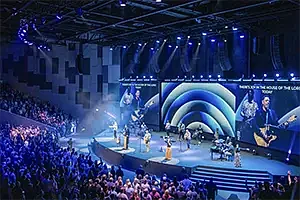


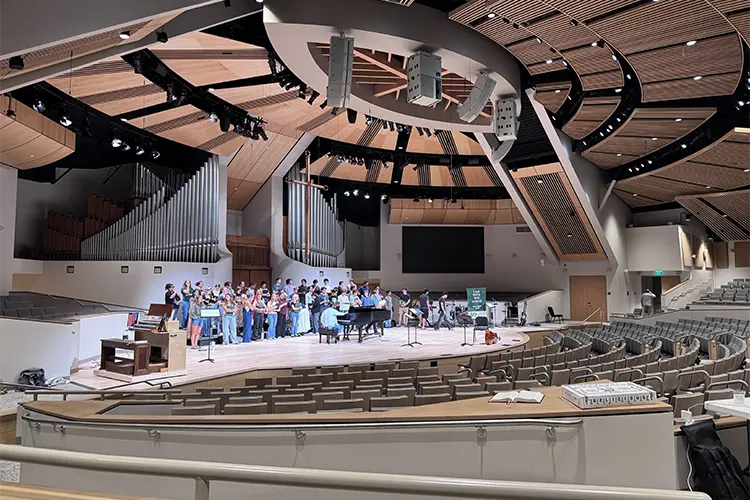
The CU Center at Concordia University Irvine has retained its iconic architectural shape and doubled its seating capacity thanks to the ART active acoustics system from Amadeus, which allows the space to accommodate everything from an intimate sermon to a full symphony orchestra.
The team behind the project will explain how they achieved this in a free webinar on November 12.
Preserving an iconic building
The CU Center, located in Orange County, California, has been at the heart of campus life at Concordia University Irvine since the 1980s, but its facilities had become too small. The original hall seated around 350 people, and its cone-shaped ceiling, circular floor plan, glass surfaces and hard reflective materials created a highly reverberant acoustic environment that was difficult to control.
Constructing a new building with a different geometry would have been the simplest solution, but the CU Center is an architectural landmark on campus, and Concordia wanted to preserve it. The goal was to retain its distinctive profile, expand the space and achieve suitable acoustic conditions for uses ranging from spoken sermons to full choirs and organ performances.
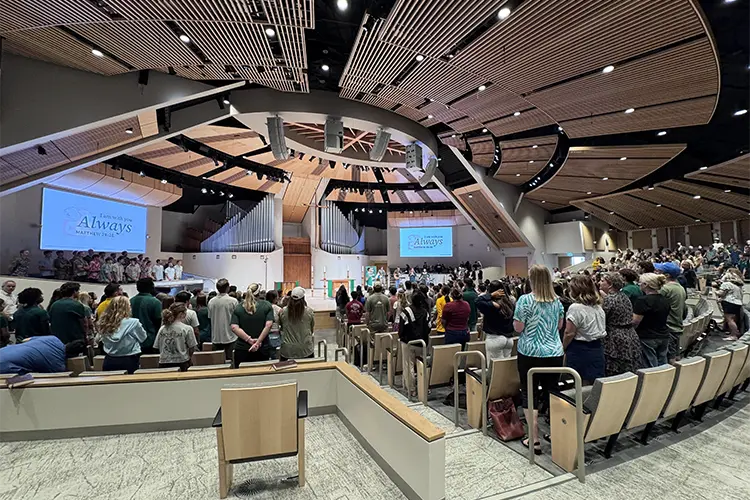
The building was essentially divided in two. The stage half was retained, while the audience area was completely dismantled, rebuilt and extended. The floor area increased by more than 560 m², and seating capacity rose from approximately 350 to 700 people. The renovation also made it possible to enlarge the stage and incorporate choir lofts for 110 singers into the platform.
A dry acoustic environment with active acoustics
What the new hall could not change was its geometry: circular spaces tend to focus sound, and there was no way to eliminate this behaviour through architectural design without compromising the building's identity.
During construction, Tim Odle, Vice President of University Operations, explained to the student newspaper that, unlike Concordia's other halls, this one had been designed so that "electronics create the acoustics".
The hall's natural acoustics were deliberately designed to be very dry, using absorption and diffusion treatments to achieve a reverberation time of approximately 1 second at mid frequencies and 0.8 seconds at low frequencies.
Building on this foundation, the Amadeus ART system creates the acoustic conditions required for each activity. Its capabilities go beyond simply adding reverberation, allowing the room's acoustic geometry to be virtually reshaped using the geometric approach developed by Amadeus.
Today, the same circular space can transition from an intimate worship service to a concert featuring a full symphony orchestra simply by selecting a preset.
The opening weekend established the CU Center as a premier concert hall and a community-connecting worship centre, with impressively natural-sounding acoustics, says Dr. Jeff Held, Assistant Dean and Director of Arts at Concordia University Irvine.
The webinar
Active Acoustics for Education and Worship is a free 60-minute webinar taking place on Thursday, November 12, 2026, at 17:00 CET.
Aimed at consultants, integrators, music educators and those responsible for houses of worship or university facilities, it will cover the following topics:
- Why Concordia decided to preserve its iconic building and why active acoustics was the only viable solution to make the 700-seat hall work effectively.
- How the system went beyond reverberation to virtually reshape the room's acoustic geometry.
- How to configure presets around the way a venue actually operates, allowing staff and volunteers to use them easily in their weekly activities.
- What could only be identified during the second acoustic tuning phase, once the venue was in regular use.
Speakers:
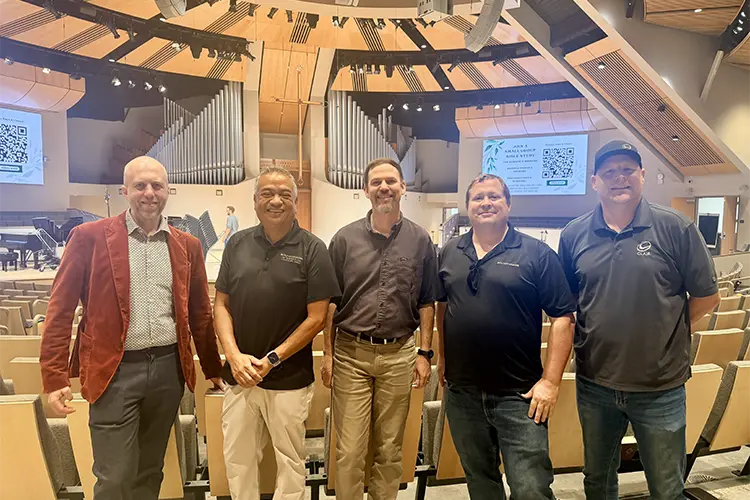
- Dr. Jeff Held, Concordia University Irvine.
- Jeff Miller, Associate Vice President, Theatre & Acoustics, Salas O'Brien.
- Michael Mendoza, Project Manager, Sound Image Integration.
- Fabio Kaiser, CEO of Amadeus Acoustics.
- Thorsten Rohde, Business Development at Amadeus Acoustics.
- Volker Werner, CTO of Amadeus Acoustics.
 Instagram
 LinkedIn