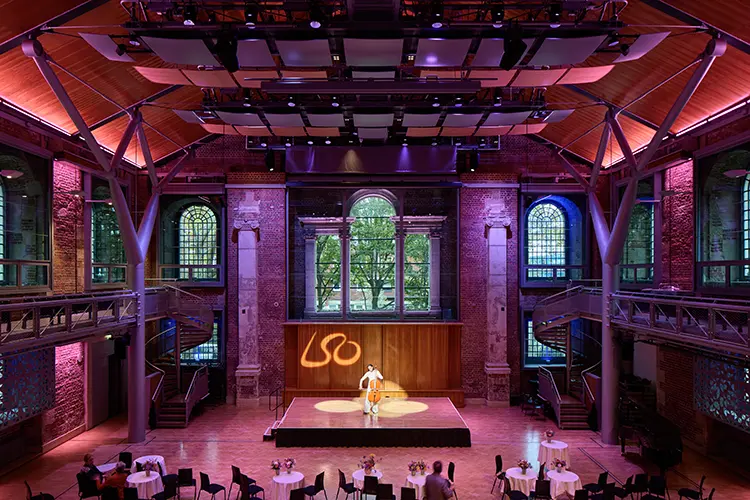
St Luke’s of the London Symphony Orchestra (LSO) has for many years been one of London’s most emblematic cultural spaces: a Grade I–listed church converted into a venue for world-class concerts, recordings, and educational activities, as well as a key pillar of the LSO’s artistic and community work.
However, after more than two decades of continuous use, the building’s infrastructure was struggling to support the scale and ambition of the activity taking place within it.
Created to modernise St Luke’s and expand its digital and technical capabilities, the Future Ready project set out to renew the venue for the next generation, with LSI Projects playing a key role in the technical transformation.
For the LSO, this refurbishment was much more than an upgrade of outdated systems: it represented the opportunity to create a space capable of supporting the orchestra’s ongoing evolution. As Sabina Noble, Venue Manager at LSO St Luke’s, explains:
This redevelopment builds on more than 20 years in which the venue has been a home for performance, recording and LSO Discovery, supporting our artistic activity, digital output and community reach. Rethinking the venue from the inside out has opened up opportunities for the orchestra that simply didn’t exist before.
The existing lighting, sound and AV systems had reached the end of their lifespan, kept operational only through a series of small fixes over time. The Future Ready project allowed the team, together with Theatre Projects Consultants and LSI, to step back and redesign these systems from the ground up. Much of this work focused on Jerwood Hall, the venue’s main performance space and the beating heart of St Luke’s. Here, Theatre Projects created a unified performance, worklight and houselight system, integrating production lighting with architectural and emergency lighting designed by Max Fordham.
The new system allows seamless switching between ETC Paradigm and the LSO’s own lighting desk, giving the team exactly what they need: subtlety for small ensembles, power for full orchestras, and the confidence that whatever is happening on stage, the room will respond appropriately. But the technical transformation extended far beyond lighting. As St Luke’s evolved into a hub for recording and live streaming, its ageing audio system increasingly became a limitation. The refurbishment addressed this with new containment and cabling throughout the building, a dedicated audio control room built to professional studio standards, and a digital editing suite that now also functions as the camera-control gallery for streamed and recorded events. These improvements enable faster turnaround times, smoother workflows and a building capable of keeping pace with everything the LSO wants to deliver.
As systems integrator for the project, LSI was responsible for the complete technical installation across the building. Its scope included the integration of lighting control and power management systems; networked audio, sound and communications infrastructure; digital intercom and assisted listening systems; venue-wide paging; and video relay and production systems, along with extensive new fibre, data and signal cabling, the fit-out of the new Audio Control Room and Master Control Room, and full testing and commissioning of the upgraded systems.
Naturally, a building of this age and status presented significant challenges: extremely tight containment routes, limited space and no guarantee that new cabling could be added without major intervention. With many of the original routes and shafts already saturated, accommodating the upgraded infrastructure required careful planning.
We relied heavily on the creativity of LSI’s site team to find solutions, including rerouting some of the cabling between the new equipment rooms in the basement and the clock tower. In the end, all services were successfully installed, even in the most challenging areas, while keeping the infrastructure accessible for future upgrades, explained John Riddell, Principal at Theatre Projects.
From LSI’s perspective, sensitivity, phased planning and collaboration were key to success. “Working within a Grade I–listed building meant constantly balancing technical performance with protecting the building itself”, noted Liam Hawes, Project Manager at LSI. “Close coordination across the project team and just-in-time delivery were essential, particularly given the very limited space available on site”.
The logistical complexity extended beyond construction. The venue, including instruments, staging and technical equipment, had to be relocated to storage across multiple sites. Rehearsals, recordings and Discovery sessions had to be reimagined as a mobile programme, with production systems adapted for remote use—something that was only possible through strong collaboration between all parties. “Throughout the works, clear communication was maintained between the LSO as Client, Avison Young as Project Manager, the design team, GPF Lewis as Contractor and the key subcontractors, including LSI”, said Noble. “This fluidity meant that when challenges arose, we were able to resolve them quickly and keep the project moving”.
Since reopening, the benefits of the refurbishment have been felt almost immediately. Dedicated infrastructure now separates operational and technical demands, hybrid events can be delivered more efficiently, and the building’s digital backbone enables faster transitions between activities. The reconfigured spaces also support concurrent programming—a game changer for the organisation. “In these first months back in the building, the improvements and additional capacity are already making a real difference”, Noble added. “We are now able to welcome many more people into the programme at St Luke’s, and it is wonderful to see so many benefiting from the work that has gone into this”.
The new systems have fundamentally changed how the building can be used. From streamlined video production and improved live streaming capabilities to faster setup and turnaround times, the infrastructure now supports the LSO’s technical team in delivering a much wider range of activities, often simultaneously, Hawes continued.
Acoustically, Jerwood Hall has been refined through a series of fixed overhead reflectors designed by Threshold Acoustics and specified by Theatre Projects. These improvements have increased immediacy, presence and clarity for the orchestra, helping larger sections hear one another with much greater accuracy. However, for Riddell, the new audio control room stands out above all. “It is an exceptionally well-finished space, comparable to those found in the most renowned professional studios”, he said. “It’s not just a beautiful room—it works brilliantly”.
Working within the constraints of a Grade I–listed building, LSI’s technical team translated the design vision into a robust, future-ready technical platform that now underpins all artistic, educational and digital activity at St Luke’s.
Reflecting on the project as a whole, Riddell concluded: “What stands out most is the collective effort of everyone involved. Very few performing-arts buildings are delivered on time, on budget and to an exceptional standard, but LSO St Luke’s is one of them”.