Blindness, an intense, raw and visceral work lit by Christina Thanasoula, directed by Emily Louizou and premiered at the 2025 Athens Epidaurus Festival, has won two prestigious LIT Lighting Design Awards: one in the Stage Lighting category and another in Theatre Performance Lighting.
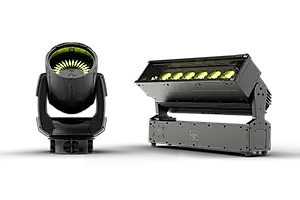
Christina’s innovative lighting design incorporated 24 Astera Titan Tubes, used to great effect and becoming a central element of the piece’s lighting aesthetic.
This was Christina’s first time submitting a project to the awards – representing the Athens-based design studio Creative Lighting – and she is delighted with the results.
Light is often invisible. Lighting designers work in the shadows with this invisible element, yet we all need to feel seen. These awards offer the opportunity for visibility to those of us working backstage. Winning the award is a great honour, and I want to give a huge THANK YOU to the entire creative and technical team who brought this show to life in just four days, racing against time, commented Christina.
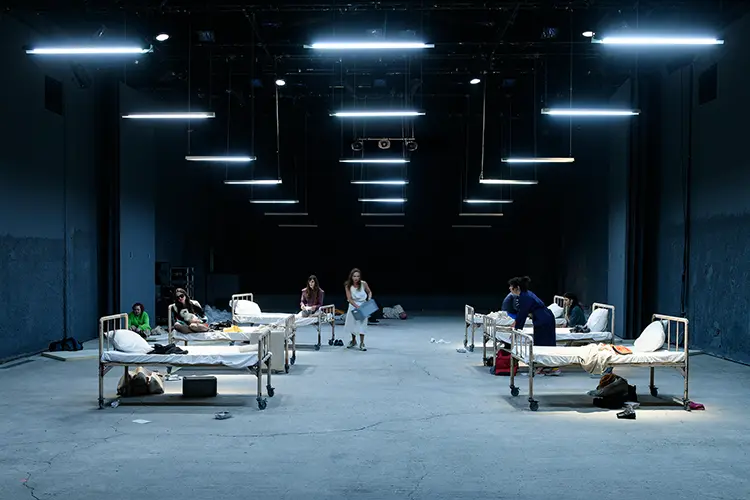
Blindness, based on the novel by José Saramago and adapted for the stage by Simon Stephens, tells the story of a blindness epidemic. The main scenographic concept involved recreating an abandoned hospital psych ward, and lighting was essential both in building the performance’s visual identity and in defining location and atmosphere.
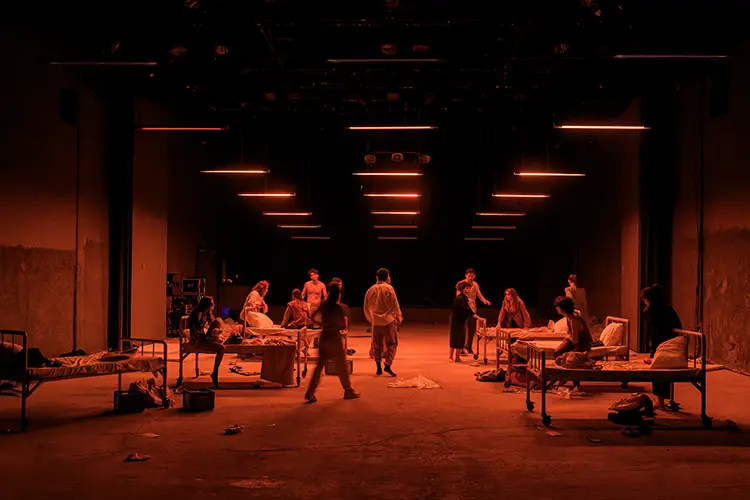
Fluorescent-style lighting —characteristic of institutional spaces— was used as the key lighting and was replicated in the theatre using the Titan Tubes. These provided the excellent light dispersion and the smooth, realistic and highly accurate colour transitions needed to support the narrative.
Since the Titan Tube has a very contemporary appearance, Christina and set designer Thalia Melissa worked together to disguise the fixtures within worn scenic housings that helped recreate the harsh ambiance of the psych ward. There, the luminaires resembled deteriorated and uncomfortable hospital fluorescents as a central part of the scenography.
The tubes were installed in three rows of seven units, enhancing the 30-metre depth of the space —Space E of a former factory, one of the festival’s main venues. This arrangement emphasized perspective, while allowing lighting movements between the rows to be synchronised with Irene Skylakaki’s soundscape, which included flickering effects adding extra layers of lighting texture.
Programming these oscillations and bursts of light was one of Christina’s favourite parts of the project.
This effect accentuated the fast and intense action of the piece, and I love it when music and light go hand in hand, she noted.
The remaining three Titan Tubes were used as floor specials.
Thanks to the versatility of Astera’s LED luminaires, light became a dominant dramaturgical element in Blindness: it created dystopian lightscapes across space and time, shaping the meaning, atmosphere and emotional impact of the performance on audiences.
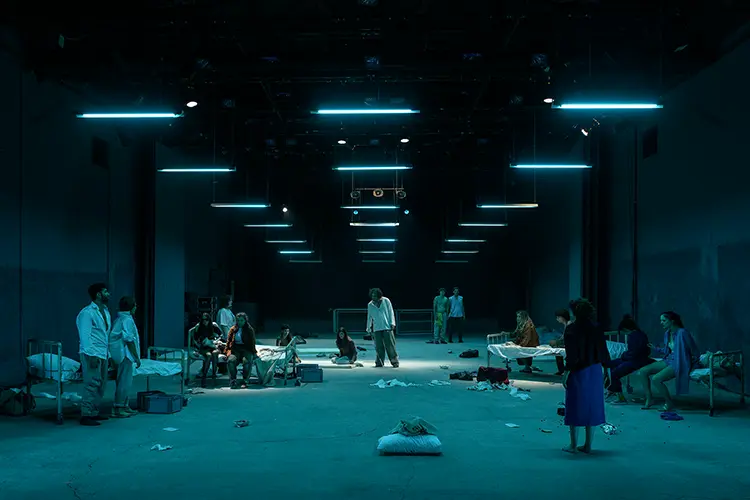
Christina recalls how another lighting designer also working at the Epidaurus Festival peeked through the backstage door, puzzled by these fluorescent-style lights that were changing colours. He came in to ask what they were… and was amazed to discover they were Titan Tubes completely transformed by being integrated into the set.
Christina’s submission to the LIT Lighting Design Awards also highlighted the sustainability aspect of using Astera luminaires.
We all live on the same planet; I find it hard to believe that anyone is not interested in sustainability. Astera offers creative tools with minimal environmental impact and allows ecological goals to be met without sacrificing creativity, she explained.
The LIT Lighting Design Awards™ –a program developed and managed by 3C Awards, a Swiss organisation dedicated to promoting international design– recognise the talent and imagination of lighting product designers and lighting professionals around the world.
The awards, spanning multiple categories, recognise lighting as both an art and a science, and as a fundamental element of design, celebrating “creativity and innovation in the fields of lighting products and applications”.
Entries were evaluated by a panel of experts across all lighting disciplines. The judging process is based on flexible criteria, constantly reviewed and adapted to meet new technical, social, economic and ecological requirements.
Each jury member is committed to providing a fair evaluation and is assigned categories according to their background and expertise. Projects are reviewed randomly and anonymously to ensure fairness.
Christina concludes: “From the beginning, I had the feeling that this project, especially its collaborative nature, had the potential to win awards. The recognition proves that, as designers, we must always be prepared to take risks and make bold creative choices that allow our work to shine”.
We are proud that the Titan Tubes have played such a central role in Christina’s powerful and imaginative lighting design. ‘Blindness’ shows how light can become a narrative force in itself, shaping space, emotion and storytelling. Christina’s ability to transform our fixtures into something so seamlessly integrated and atmospheric is inspiring. We congratulate her and the creative team for this well-deserved recognition at the LIT Lighting Design Awards, added Sebastian Bückle, Chief Strategy Officer (CSO) at Astera.
Photos by Elina Giounanli (show) and Roula Revi (portrait of Christina Thanasoula)