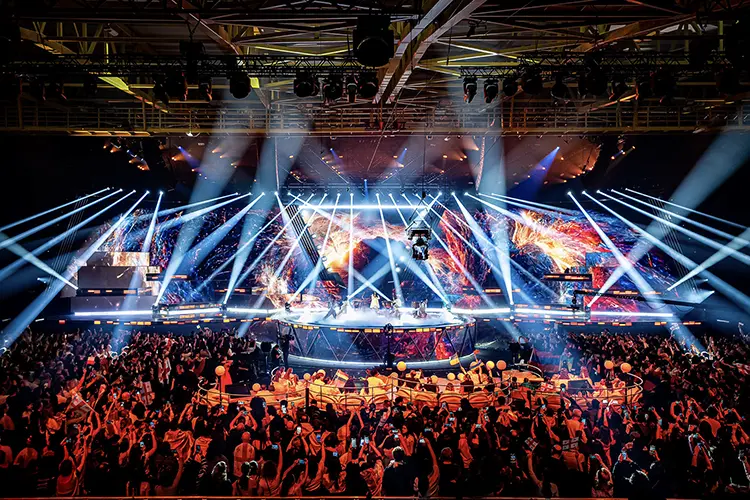
Junior Eurovision 2025 dazzled with its talent and high production values, with 18 delegations competing to win this prestigious contest.
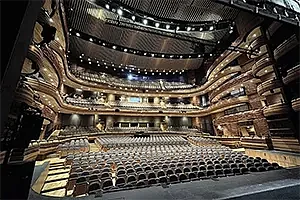
The event took place at the Gymnastic Hall of the Olympic City in Tbilisi, Georgia, organised by the European Broadcasting Union (EBU) and host broadcaster Georgian Public Broadcaster (GPB).
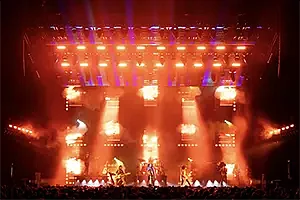
The complete stage, lighting and video concept and design was created by Raphaël Demonthy of Sunrise Studios GmbH in Berlin, who deployed nearly 300 Robe moving lights as part of a lighting rig of almost 800 fixtures.
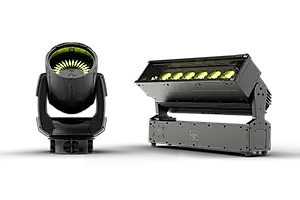
The Robe fixtures included 54 iESPRITE LTL WB, 39 ESPRITE Profiles, 26 iFORTES, 12 FORTES, 48 Spiiders, 56 MegaPointes and 36 LEDBeam 1000s.
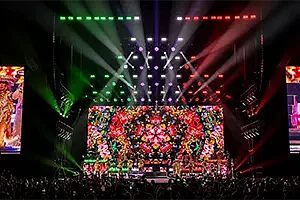
Raphaël’s FOH team was also responsible for managing content across 13 4K video outputs, distributed over different screens and stage surfaces. All of this combined to create a staging full of spectacular, unmistakably “Eurovision” moments, in a vibrant, action-packed broadcast.
The lighting equipment, together with LED screens, truss and rigging, was supplied by Bulgarian rental company ESC Rental, whose CEO, Natalie Hadad, worked with the event’s technical production manager and supervisor, Aleksandar Zdravkov, who is also CEO of ProCinema Production. This was the third Junior ESC lit by Sunrise Studios, led by Raphaël and his partner and lighting designer Chris Moylan.
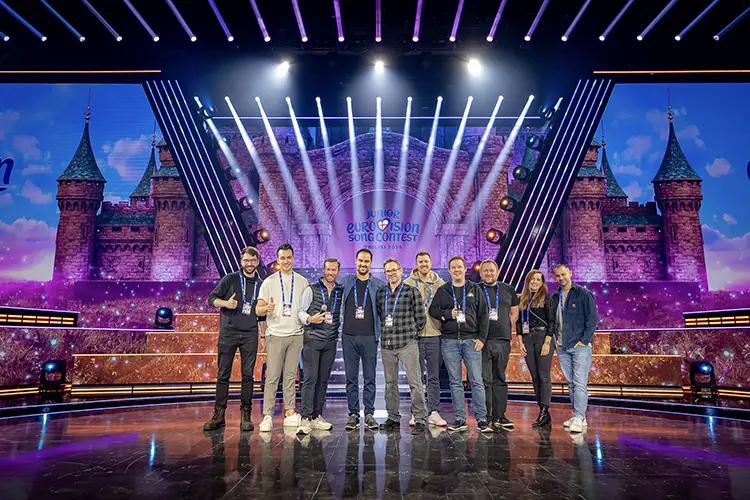
It was an even more enjoyable project thanks to close collaboration with an outstanding Georgian set design team, comprising show creative director Basa Potskhishvili, show art director Tamar Potskhishvili, show co-director David Gurgulia, and Oto Tedoradze, who oversaw the stage construction.
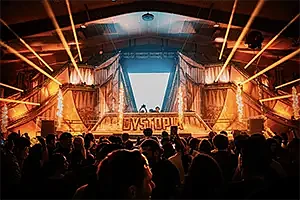
The centrepiece of the scenic setup was a 12-metre diameter “drum stage”, inspired by the famous Doli, a traditional double-headed percussion instrument at the heart of Georgian folk music. It was positioned right at the centre of the 46-metre-wide stage, with its circumference clad in video panels and lit from the top, bottom and diagonally with LED tape. In addition, three large semi-transparent LED walls were installed upstage, along with a series of multi-level, decked terraces on the left and right, adding depth and dynamics to the impressive wide-format production space.
With such a large amount of LED screen involved, Raphaël knew he would need bright, powerful and reliable luminaires, so he chose Robe products as the main moving lights.
The 54 ESPRITE LTL WB (Wash Beam) fixtures were rigged on ladders — for optimal positioning — behind the main LED surfaces, in a matrix formation.
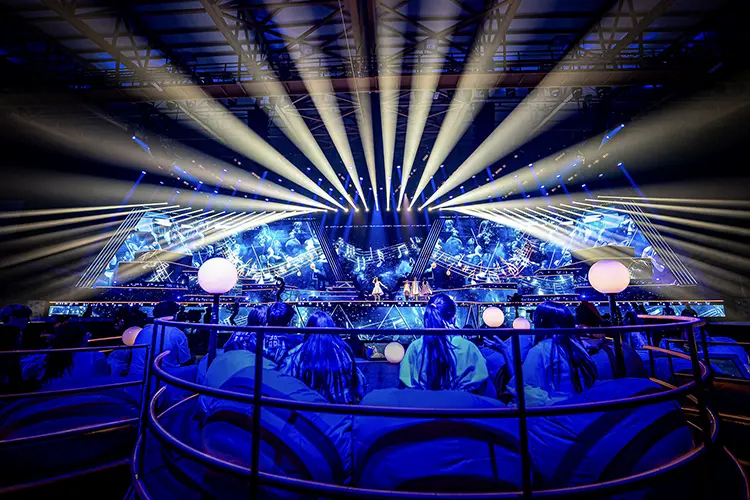
We needed a powerful luminaire, and one with a larger lens so we could maximise the 'breakup' effects requested by some delegations, explained Raphaël, adding that they looked incredible blasting through the blow-through LED.
It was the first time he had used the iESPRITE LTL fixtures on a show like this, and he was even a little surprised by the impact and punch they brought to the picture. The 39 standard ESPRITE fixtures were then distributed around the stage on the decks and around the perimeter of the drum stage, where they were used for excellent “cage effect” beams and other striking looks.
For key lighting, a combination of 26 FORTE and 12 iFORTE fixtures was used, positioned on the overhead roof trusses. Raphaël stated that the FORTE’s high CRI and the available plus/minus green and magenta adjustment filters made it possible to fine-tune the output precisely to achieve the best levels and shifts, so everything looked outstanding on TV and for the live audience… and also for those attendees who couldn’t stay off their smartphones throughout the show!
A major challenge when working in LED-heavy environments like this is finding light levels that both allow the video to perform as it should and look right on camera… and across different camera systems! “It’s essential that the screens and the lights work in harmony with the cameras”, he underlined — a delicate balancing act that was delivered with great style.
Raphaël has used FORTES and iFORTES for key lighting since the fixtures first became available, and both he and Chris are huge fans.
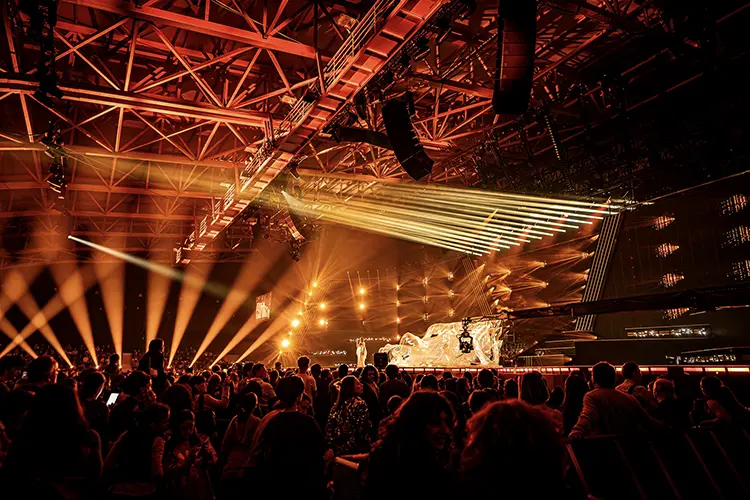
That flexibility and power is exactly what you need for great key lighting and, in this case, to meet the wide variety of requests from the delegations.
He added that it is surprising how much latitude exists in key lighting depending on the main camera systems used in different regions, and how that affects expectations.
The 48 Robe Spiider fixtures (LED wash beam) were spread across the overhead trusses and used for the main wash effects, working brilliantly, as did the 56 MegaPointes deployed along the top of the three main LED screens. They excelled as beams, specials and on-camera flare effects.
The long row of MegaPointes created an impactful visual effect in its own right and, like many industry professionals, Raphaël remains convinced that certain discharge-lamp fixtures still have a creative place in modern lighting design.
Above the audience, on a series of trusses, 36 LEDBeam 1000 fixtures were positioned. These are a little older now, Raphaël commented, but “they’re still in excellent shape and worked very well for what we needed from those positions”.
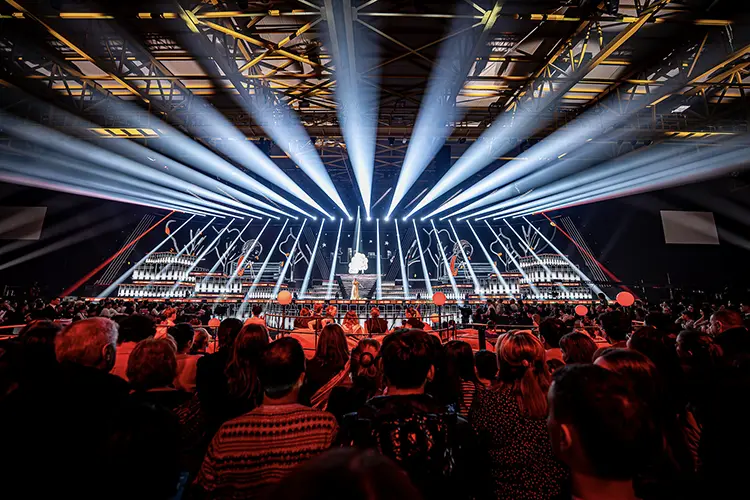
Having these Robe luminaires at their fingertips enhanced the creation of an eye-catching opening show and interval act, as well as the 18 competing delegation performances, all bursting with colour, drama and individual visual expression.
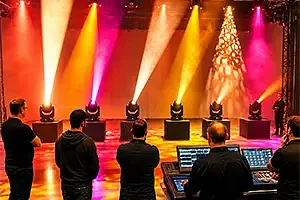
Raphaël worked with a strong FOH team, comprising Fabian Schmidt as the show’s lighting director; Marcel Knauf as assistant lighting designer; Tobias Heydhausen as key lighting operator; and Matthias Hagel, responsible for coordinating the follow spots. The project’s gaffer was Oliver Klaus, while the remote follow spot system engineers were Matze Held and Christian “Rocket Chris” Glatthor. The Sunrise Studios team also included the media server crew, with Matthias Schöffmann as server operator and media server farming managed by Chris van Deenen of Trust Rental GmbH. Head of video planning was Sebastian Huwig, and the projection mapping guru was Martin Karl. Motion graphic designers were Sebastian and Natalie Zittlau, and Natalie also served as overall motion graphic design supervisor.
Raphaël began working on this production around five months earlier and enjoyed the talent, energy and productivity of the teamwork that made this world-class event in Georgia possible. This year, they also shared their Depence files with delegations that wanted to design their own lighting show. Even so, most preferred to leave it to Raphaël and his team, who created solid, well-defined looks to support each performance during an intense 7-day rehearsal period. This was a tight timeframe for an event of this scale, due to a last-minute venue change. Even so, the strong spirit of collaboration and camaraderie among all involved allowed the production team to make key decisions and swiftly readjust the necessary elements without losing momentum.
Junior Eurovision 2025 was the 23rd edition and was won by France with Ce Monde, performed by Lou Deleuze. Ukraine’s Sofiia Nersesian won the public vote and finished in second place with Motanka, with Georgia, Armenia and Spain completing the top five.
Photos: Chris Moyan