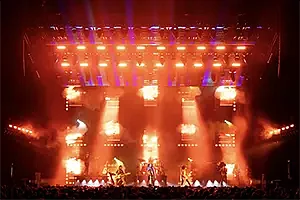
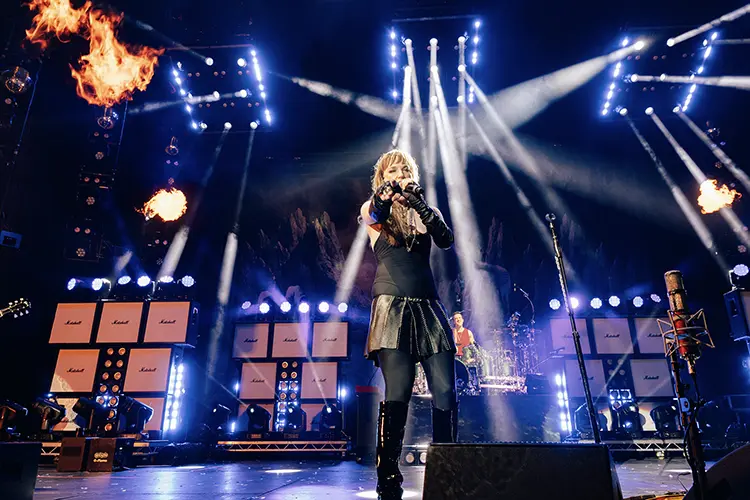
American rock band Halestorm are currently on a world tour supporting their latest album, Everest, released in August 2025. The tour, titled EVEREST, features a striking lighting design created by Mathias Kuhn, conceived to reflect the band’s drama, energy and musical power.
The production incorporates Robe moving lights, among other fixtures integrated into the rig.
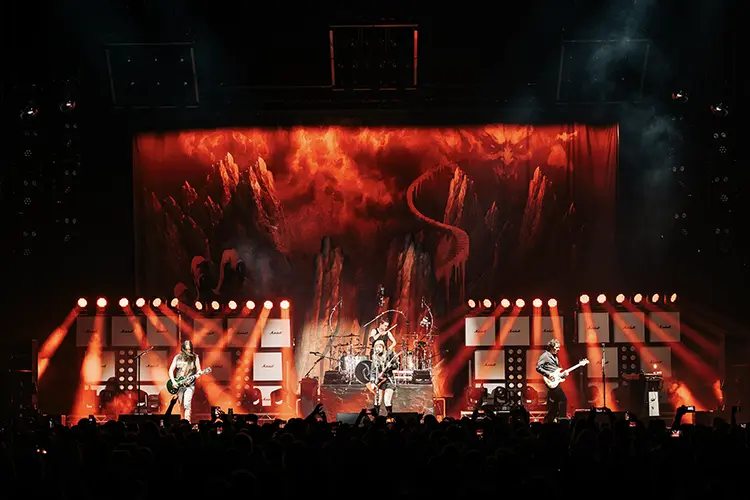
Mathias has been working with the band for three years and, for this tour, the goal was to embrace a retro aesthetic and deliver a raw, straight-to-the-point lighting show, without gimmicks. By dispensing with video and any other potentially distracting elements, the spotlight was placed firmly on the lighting and several scenic components — also designed by Mathias — which create a powerful visual backdrop for their intense live performances.
 |
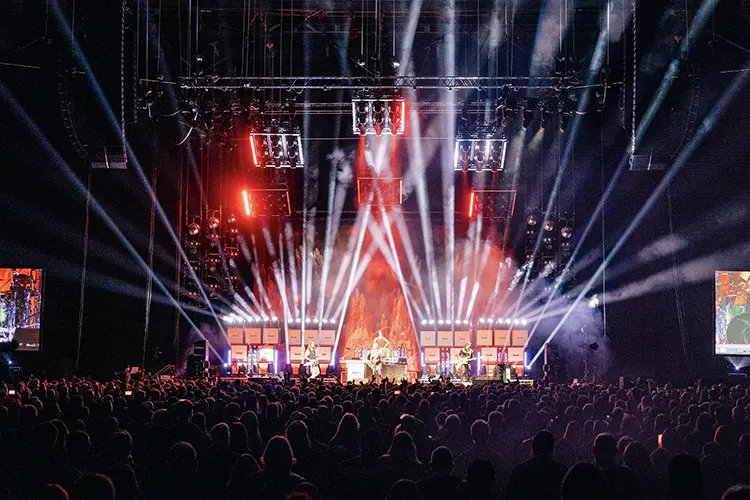 |
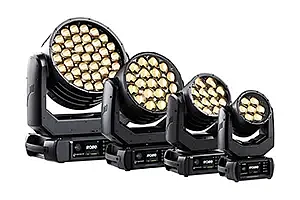
The designer drew inspiration from the iconic 1980s PAR can walls of light, immortalised by bands such as Queen, AC/DC, Judas Priest and others. To recreate this classic look using the power and dynamics of 2020s technology, he incorporated 78 MegaPointe, 8 FORTES (BMFL WashBeam in the US) and 30 LEDBeam 350 fixtures from Robe into the design.
The tour kicked off with several support dates for Iron Maiden, so Mathias also needed a distinctive set that could be quickly deployed and cleared from the stage.
Inspired by the original Spinal Tap movie, he and the band’s guitarist Joe Hottinger devised four custom mobile stage carts integrating Marshall amplifier stacks, based on the idea of Stonehenge — but full size!
The upper Marshall stacks are scenic, while the lower ones are a functional part of the backline. Behind this setup is a scenic backdrop featuring rock formations, mountains and a magical curved staircase. Each of these mobile platforms integrates 6 LEDBeam 350 fixtures on top, configured in ACL style, and 4 MegaPointe fixtures in the base. The amplifiers and luminaires form a single unit that travels pre-assembled, so they simply roll off the truck and on or off the stage, streamlining load-in and load-out. This modular system also became the conceptual starting point for the rest of the lighting design. Both the LEDBeam 350 and the MegaPointe were selected for their compact footprint and high output — key features to ensure versatility and performance in any venue.
A central aspect of the concept was the ability to scale the design up or down to suit a wide variety of venues during the first legs of the tour. The challenge was to ensure the show looked equally impressive in both small clubs and large arenas, while remaining practical and adaptable for day-to-day operation in these different environments.
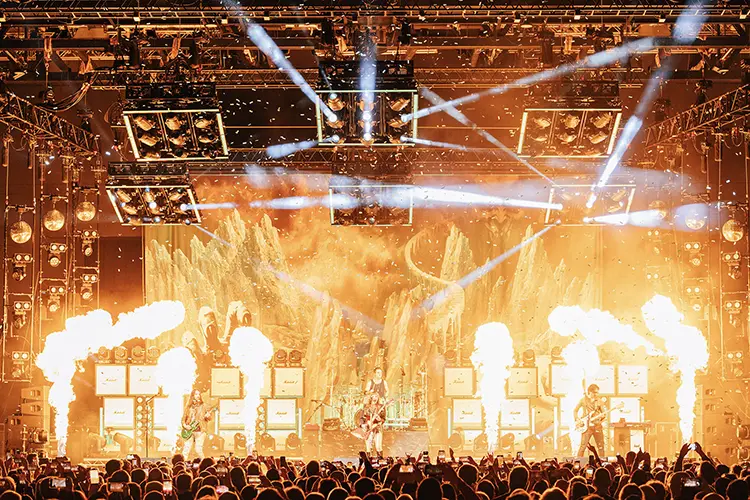
The overhead rig was defined by six raked, flown lighting pods complementing the four mobile stage carts. For the design, Mathias chose fixtures he knew well, including Robe products.
The LEDBeam 350 fixtures are very compact and lightweight, yet they deliver impressive output. They also work brilliantly alongside the MegaPointe in beam mode: they are a perfect combination and incredibly fast, commented Mathias enthusiastically.
The MegaPointe fixtures are among his all-time favourites and were a perfect fit for both this design and the look Halestorm wanted, thanks to their intensity and the versatility of their gobo effects. The MegaPointe aesthetic is also reflected overhead: each of the six flown pods incorporates a 3x3 matrix, totalling 54 fixtures in the air, joined by 18 more positioned on the floor. Mathias also highlights the excellent synergy between the two models, noting how effectively they work together within the design. For front lighting and specials on the front truss, 8 FORTES or BMFL WashBeam fixtures were used, chosen for their brightness and solid performance.
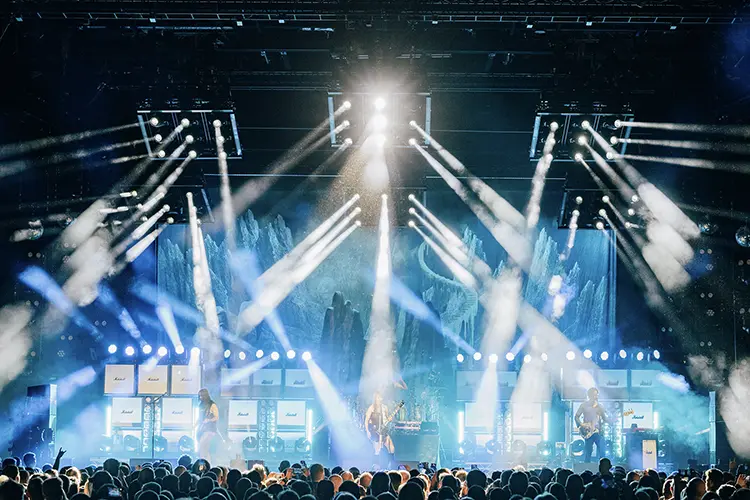
On the recent UK and European dates at the end of 2025, these fixtures were FORTES, and the full lighting and audio package was supplied by Liverpool-based Adlib, along with the sound system. The floor package was provided by Go Audio from Hamburg — Mathias’ hometown — for the European tour, and by Bandit in the United States.
Mathias hates leaving equipment in the truck because it will not fit into a venue, so considerable pre-planning went into ensuring the lighting and scenic design was flexible enough to adapt from the most intimate venues to the largest stages, always filling the space and maintaining a strong visual impact.
Although the absence of video meant all the visual responsibility rested on lighting, Mathias embraced the challenge, taking the opportunity to work with additional special effects — low fog, bubbles, confetti, etc. — which he loves for the extra texture and dimension they bring to live shows. He enjoys working with Halestorm because the band is always open to new ideas and suggestions and takes an active interest in how they look on stage. And since he is also a fan of their music, it is hard for him to imagine better gigs than these.
The tour is production managed by Joe DiLeo; the lighting director on the road in Europe and the UK was Alina Schmidbauer; and in the US, the lighting director and programmer was Rodger Pugh.
Photo credits: Alan Evans