No one signs up for the Dakar — a 10,000-kilometer off-road rally between Paris and the capital of Senegal — without a strong spirit of adventure. And no one manages to finish it, let alone win it, without absolute determination. Olga Lounová possesses both qualities in abundance.
The multi-talented Czech artist, who was a navigator on a winning Dakar team, is known in her country both as an actress and a singer. She was about to take a major step forward in her music career — moving from performing in small theaters to large venues — when COVID brought everything to a halt. Once the pandemic subsided, she was preparing to regain that momentum and relaunch her career, but then the Dakar once again crossed her path.
Just as she was ready to try again, she became pregnant. Some singers might have put their plans on hold at that point, but not Olga. Pregnant or not, she began her transition to larger venues in December. Fortunately, she had the support of Martin Hruska, one of the world’s leading stage designers, who not only possesses immense talent, but also shares her unwavering determination.

It has been a true journey. The tour was postponed several times, first because of COVID, then due to the Dakar Rally, and more recently almost again because of Olga’s pregnancy. However, we moved forward with the tour and, in the end, it has gone very well. Olga is the first Czech female artist to enter the Billboard charts in the United States. There has been tremendous interest from fans. Our first concert was successfully held at the O2 Universum in Prague, which has a capacity of 6,000 people. The next step is to take her shows to venues two and three times larger, Hruska said.
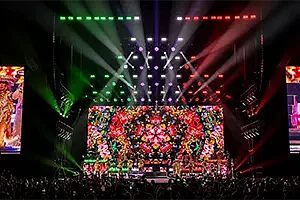
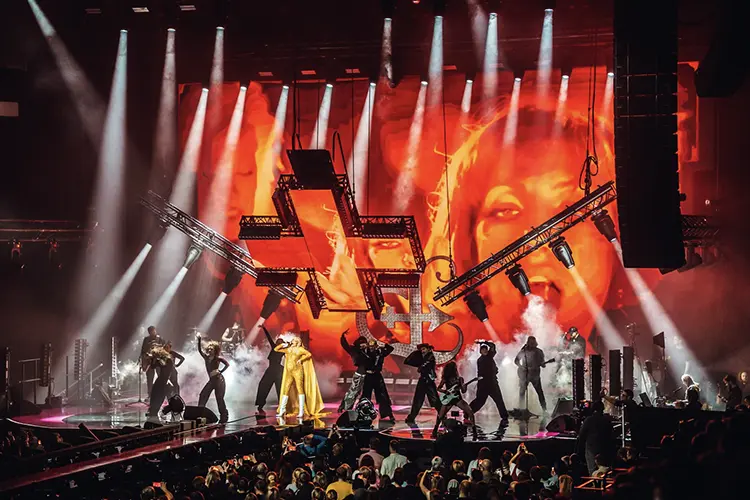
Adapting his design to take his client’s pregnancy into account, Hruska relied on 98 CHAUVET Professional fixtures, supplied by the Czech company Mastro, to create seamless, flowing lighting looks. Operated by lighting designer Dominik Šiška on a ChamSys MagicQ MQ500M Stadium console, the lighting highlighted the many distinctive elements of Hruska’s stage design.
“Due to the artist’s pregnancy, I had to simplify several elements of the concert, especially the parts where she was flying or moving on suspended structures”, explained Hruska. “We kept only a tilting cross with stairs and a railing that she could climb safely. The choreography was also adapted: Olga minimized her movements, and the physical performance was largely carried by the dance company”.
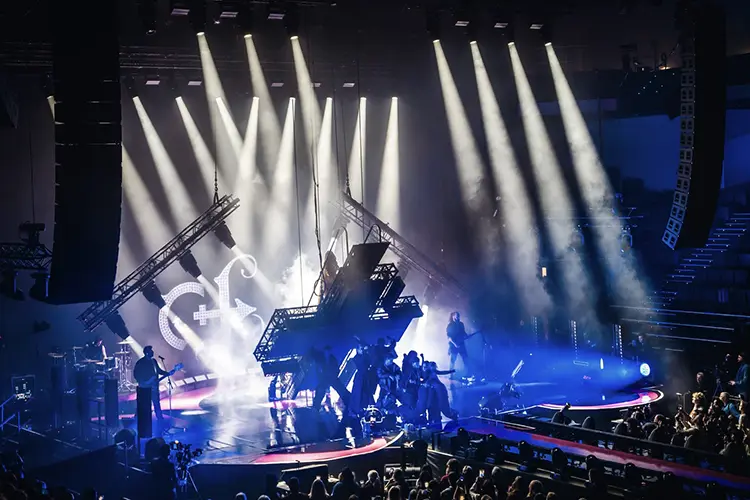
Regarding the automated cross-shaped set piece, Hruska commented: “The cross seemed to me to be the optimal simple solution for adapting the stage to Olga’s pregnancy. It is an interesting shape. We mounted an LED screen on it, and it moves with four motors. I designed stairs with steps of equal height and depth, attached to the upper part of the cross, allowing a 45-degree tilt in both directions”.
This allowed me to create two distinct scenes: the cross could tilt forward with the screen facing the audience and the artist standing on it, or tilt in the opposite direction so the audience could see the stairs as the artist climbed. There was also a third option that allowed the artist to stand in a horizontal position on the cross and “float” above the stage. I eliminated this possibility during preparations due to the advanced stage of her pregnancy. In short, the cross combined with the LED screen in the background allowed me to create more interesting effects, Hruska continued.
Adding a captivating sense of depth to his effects, Hruska achieved an artistic fusion of video and lighting. Through careful color matching and precise coordination of movement and brightness levels, he ensured that video imagery and lighting worked together to create an immersive environment that supported the artist’s performance.
This combination was evident during the song Dark Water, when Hruska and Šiška created an “underwater world” on stage by coordinating colorful lighting with images of swimming fish and rising jellyfish. “I also used jellyfish as real scenic elements in the foreground, creating a realistic three-dimensional underwater scene”, noted Hruska. “At the center of this scene were Olga and the tilted cross”.
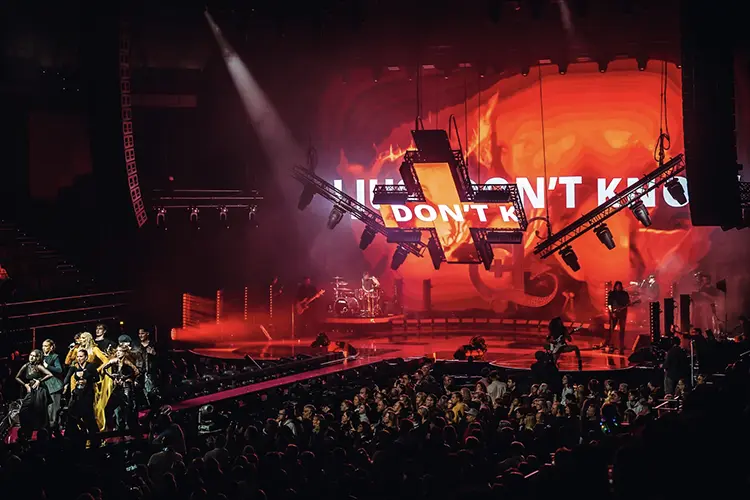
To bring color to this vivid panorama, 28 Color STRIKE M (motorized strobe-wash fixtures), 22 COLORado PXL Curve, 12 Rogue R2X Beam, and 12 Maverick Storm 3 BeamWash fixtures were used. To add impact at key moments and provide audience lighting, 24 STRIKE Array 2 fixtures were also deployed on the front truss.
Šiška used many of these fixtures to outline the contours of Hruska’s striking design. For example, 16 Color STRIKE M units were positioned on the floor in a semicircular layout, following and accentuating the outline of the stage, while eight COLORado PXL Curve fixtures were mounted on the cross to highlight its shape. The remaining fixtures were distributed along the sides and rear of the stage. Šiška placed the Rogue R2X Beam fixtures at the back of the stage, behind the band. “The beams were used to enhance the show’s dynamics, adding energy and visual impact throughout the performance”, he explained. “The Maverick Storm 3 BeamWash fixtures were used to illuminate the band and dancers, with eight units on the front truss and four positioned on the floor at the sides of the stage”.
In Hruska’s view, the sold-out concert succeeded in giving fans a preview of what they can expect from future Olga Lounová shows.
We wanted to excite the audience. Given Olga’s popularity, the plan is to repeat the concert in increasingly larger venues with even greater anticipation, he said.