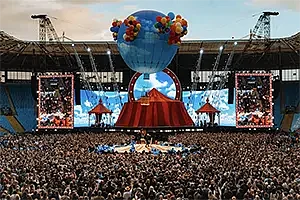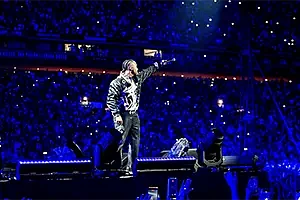
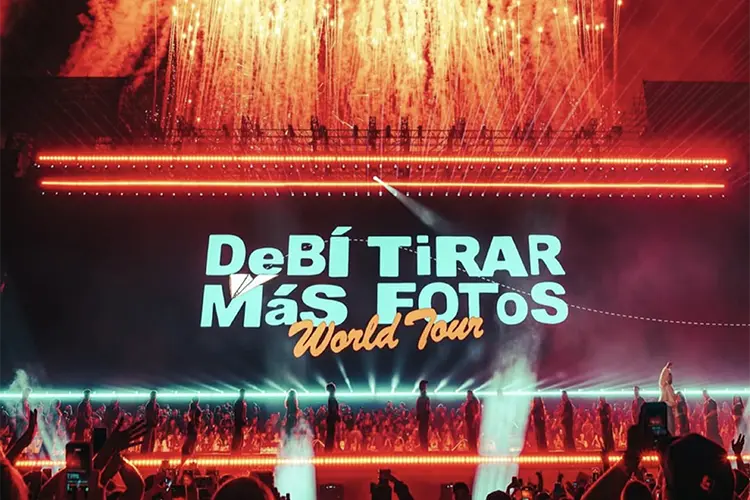
When Bad Bunny launched his Debí Tirar Más Fotos Tour in November 2025, he brought to the stage an album whose significance extended far beyond the world of pop. Debí Tirar Más Fotos had been awarded the 2026 Grammy for Album of the Year earlier that year, becoming the first entirely Spanish-language album to receive the honor.
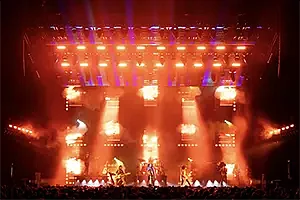
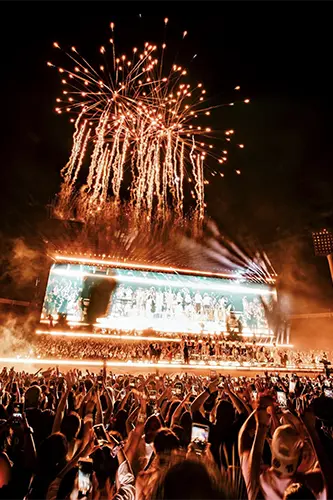
The tour consistently translated the album’s artistic ambition into a live format: more than 50 stadium shows across nearly 20 countries on four continents required a lighting design of extraordinary scale.
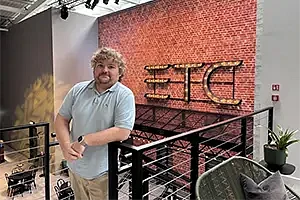
Lighting designer Marcus Jessup was responsible for the project. His career began at the age of 14 in the production environment of a large church, where he was introduced at an early stage to nearly every aspect of live production. He later studied at Indiana State University and Full Sail University and also worked at Everlast Productions in Miami. There, he expanded his expertise across various event technology disciplines before moving into the touring sector. The Debí Tirar Más Fotos Tour is the largest production of his career to date.
However, Jessup does not begin with the lighting rig, but with the stage itself. For Bad Bunny, he developed a concept inspired by the emotional universe of the album, built around the contrast between large-scale images designed for the vastness of stadiums and deliberately restrained, almost intimate moments. This interplay between spectacle and minimalism defines the staging, always closely connected to the music, the dramatic structure and the artist’s personality.
Designing a tour conceived for stadiums involves very different rules from those of an indoor venue or arena. The scale of these spaces offers enormous creative possibilities, but it also demands precise control over light intensity and usage. A stadium absorbs a great deal of light. What matters, therefore, is not only how much power the rig can deliver, but knowing when to use it and when to hold it back.
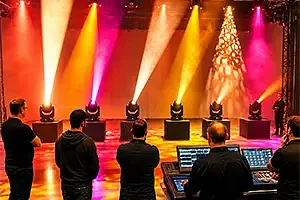
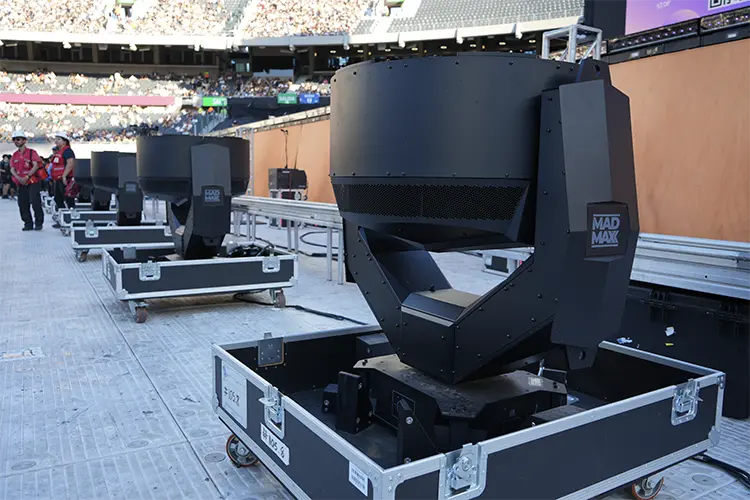
For the international shows, Jessup relied on two GLP solutions that became essential tools in his design: 136 JDC2 IP and 14 MAD MAXX fixtures. The requirements were clear: luminaires capable of covering large spaces, delivering high output and providing a distinctive visual identity. Both JDC2 IP and MAD MAXX met these demands in different yet perfectly complementary ways.
The MAD MAXX fixture took center stage in the scenes with the greatest visual impact. With an output of up to 68,000 lumens generated by an array of 19 high-performance LEDs, the fixture creates imposing columns of light capable of dominating the full width of a stadium and projecting beams high into the open sky. When the 14 MAD MAXX fixtures rise in sync, the effect feels less like a conventional moving-head look and more like a genuine architectural element built from light. Within the rig, the MAD MAXX was the most powerful light source, with enough intensity to stand out clearly from every other fixture in the design.
 Its distinctive optical character also played a key role. At the time of the tour, the MAD MAXX was still a relatively recent addition to the GLP portfolio and offered exactly the visual personality Jessup was looking for. Its aesthetic recalls the long-throw searchlights of earlier generations, reinterpreted in a modern moving-head system. Even across the vast distances of a stadium, this character remains clearly recognizable and gives the show’s most spectacular scenes an unmistakable visual identity.
While the MAD MAXX defined the vertical scale and reach of the design, the 136 JDC2 IP fixtures provided its rhythmic structure. This hybrid LED fixture combines a powerful white strobe with large RGB color surfaces and independently controllable segments. As a result, the JDC2 IP goes far beyond the traditional function of a strobe. Its zone-based control enables internal animations, movement effects and graphic sequences that add depth and dynamism to the design without relying solely on the fixture’s motorized tilt.
The combination of strobe intensity, wash functionality and segmented control made the JDC2 IP an especially versatile tool within the show. During the most energetic passages, it delivered hard accents, strong silhouettes and precise rhythmic impulses. In quieter moments, it enabled subtle color transitions, graphic patterns and controlled movements that structured the stage visually without overwhelming it.
Despite the enormous scale of the production, the lighting design remained firmly in service of the music. The fixtures were intended to support the show’s emotional narrative, never overshadow it. In fact, many of the most memorable moments emerged precisely because intensity, brightness and movement were not used continuously, but only when the music and performance created the space for them.
At the international shows of the Debí Tirar Más Fotos Tour, the combination of JDC2 IP and MAD MAXX gave Marcus Jessup the flexibility required to develop this approach. The MAD MAXX provided reach, presence and striking vertical imagery for some of the world’s largest stadiums, while the JDC2 IP added control, rhythm and graphic versatility to the show’s richly detailed visual language. Together, the two GLP systems formed the backbone of a design that convincingly combined monumental stadium-scale impact with exceptional musical precision.