

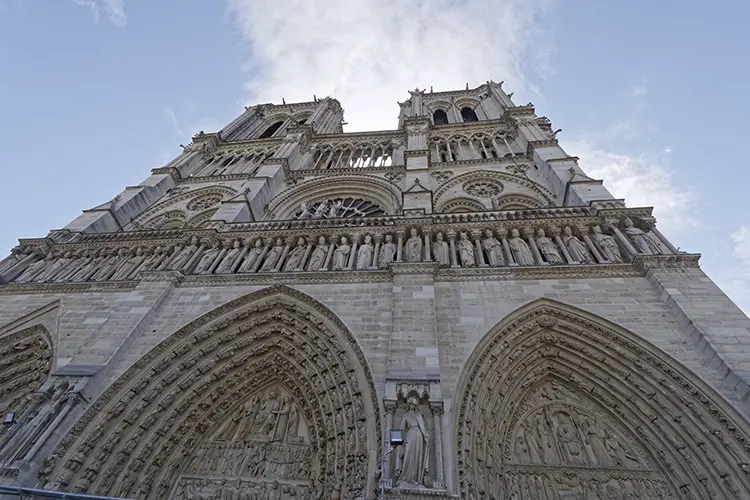
After the terrible fire, it only took five years of work — albeit extremely intensive — to rebuild the Notre-Dame de Paris cathedral.
Novelty, the integrator responsible for re-equipping Notre-Dame, was consulted two years before the cathedral’s reopening to supply a new sound system, whose requirements called for expanded coverage while keeping the technical equipment as discreet as possible.
After an in-depth study, it became clear that only Sennheiser’s Spectera wideband wireless system met all the established requirements, while maintaining the expected level of demanding standards.
Large RF coverage and high reliability
When David Créteur, project lead at Novelty, began reviewing the RF wireless equipment for the cathedral, he realized they needed a solution that could meet the demands stemming from the reconstruction of Notre-Dame de Paris. The new requirements included sound reinforcement for mobile celebrations, where priests or the archbishop would move around while still being heard clearly and without dropouts. In addition, the use of new spaces such as the side chapels had to be taken into account. In short: RF coverage had to be ensured along the length of the cathedral, from the entrance of Notre-Dame to the Chapel of the Crown of Thorns reliquary located at the very back, and also across its width, overcoming obstacles such as wooden partitions and massive stone pillars.
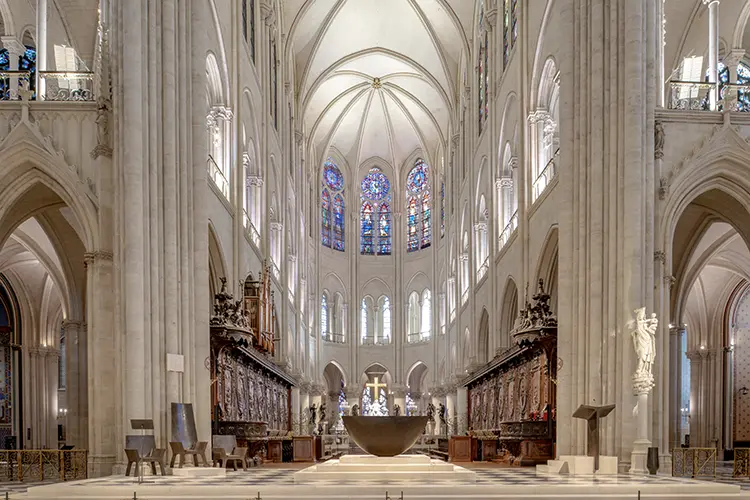
A place of sharing open seven days a week
Beyond ensuring reliable RF coverage across almost the entire cathedral, Créteur was looking for a discreet and easy-to-operate system, knowing that Notre-Dame must combine spiritual life with welcoming the public. As a place of worship, Notre-Dame de Paris has always been freely accessible to everyone.
Notre-Dame is a place of sharing open to visitors, whether they wish to attend a service or simply want to walk beneath its vaults. This is what makes this cathedral so unique: it welcomes the whole world, worshippers and visitors alike, with services being held during visits, and visits continuing during services, says Laurent Prades, technical manager of Notre-Dame de Paris.
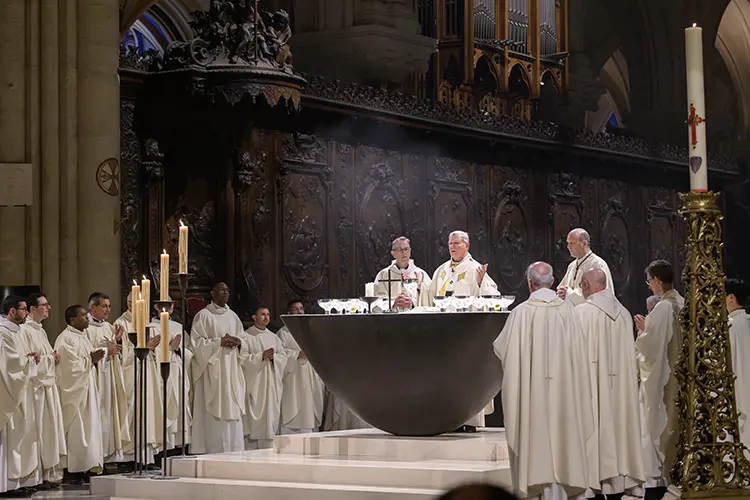
In practice, Notre-Dame remains a place of prayer and contemplation for the thousands of worshippers who can attend five services every day of the week. But it is also a space open to the public 12 hours a day, seven days a week, 365 days a year.
In search of the right wireless audio technology
Given the new requirements and the exceptional operating conditions, the question was: which wireless system should be used? Notre-Dame’s former system relied on an analogue two-channel Sennheiser 3000 series receiver and a pair of active directional antennas positioned at the center of the liturgical podium. This legacy system was proof of the effectiveness and long-term reliability of Sennheiser wireless, but given the area to be covered, Créteur felt it was time to move on from analogue:
“Instead of working only along the axis, we now had to cover almost the entire cathedral, which is just over a hundred metres long from the entrance to the back and almost 50 metres wide at the transept. With the digital wireless technologies we were familiar with, we could have done it, but we would have had to multiply the number of antennas to a total of at least eight placed throughout the building, and then connect them with long lengths of cable. To compensate for the rigidity and line losses associated with copper coaxial cable, we would have had to use costly fibre extension solutions, which would have created problems when combining antenna pairs and creating coverage zones. Ultimately, the installation would have been quite complex, requiring the use of numerous devices, with the added difficulty of having to activate and deactivate zones manually”.
Knowing that the installation had to run autonomously, without the constant intervention of a technical manager, Créteur had to find another solution.
Spectera solves all problems
Moving away from traditional RF wireless technologies, which were too complex to implement, Créteur considered switching to a DECT-based solution. Then, during a chance encounter with a Sennheiser presentation, he discovered the possibilities offered by Sennheiser’s WMAS implementation, the new Spectera system:
The further we got into the presentation, the more Spectera seemed to solve the problems one by one, and to perfectly meet the specific requirements of our project by simplifying the system and its installation. First of all, unlike traditional wireless systems, Spectera does not need diversity, so with comparable or even superior coverage, we can go from eight antennas to four, which halves the cabling. Secondly, the antennas combine without the need for a technician to intervene, eliminating the operational difficulties associated with zoning. And finally, the antennas are connected via Ethernet cables, a standard that is easier to integrate and more affordable than coaxial cable.
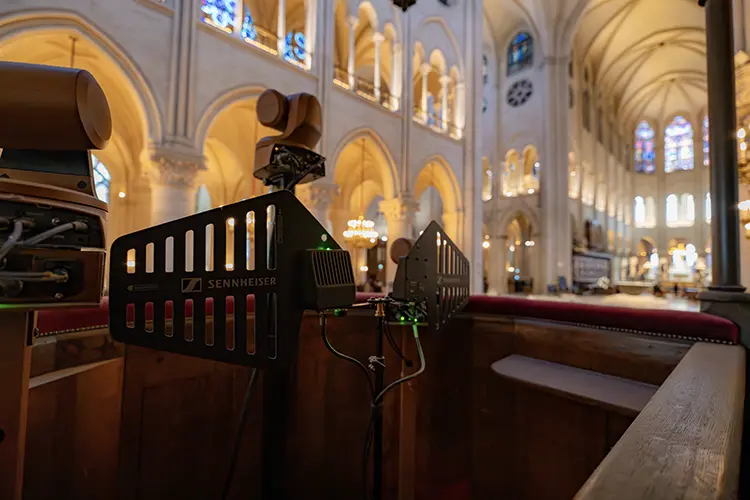
However, taking the requirements into account, the team planned to cable the Notre-Dame cathedral with fibre rather than RJ45: “When Sennheiser confirmed that fibre extension works simply by adding a fibre media converter from the list of models they had tested, we realized that Spectera was the solution we were looking for”.
In a historic site such as Notre-Dame, any technology used must be durable and virtually invisible, as Alain Richon, project manager for the sound system for the diocese in the cathedral, points out: “Every cable path was studied with the architects and, to anticipate future developments, it seemed logical to opt for fibre. In this context, a system like Spectera, which is based on technologies from the world of telecoms and networks, fits with this vision”.
Simpler deployment
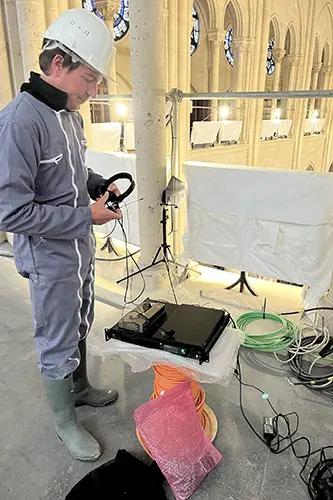 On paper, the further the study progressed, the more the system seemed to fit Notre-Dame de Paris, but Spectera’s RF transmission stability still had to be verified onsite. For this reason, in early 2024 a full-scale test was organized in a cathedral still under construction: “We were all dressed in white overalls”, Créteur recalls.
Together with Sennheiser’s Hadrien Soulimant (Business Development Manager Professional Audio) and Charly Fourcade (Technical Application Engineer Pro Audio), Créteur set up a test configuration in the middle of the scaffolding. In parallel, a test span was created to check the visual appearance and audio quality of the sound system.
The results were very promising, but the tight renovation schedule still had to be met. Exceptional circumstances called for exceptional measures, and so, in autumn 2024, Sennheiser delivered a temporary, pre-production configuration comprising a Spectera Base Station and three SEK bidirectional bodypacks. While waiting for Spectera’s handheld transmitter to become available, a Digital 6000 wireless system was also deployed, comprising a two-channel receiver and two handheld microphones.
Sennheiser microphones at the heart of Notre-Dame
Today, liturgical life has resumed at Notre-Dame, with rhythm given by the five daily services. “Every morning before the first mass and every evening after the last mass, worshippers and visitors are welcomed in the narthex for the Angelus prayer”, Prades explains. On the technical side, microphone choice varies according to preference: some priests use a handheld microphone while others use a bodypack transmitter with an MKE 40 clip-on microphone, appreciated for its discretion and sound quality.
The cathedral also has an audiovisual control room, from which the teams of television channel KTO provide daily broadcasts.
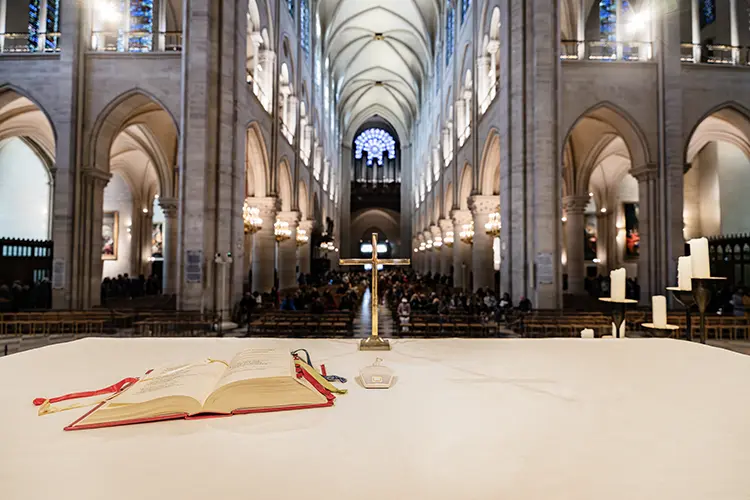
When unobtrusive sound capture is required, the microphone chosen for the altar of Notre-Dame, the MEB 114 boundary microphone, is the most suitable because it is both aesthetic and precise, with very consistent directivity across the spectrum. The wireless microphones can also be used for the hosts of concerts by the ‘Maîtrise Notre-Dame de Paris’ choir, which the ‘Musique Sacrée à Notre-Dame de Paris’ association organizes every Tuesday.
Spectera simplifies installation
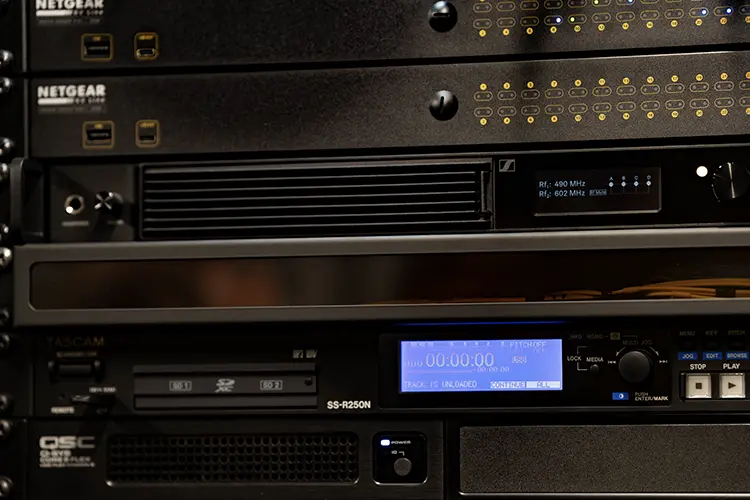
Notre-Dame’s technical rack is simple and compact: the Spectera Base Station occupies a single rack unit and allows the use of up to 32 microphones and 16 stereo IEMs. With a traditional system, the necessary components would have required much more space and higher electricity consumption. Spectera integrates directly with a DiGiCo console via Dante, using a 4ERA4 matrix, which enables smooth transport and distribution of audio channels to the console. Although the four antennas were initially planned to be located on the gallery at a height of around ten metres, they were ultimately brought down, providing very stable coverage throughout the cathedral.
A scalable installation
As soon as the installation had been completed, David Créteur was already thinking about its future: “On some occasions, priests may need to address people from outside, in front of the church. In that case, a fifth antenna would be needed, and we could add it without any issue. In fact, we already tested this in a real situation: while the system was operating, we took antenna 4 outside and coverage remained stable, without any need to restart anything”.
Spectera allows Créteur to confidently look ahead to future usage scenarios:
Spectera gives us the freedom to accommodate a larger number of bodypacks, either permanently or on a rental basis for one-off events in the cathedral. We could also reroute additional channels to the outside to facilitate the work of our regular partners KTO or Radio-France, who often come to Notre-Dame. In addition, thanks to its bidirectionality, Spectera offers new possibilities for sound engineers. When they need to move around to make level adjustments from their tablet, they can now press a PFL (Pre Fader Listening) button and hear it directly through their headphones plugged into an SEK bidirectional bodypack. Even though these uses were not originally requested, we’ve realized that these features can be useful. Why not take advantage of them since they are already included?