DiGiCo expands the capabilities of its Quantum and SD-Range consoles with the release of V20 software. This update, available for download from the website, introduces innovative features that enhance user experience and optimize workflow.
Direct integration with Fourier Audio and Sound Devices
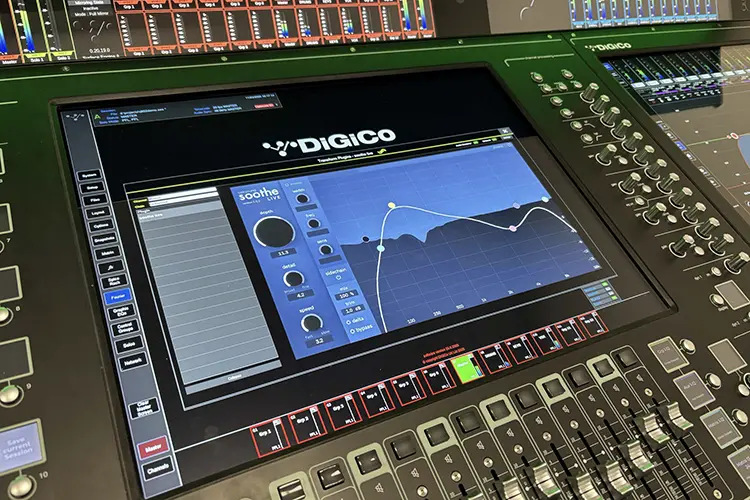
V20 software offers direct integration with Fourier Audio for all Quantum console work surfaces. You can now connect your console to the transform.engine control network to sync session files and snapshots, as well as view and control plugins on your console’s touchscreen. When selecting a channel with a Fourier plugin chain inserted, the plugin chain will display on the main console screen. Parameters can be adjusted via the touchscreen and rotary encoder, provided the plugin manufacturer has enabled that functionality.
Session and snapshot (Cuelist) control from transform.engine has also been implemented. Loading a session on the console will load the session of the same name on the Fourier device. The transform.engine system can also follow commands, including saving a session. Snapshot insertion, activation, updating, auto-update status, deletion, and reordering are all copied to the engine, ensuring snapshots remain in sync with the console.
Version 20 also adds support for Sound Devices transmitters. With the new Astral external control device, you can program macros to trigger directly from the transmitter when using A20-Nexus and A20-SuperNexus receivers. Use cases include simple push-to-talk, muting a separate feed to a director on a broadcast stage, or allowing a vocalist to toggle a specific effects send for their microphone during a performance.
Mustard Source Expander (MSE): advanced dynamic control
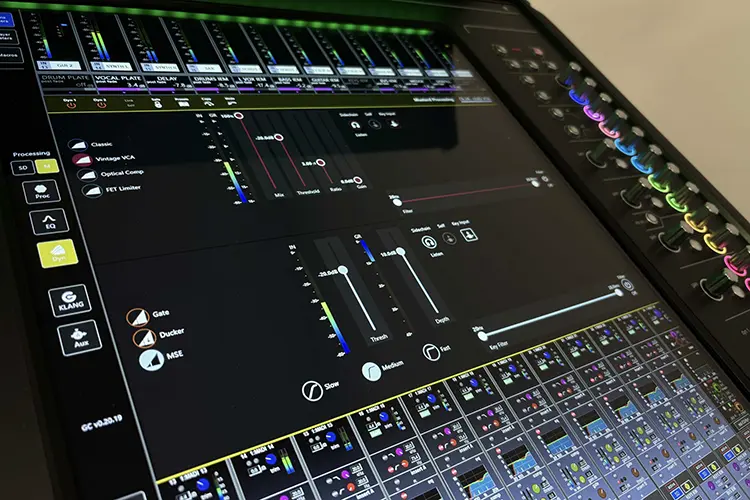
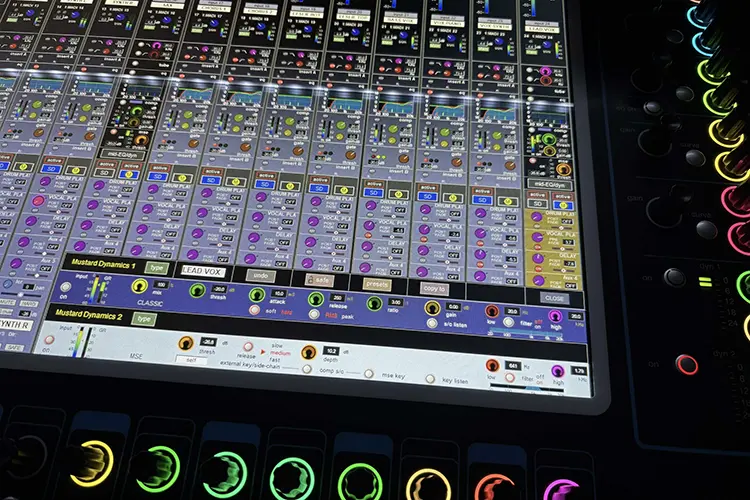
V20 software introduces the Mustard Source Expander (MSE), a new dynamics option for Mustard processing channels on Quantum consoles. The MSE reduces a signal’s level by a set amount when it falls below a threshold. It functions similarly to a gate but is better suited for non-transient signals such as vocals or brass.
By reducing level when a singer stops singing, the MSE can minimize feedback potential and reduce stage noise bleeding into open mics. Controls include threshold, depth (up to 40 dB), and release time. A sidechain option is also available.
Theatrical compatibility for Quantum225
V20 software is also the required update to enable the optional Theatre software package on the Quantum225 console, ideal for small- to mid-sized theatre productions and venues. The “T” package alters the console’s cue list functionality to suit theatrical applications and provides tools for managing cast and costume changes via Players and Aliases.
Upgrading to Theatre on a Quantum225 provides the same additional channel count and processing as the Pulse upgrade, with 96 input channels, 48 buses, 36 Mustard processes, and 48 Nodal processes. It also expands the matrix beyond Pulse’s, increasing it to 24×24.
A legacy of innovation and durability
At DiGiCo, we strive to deliver lasting, upgradable solutions. Our R&D team continually asks, ‘How can we add more performance and value to what our customers already own?’ By using the industry’s fastest, most powerful DSP, software updates are key to increasing channel count, streamlining processing, and adding new features. With our new V20 software, even SD7 and SD8 users who’ve owned their consoles for over 15 years can continue to benefit from the latest advancements, said Austin Freshwater, Managing Director of DiGiCo.
Other V20 software highlights
- Moving an EQ band on the Quantum852 via the hardware channel will now select that band on the golden channel.
- The subnet mask is now displayed in Diagnostics.
- A confirmation message appears when deleting a bank from the fader bank panel.