
This article represents a first step towards the exciting universe of immersive audio, and with it, DPA aims to make an initial tour through basic and essential concepts. Additionally, fundamental tips are provided to ensure optimal performance in our first immersive recordings.
Elemental acoustics: What does immersive audio imply?
Immersion goes beyond being surrounded by something, such as water, for example. In the realm of sound, immersion also implies a sense of envelopment. This is closely related to spatial information and its perception.
Achieving auditory immersion is not just about receiving sound from various directions; it involves much more. Channels may contain information about the same sound source, but from different angles. If all channels reproduce the same sound exactly (multichannel mono), we will never achieve the desired immersion.
Historically, immersive audio has been known as surround sound or 3D audio, even when speakers were only arranged in the horizontal plane. While surround sound has traditionally been based on a 5.1 format (five full-bandwidth channels and one low-frequency channel), more recent formats can be, for example, 7.1.4 (seven channels in the horizontal plane, one low-frequency channel, and four height channels), 9.1.6, or variants like Dolby Atmos, Auro 3D, or 22.2 in Japan (10 channels in the horizontal plane, nine height channels, three channels in a lower layer, and two low-frequency channels).
How is immersive audio achieved?
Achieving immersive audio involves the use of various recording and mixing techniques. Mixes for film formats like Atmos and similar often encompass a wide range of sources: mono, stereo, and multichannel recordings with spatial information. Adding sound objects allows experimenting with spatial incidents, such as the location of a helicopter at an oblique angle backwards. Timecode and coordinates determine when and where the object appears in rendering, hovering over the audience's heads.
Ambisonics/Higher-order ambisonics
Some audio professionals turn to ambisonics, both in first-order and higher-order formats. First-order ambisonics is based on an A-format microphone array (four cardioid capsules arranged in a tetrahedron), which is then reformatted virtually into B-format, comprised of three bidirectional microphones and one omnidirectional microphone.
On the other hand, higher-order ambisonics involve a physical sphere with diameters of 10 to 20 cm, housing 8, 16, 32, or 64 microphones evenly distributed. Mixing these signals provides exceptional precision, capable of clearly reproducing sound position. This technique requires the listener to be positioned at the optimal point for a complete experience, making it ideal for virtual reality applications.
Spatial recording
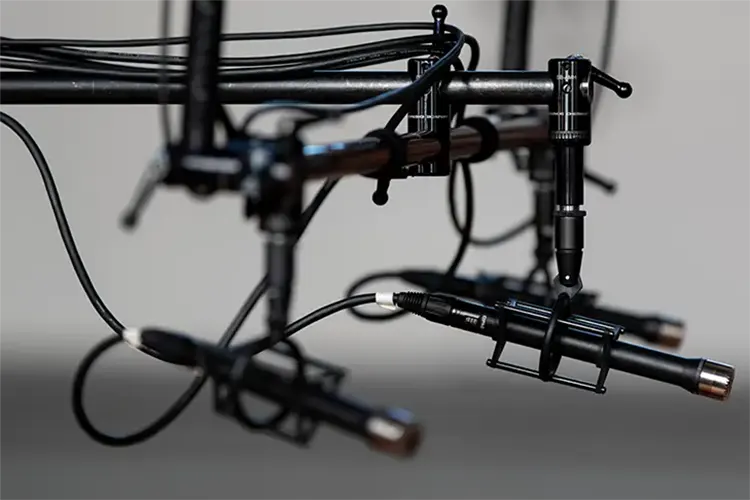
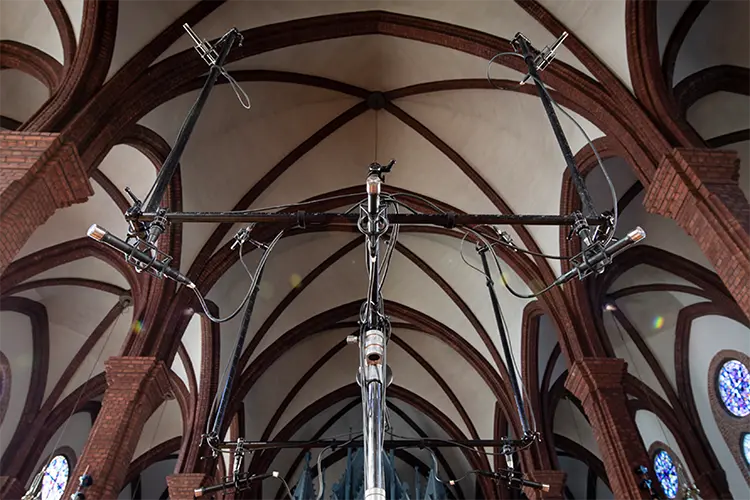
Other recording methods, more natural and used in music production, involve formats with large separation between the recording microphones. For example, Norwegian sound engineer Morten Lindberg (2L), renowned for his impressive Grammy-winning immersive recordings, employs an array of seven omnidirectional microphones as a base layer, and four additional ones for the height layer. The minimum distance of one meter between the microphones generates uncorrelated sound that envelops the listener, regardless of their position. This technique is not only applied to music but also to the creation of soundscapes that can be enjoyed in extensive areas.
Decorrelation
In certain mixes, sound comes from a limited number of channels. Through decorrelation, other channels, such as those in the upper layer, are derived from these base channels. This technique involves special audio processing and is commonly used in large-format setups, such as sound reinforcement in concerts, to reduce the unwanted comb filtering effect.
Speaker configuration vs. Microphone configurations
Often, speaker setup determines the initial arrangement of microphones. A basic microphone technique involves placing one microphone for each speaker/channel. However, achieving the most important parameters, such as spatial precision, coverage, immersion, spectral balance, and others, simultaneously is very difficult.
Experimentation and testing of various configurations are key. Directional microphones placed closely together can provide a good sense of source position, making them preferred for accurate reproduction of soundscapes and the like.
Spaced microphones offer greater spatiality and can be directional or omnidirectional. Omnidirectional microphones are excellent for capturing low frequencies, especially if speakers have adequate low-frequency response. If a certain degree of directivity is required, omnidirectional microphones with pressure equalization (APE) can be used.
Tips for immersive recording
- Adjust the gain of each microphone in the array to have the same sensitivity during recording.
- Greater separation between microphones provides more spatiality, although in some cases, it may reduce directional accuracy.
- If the speakers are widely separated, the microphones should follow this separation pattern.
Photo credit: Morten Lindberg/2L