

In professional audiovisual systems, latency is an inherent parameter of any signal chain. From a technical standpoint, every sequence of capture, processing, transport and playback introduces measurable delays, derived from physical, electronic and computational limitations.
Therefore, so-called “zero latency” is not achievable in real terms, but is commonly used as a commercial or conceptual expression.
In entertainment environments—such as live shows, immersive installations or theme parks—the relevance of latency lies not only in its absolute value, but in its stability and temporal coherence between subsystems. Misalignment between audio, video and control systems can produce perceptible effects, especially when simultaneous visual and auditory references are present.
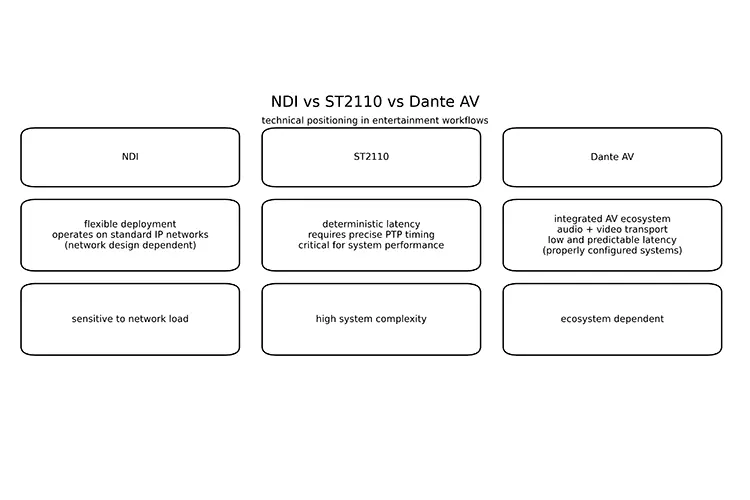
In this context, the adoption of IP-based transport technologies has introduced new design scenarios. Protocols such as NDI, SMPTE ST 2110 or Dante AV enable the distribution of audiovisual signals over data networks, but present significant differences in terms of architecture, infrastructure requirements and synchronization mechanisms.
NDI (Network Device Interface), developed by NewTek, is designed for low-latency compressed video transmission over standard IP networks. Its implementation often does not require dedicated broadcast infrastructure, facilitating adoption in environments where flexibility and rapid deployment are priorities. However, its performance—including latency, jitter and stability—depends directly on factors such as network design, congestion, hardware quality and system configuration. As a result, its behaviour is not strictly deterministic in all scenarios.
The SMPTE ST 2110 standard defines a set of specifications for transporting uncompressed audiovisual streams over IP networks, separating video, audio and ancillary data into independent flows. This approach enables greater granularity in signal handling and relies on synchronization mechanisms such as Precision Time Protocol (PTP), defined in IEEE 1588. When implemented on networks designed according to its requirements—including precise synchronization, traffic control and sufficient capacity—it can provide accurate temporal alignment between streams. However, proper operation requires dedicated network infrastructure and rigorous configuration.
Dante AV, an extension of the Dante ecosystem developed by Audinate, incorporates video transmission within an architecture originally designed for audio over IP. Its design facilitates integration in systems where Dante is already deployed, enabling unified management of audio and video on the same network. As with other IP-based systems, its performance depends on the specific implementation, the equipment used and the network topology.
Regardless of the protocol, multiple studies and field experiences agree that total system latency does not depend solely on the transport method, but on the sum of all intermediate processes. Each stage—encoding, decoding, scaling, processing, conversion or distribution—introduces additional delays. In complex systems, the accumulation of these stages can be more decisive than the network protocol itself.
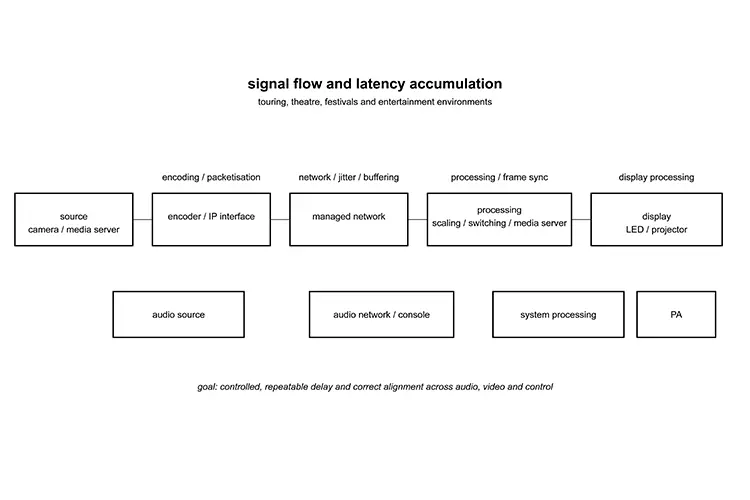
Likewise, temporal variability (jitter) and packet loss in IP networks can affect signal stability if appropriate quality of service (QoS), network segmentation and traffic control mechanisms are not implemented. For this reason, common technical recommendations include the design of dedicated or properly segmented networks, prioritisation of critical traffic and continuous system monitoring.
Global synchronization is another critical factor. In environments with multiple devices, the absence of a common time reference makes precise signal alignment difficult. Technologies such as PTP allow this reference to be established, although its accuracy depends on implementation quality, network topology and equipment compatibility.
From an operational standpoint, latency management does not necessarily imply absolute minimisation, but rather control within known and consistent margins. In many professional systems, intentional delays are applied to align audio and video, compensating for differences introduced across different signal paths.
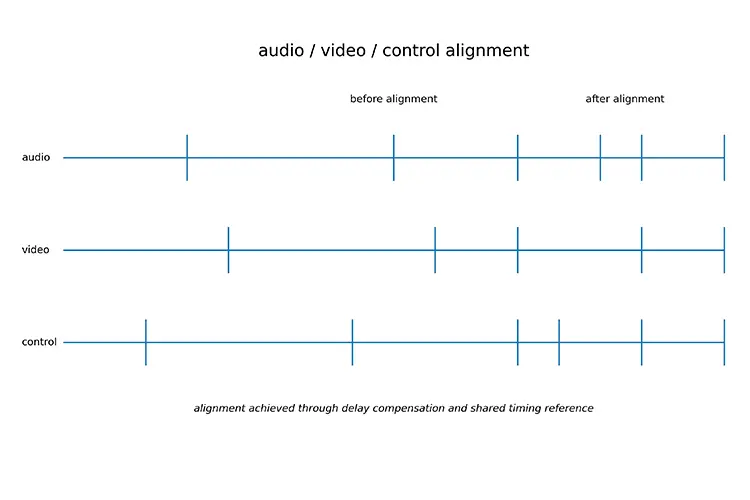
In conclusion, latency in audiovisual systems is an inherent property that must be characterised, measured and managed. IP-based technologies offer significant advantages in terms of flexibility and scalability, but require a rigorous design approach to ensure predictable behaviour. More than the choice of a specific protocol, the consistency of the final result depends on system architecture, implementation quality and control of the variables affecting signal transit time.