
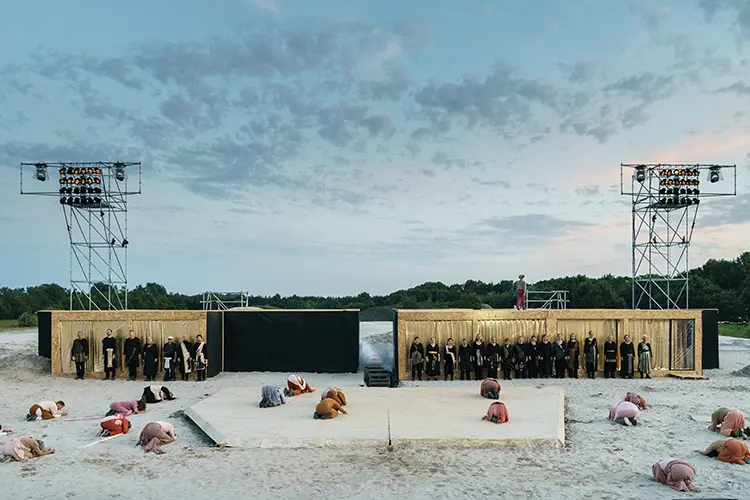
In August and September, Zummerbühne Groningen (Groningen Summer Theatre) presented Gronieken, a musical theatre production staged in a sand depot in Meerstad.
The unusual open-air location posed special challenges for both the technical crew and the equipment, and the wireless audio transmission was handled by a Sennheiser Spectera ecosystem with two Base Stations, 49 SEK bodypacks and eight DAD antennas.
Spectera premiere at Zummerbühne Groningen
When I heard that the brand-new Sennheiser Spectera system was going to be used for Zummerbühne 2025, I was thrilled. It’s always a privilege to work with state-of-the-art audio technology. Of course, I was already familiar with the name Spectera. Rumours about WMAS technology had been circulating in the audio industry for some time. But it soon became clear that not everything my colleagues were saying at the time was well-founded, explained Kasper van der Spoel, who was responsible for the theatre’s RF equipment for the third time.
At the end of June, rental company AddLive, the full-service provider for Zummerbühne’s technical equipment, received the Spectera systems. Van der Spoel reacted immediately: “I took the units home and put them through intensive testing for a week. I also had the opportunity to work at Opera op de Parade in ’s-Hertogenbosch, where Marty Brugmans, the technical producer, and equipment provider Unlimited Sound & Vision had no fewer than three Spectera Base Stations and 90 SEK bodypacks in use—probably the most extensive practical application of the system so far”.
 |
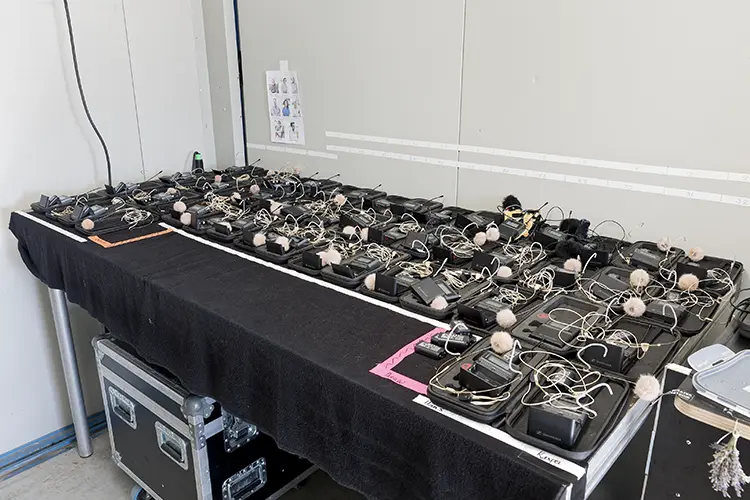 |
Since stage monitors were also being used, Zummerbühne used the 49 SEK bodypacks mainly as microphone transmitters. The bidirectional functionality, with both microphone and IEM channels, was used for the conductor and three musicians (trombone, saxophone, bass clarinet) who needed to move around the stage.
SEK Bodypacks: passing the endurance test
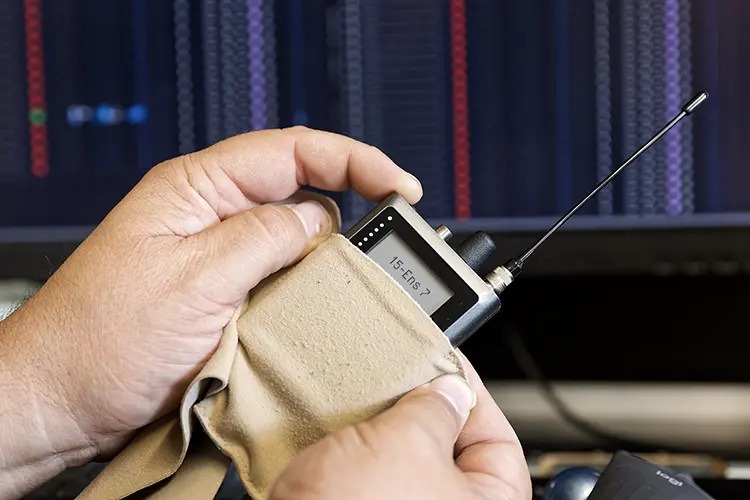
At the open-air venue on the outskirts of Meerstad near Groningen, Gronieken had to contend not only with wind and rain but also with the constant presence of sand. “No matter what you did, the sand got everywhere”, van der Spoel said with some resignation. “Of course, we did what we could to protect the equipment, such as sealing the in-ear sockets of the SEK bodypacks with small plastic plugs to keep the fine sand out”.
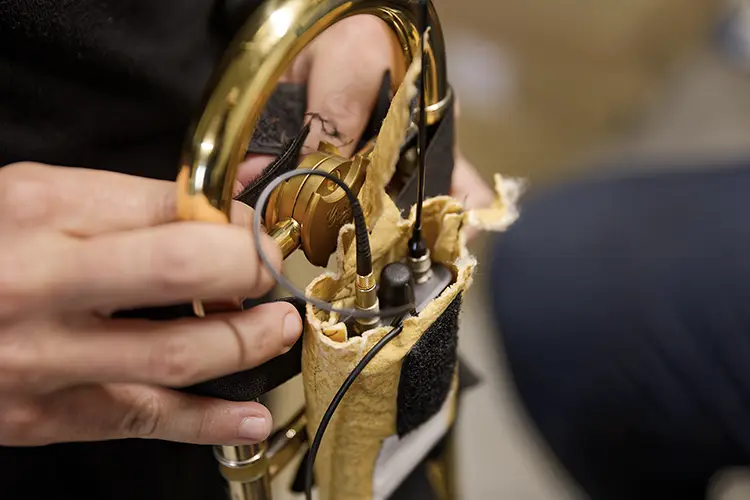
The performers wore their bodypacks in pouches under their costumes, but “even so, every now and then one of the bodypacks would end up in the sand”, van der Spoel recalls. “This was especially problematic for Matija Franješ, who played Cerberus, the hound of Hades—a role that required him to roll around in the sand frequently. Sand in the equipment was almost unavoidable, as was the case during some dance and acrobatic performances. But even under these extremely harsh conditions, the functionality of the SEK bodypacks was never compromised”.
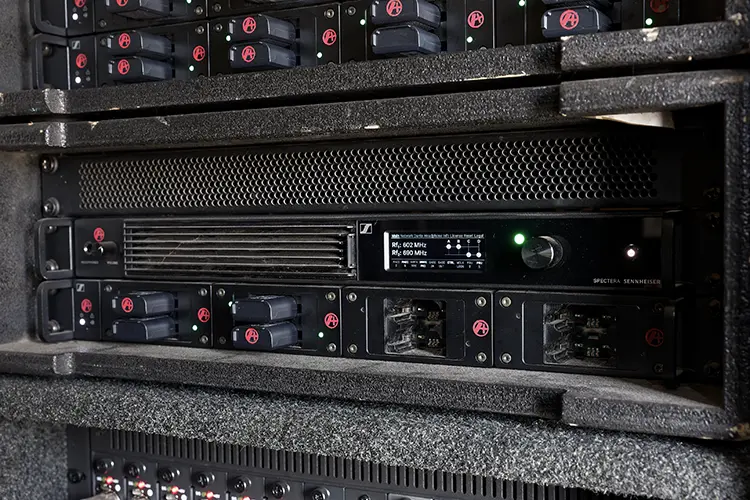
Not even the Base Stations stored in a container were spared from the pervasive sand: “Even though there was less sand there, it still managed to get into every nook and cranny of our production containers, meaning I had to clean the ventilation grilles of the Spectera Base Stations regularly”, said van der Spoel. “When the performance season ended, I carefully opened both units to remove any sand that might have entered”.
As is common in productions of this kind, the equipment was not switched off between performances to avoid unpleasant surprises when turning it back on, especially due to possible moisture ingress. At the end of the season, van der Spoel’s conclusion was clear:
Based on our experience in the sand depot, I can confirm that the Spectera SEK bodypacks are ideal for use in harsh environments. The performers also praised them. When they walked to the crew catering area, located some distance away, with their bodypacks turned on, the wireless connection eventually cut off cleanly without any audible interference. Likewise, we could replace battery packs without any noise while the system was running.

Smart control
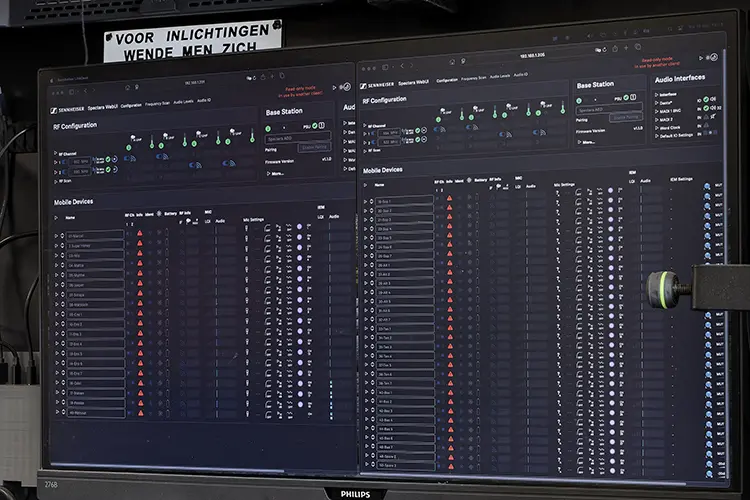
Van der Spoel made extensive use of the ability to remotely configure SEK bodypack parameters through Spectera WebUI. “I set the pre-amplification for the headworn microphones in close consultation with my FoH colleagues”, he explained. “All bodypacks were configured to the same level, regardless of the user’s vocal volume. For the mobile musicians, I set a control range of –40 dB to +3 dB for their in-ear monitors. I also found it very helpful that the software alerts you when a plug starts to come loose from its socket. At first, I had to get used to the fact that the potentiometer on the SEK bodypack has no physical start or end point and can rotate endlessly, but in practice, it hasn’t caused any issues”.
Up in the air: DAD antennas on the lighting towers
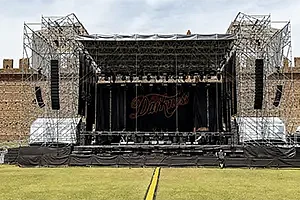
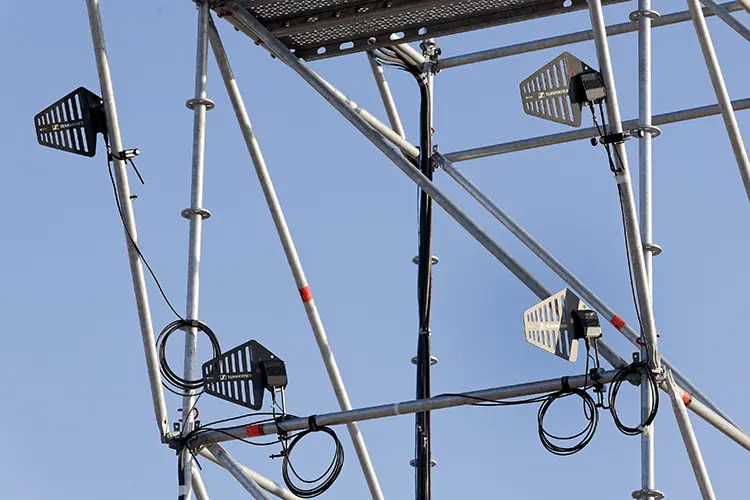
Van der Spoel installed four DAD antennas at different heights and positions on each of the two lighting towers. The antennas were connected to the Spectera Base Stations using Cat 5e cables up to 50 metres long. “Signal transmission over Cat cables works perfectly”, said van der Spoel. “I wired the antennas so that each antenna on the left and right of the performance area corresponded to each of the 8 MHz blocks of a Base Station”.
 |
 |
4 × 8 MHz for Zummerbühne
Spectera operated across four 8 MHz blocks, with centre frequencies of 522, 554, 602 and 690 MHz. “With all the possibilities Spectera offers in the UHF band, I can work extremely well in the Netherlands”, said van der Spoel. “Once you’ve completed the frequency scan, you can always position the 8 MHz blocks sensibly in the spectrum, especially since it’s not necessary to strictly adhere to existing TV channels. I’m particularly impressed that Spectera’s audio channels can be placed very close together without creating interference or artefacts”.
Greater efficiency: Spectera Speeds up setup
Van der Spoel noted that with Spectera, the wireless equipment could be put into operation much more quickly than in previous years, when products from another company were used.
Once the basic parameters are defined, Spectera automatically applies the remaining settings and synchronizes the SEK bodypacks assigned to the Base Station. It’s far more convenient. I was able to save around one-third of the setup time I previously needed. A very useful feature is that the laborious task of labeling each bodypack disappears, as the assigned user’s name is continuously displayed on the e-ink display, even when the battery packs are removed.
Van der Spoel is pleased with the BA 70 lithium-ion battery packs powering the bodypacks: “The BA 70 packs have enough power to easily last an entire performance. I began handing out the SEK bodypacks at 6 p.m., and the show didn’t end until about 11 p.m.—and even when used with the bidirectional function, they still had 15 to 20 percent capacity left”.
Impeccable sound that speaks for itself
Asked to compare Spectera with analogue IEM wireless systems, van der Spoel is unequivocal: “There’s simply no comparison. There is a world of difference between conventional analogue wireless technology and the Sennheiser Spectera system. There’s no noise anymore; the sound is transparent and open. I can even hear the difference at my RF console when monitoring the audio with my Sennheiser HD 25 dynamic headphones. I’m very happy with the sound, and so are the musicians. When our sound designer, Jannes Noorman, heard the sound transmitted by Spectera for the first time at the sand depot, he was immediately impressed. I’ve worked with Jannes for many years, but I’ve rarely seen him with such a broad smile as when he first listened to this system”.
To transmit the audio signals, van der Spoel selected the “Live” audio link mode for both microphone and IEM channels. This mode uses Sennheiser’s proprietary SeDAC codec, which has a latency of just 1.6 milliseconds. “I have 49 SEK bodypacks in operation, and all users receive the same audio quality”, van der Spoel explained. “The fact that our entire audio signal flow is fully digital also benefits the overall sound: from the initial A/D conversion to the digital inputs of the power amplifiers, there are no longer any analogue intermediate steps. Everything runs at a 24-bit word length and a 96 kHz sampling rate. The two Spectera Base Stations are connected via MADI to the stage I/O rack of the digital mixing console”.
At the Spectera premiere in Groningen, Kasper van der Spoel was supported by Sennheiser RF specialist Vincent Tilgenkamp and Ivo Dousi, Business Development Manager. Following Tilgenkamp’s advice, two passive omni-directional A 1031-U antennas were added to the wireless setup, as mobile musicians sometimes performed inside metal containers, which weakened RF reception. The solution was to install a Sennheiser A 1031-U antenna outside the container and place its counterpart inside, linking the two with a short coaxial cable. “Only an expert would come up with the idea of installing a passive passthrough like this”, van der Spoel admitted appreciatively. “You learn something new every day”.
'What the hell is that?'
In Gronieken, Jannes Noorman not only operated the FoH console for many of the performances, but also handled the sound design together with his colleague Peter Zwart. The experienced team created a top-level signal chain for the show, beginning with Sennheiser Spectera and ending with high-end loudspeakers optimised for the venue’s particular conditions.
“Before Gronieken, I hadn’t had the chance to work practically with the new Sennheiser Spectera system, and during the first rehearsal on-site I was completely surprised—in a very positive way: the sound is simply stunning!” Noorman said. “Our lead actor, Marcel Hensema, looked at me during that rehearsal and asked, completely blown away: ‘What the hell is that?’. He immediately wanted to know more about the new Sennheiser system because he might want to use it for his solo projects in the future”.
Noorman continued: “That excellent first impression was fully confirmed during the subsequent rehearsals and performances. I had to make far fewer adjustments to the individual microphone channels on the console EQ than I would with other wireless systems. And I’ll gladly repeat it: Spectera sounds fantastic—especially in combination with the internal floating-point processing of our mixing console and the optimal setup of our PA system. The Spectera bodypacks also proved to be very robust, withstanding the extremely harsh sand-depot conditions without issue. And of course, I listened to the in-ear channels as well, and my positive impression of the microphone signals applies just the same”.

Spectera’s sound has left a mark
Summing up his experience at the end of the season, van der Spoel stated:
Although the system has only recently been launched, everything ran smoothly, and I’m sure future software updates will bring even more exciting features and refinements. The audio quality of the Sennheiser Spectera system is flawless and far surpasses all the products we have used for Zummerbühne in recent years. The sound of Spectera has truly left a mark on us.