If Thee Sacred Souls evoke the raw soul-funk sound that Amy Winehouse popularized in the early 2000s, it’s no coincidence: in their early days, they shared the independent label Daptone Records with the iconic British singer, along with a vintage aesthetic, an organic production philosophy, and part of the same creative circle.
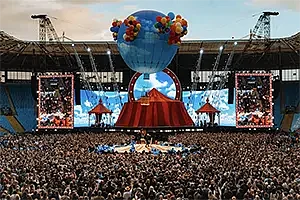
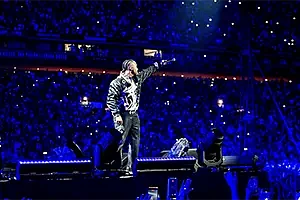
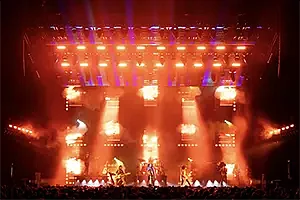
Fans of Thee Sacred Souls will have plenty of opportunities to experience the band’s unmistakable sound this year. The group’s three core members, joined live by an extended lineup of musicians, will travel across much of the world following several special performances this spring, including two nights at Los Angeles’ Greek Theatre. The tour continues through Asia and Oceania in May, European festivals in June, the UK in July, and returns to North America in August and September with The Constellation Tour.
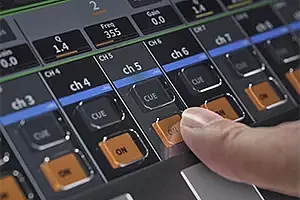
Every show on the tour will run on DiGiCo Quantum consoles. The Quantum326 will serve as the main workhorse thanks to its powerful processing and compact footprint, making it ideal for a wide range of venues and productions. The consoles are being supplied by Sound Image — a Clair Global brand — from its Escondido, California office. Quantum338 consoles and other Quantum models will also be available for international fly dates, along with an SD-Rack stage box.
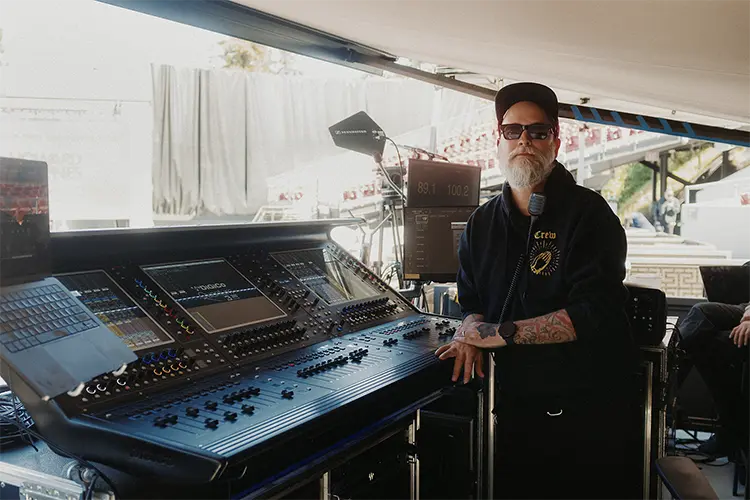
DiGiCo is always at the top of our riders; for the May tour, ninety percent of the gear will be DiGiCo. Whenever we’re touring across the United States by bus and trailer, we always bring a DiGiCo with us. It’s been my favorite console throughout all these years, explains Josh Benton, Thee Sacred Souls’ FOH engineer for the past five years.
The band’s relationship with DiGiCo dates back to a 2025 appearance on Austin City Limits. “At the time we were using a different console; Austin City Limits was one of those dates where we worked with locally provided gear, and they had DiGiCo Quantum338 consoles there”, Benton recalls. “During soundcheck and line check, our lead singer Josh Lane grabbed the microphone and said, ‘This is the best mix I’ve ever heard. What are we doing differently?’ Then the monitor engineer replied, ‘We’re using a DiGiCo.’ Josh looked at me and said, ‘Can we use these consoles from now on?’ We switched to DiGiCo and never looked back. And that’s a true story!”
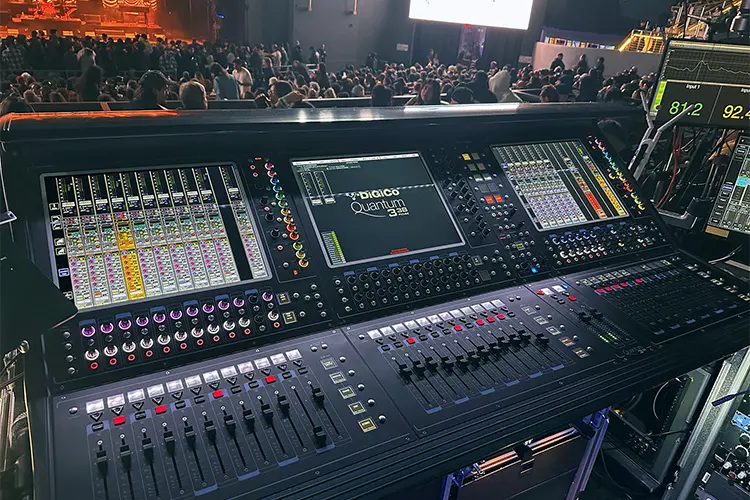
Although he has used both the Quantum326 and Quantum338 for Thee Sacred Souls shows, depending on availability and the type of performance, Benton says the Quantum326’s features and flexibility make it his ideal touring companion.
“Both consoles are excellent, but for touring I prefer the Q326 because it’s more compact. We both really appreciate the flexibility of the consoles. Needless to say, they sound incredible, and the ability to move any function anywhere allows each of us to configure our workflow exactly how we want in any situation. I’m also a huge fan of being able to swap DMI cards; if we want to use different protocols on the back of the console, we just swap the card and we’re ready to go. Honestly, that’s been a huge advantage since we started using the Dante protocol”.
Benton also highlights Quantum’s Mustard processing, especially its optical compressors and other dynamic tools, as well as several Spice Rack EQ features. But what truly makes the Quantum326 such a perfect fit is its ability to adapt to both his workflow and the band’s stage setup.
Our input list isn’t particularly large — it doesn’t exceed 40 channels — and they don’t use playback tracks either: if you don’t see it on stage, it isn’t happening. That’s why Quantum’s processing power goes far beyond what we actually need. I could have two full bands on stage, double the input count, and still have plenty of power left over, even including effects returns and additional processing. That allows me to focus entirely on the mix and on a live production that can become fairly complex. While the core band is made up of three musicians, onstage we’re usually at least 11 people, and sometimes as many as 15 when we add a string quartet, as we did at the Greek Theatre shows in Los Angeles. On top of that, with a single SD-Rack we can handle both our own needs and those of the guest artists touring with us, which is also something we plan to continue during the summer run, all within the same infrastructure. That makes the entire workflow much faster and more efficient, he explains.
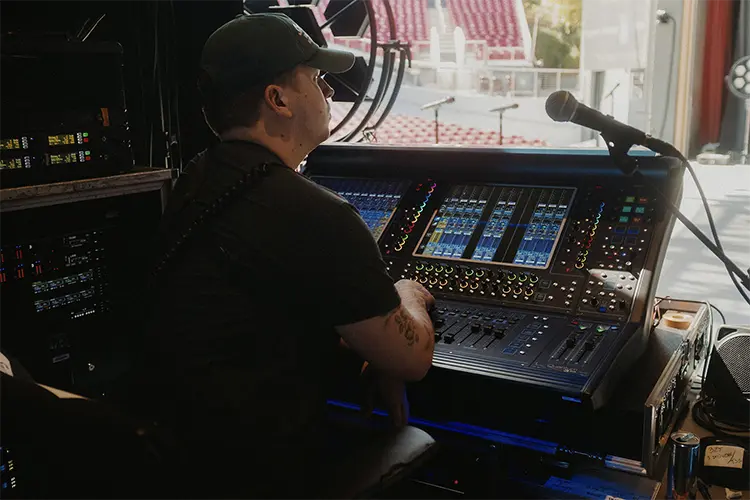
On the monitor side, Zac Gerig also handles a demanding workflow, combining IEM systems with traditional wedges. “When we bring strings, that means 12 stereo in-ear channels and six wedge mixes”, he explains. “Monitor world gets busy”. That’s also why he’s equally enthusiastic about the Quantum326. “What I love is that I don’t need any external gear; all my processing happens directly inside the console itself”, he says. “So I’m using all the built-in Spice Rack and Mustard EQ processing. The best part about not relying on outboard gear is being able to fully take advantage of everything Quantum has to offer”.
For example, Gerig describes the Mustard Source Enhancer — a tool designed to reduce microphone bleed and minimize feedback risk — as “a total game-changer”, thanks to its ability to apply sidechain processing to a specific frequency, something very few similar processors can do.
“We have a couple of singers with softer voices onstage, and the MSE makes a huge difference in reducing stage bleed. There’s also one song where the lead singer walks through the crowd while singing and goes as far as the stage design allows him to. The Mustard Source Enhancer’s ability to keep the delay and PA out of the microphone is a massive advantage. In fact, we recently did a show on an older DiGiCo console that didn’t have that feature, and it really made me miss the Mustard processing”.
But for Gerig, it all comes back to workflow.
I love the control surface and the workflow, as well as the flexibility DiGiCo gives you to customize layers and macros. In monitor world, the most important thing for me is speed, but without sacrificing sonic precision. I try to make every adjustment possible with just a couple of button presses, because during line check — or at a festival where there’s no time for a proper soundcheck — the 15 people on stage can all talk directly to me through talkback. If I take more than ten seconds to react and make adjustments, I fall behind. Quantum gives me the workflow I need to keep up with everything happening onstage. If any issue comes up, I can get to the right control and solve it in seconds instead of minutes, and that makes an enormous difference. There’s a huge amount happening simultaneously at every show, but I’m able to keep everything under control thanks to Quantum’s surface design and incredible flexibility. That’s why it has become my favorite console for everything, he says.
Image captions:
(Photo credits: Ben Zucker/@benzckr)
- DiGiCo_TSS_1 – FOH engineer Josh Benton at a DiGiCo Quantum338 console
- DiGiCo_TSS_2 – Monitor engineer Zac Gerig working on a DiGiCo Quantum326 console
- DiGiCo_TSS_3 – Thee Sacred Souls’ FOH mix position during the recent Greek Theatre shows