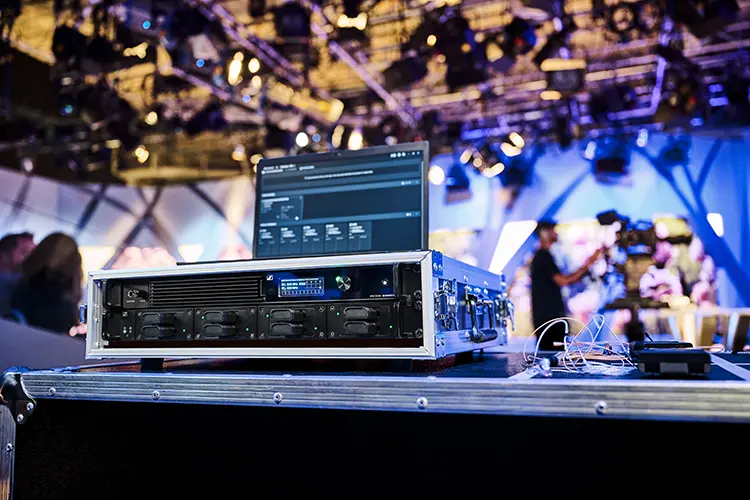
At IBC 2024, Sennheiser marked the beginning of a new era in wireless digital audio transmission with the world’s first bidirectional wideband solution: Spectera.
Utilizing the innovative WMAS (Wireless Multichannel Audio Systems) technology, Spectera reduces the complexity of wireless systems while enhancing capabilities, allowing time-saving workflows and providing full remote control and monitoring, including continuous spectrum detection.
Spectera features bidirectional bodypacks that handle both IEM/IFB and microphone/line digital signals simultaneously. The solution is resistant to RF attenuation and allows flexible use of the wideband RF channel, for example, for digital IEMs with a spectacular latency of up to 0.7 milliseconds.
We are thrilled to see how years of technological development and spectrum policy work are turning into a digital wireless ecosystem that will solve many of the problems faced by users of wireless multichannel systems today. Our wideband solution will be ideal for large productions, whether in touring, broadcasting, theater, or any other area requiring multichannel audio setups. Spectera meets the major customer demands for ease of use, operational reliability, and flexibility. It offers less hardware, dramatically reduced frequency coordination, redundancy, and the flexibility of an ecosystem that grows with your needs, say co-CEOs Dr. Andreas Sennheiser and Daniel Sennheiser.
Driven by WMAS – the wideband approach
Bidirectional wideband transmission addresses many of the typical challenges faced by users, operators, and owners of wireless audio systems today.
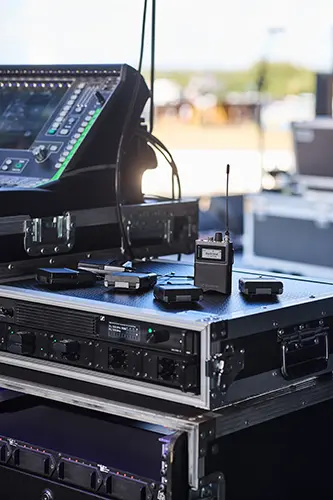 These challenges include complex frequency coordination and complicated rack wiring for high channel counts, and the large footprint that a multichannel wireless system still occupies, whether in storage, on a tour, or backstage, both in terms of space and the time required for setup, teardown, and configuration.
Bidirectional wideband transmission solves many issues typical of multichannel wireless systems. For example, large racks backstage with IEM transmitters and microphone receivers can be replaced with a single smart base station.
Sebastian Georgi and Jan Watermann are the inventors of Sennheiser’s specific approach to WMAS. The technology they developed is a patented variant of OFDM-TDMA, adapted for bidirectional multichannel communication and low latency. They compare this wideband approach to the standard narrowband technology: “Instead of many 200 kHz RF carrier frequencies, we use a single wideband RF channel for audio transmission, or more precisely, bidirectional audio and control data transmission. In Sennheiser’s approach, the wideband RF channel is a 6 or 8 MHz TV channel, depending on local regulations. The WMAS system organizes its audio links within this channel. Each audio link, whether a microphone or IEM, is allocated specific time slots to transmit its audio information; for the first time, it is possible to have IEMs and microphones on the same TV channel instead of two separate channels with a guard interval. By utilizing the RF channel width during its turn, RF attenuation is significantly reduced. This results in a 40 times greater diversity for an 8 MHz RF channel and 30 times greater for a 6 MHz TV channel. Additionally, the spectral density is low, which facilitates frequency reuse, for example, at a festival, among neighboring theaters, or in a broadcasting complex”.
Reduced system complexity
One of the most surprising innovations in the Spectera ecosystem is undoubtedly the base station, which, in a single 1U rack unit with 32 inputs and 32 outputs, replaces a rack full of wireless microphone receivers and IEM transmitters. A whole production could be accommodated on a single wideband RF channel (6 or 8 MHz). The smaller size also extends to the bodypacks, which handle both microphone/line and IEM/IFB requirements simultaneously.
Having just one pack is not only a great advantage for performers but also simplifies the work for the sound engineer, who has one type of pack and can, if needed, quickly add an IEM to a microphone. Storage also becomes less complex, with one base station and two frequency variants – UHF and 1G4 – for bodypacks and antennas, says Bernd Neubauer, Spectera Product Management.
The future of pro wireless audio is here – and it’s bidirectional
Spectera represents a complete shift in control and monitoring: it not only offers a feedback channel but continuous bidirectional communication at all times for full remote control. Through the continuous flow of control data, audio settings can be adjusted, IEM and microphone levels adapted, RF health and battery status monitored, and much more. AES 256 encryption (AES 256 CTR Mode with >10k years of expiration) for audio and control data ensures the privacy of necessary data.
Furthermore, all units assist in spectrum detection, meaning they search for potential interference from other RF sources. With Spectera, it is possible for the first time to see “behind” the RF channel being used and detect interference.
Excellent audio quality
Spectera offers the characteristic digital audio quality of Sennheiser for microphones, instruments, and IEMs, using various audio codecs optimized for the application, all processed internally with 32-bit floating-point precision.
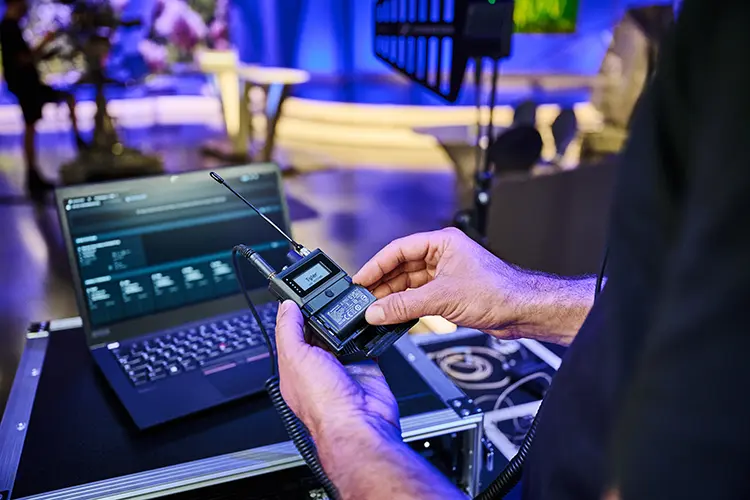
Eleven audio link modes allow selectable control of audio quality, latency, number of channels, and operating range for each audio link, flexibly during a production. The operator can always use the RF channel to its fullest, either providing fewer high-quality audio links or allowing more links and reducing quality accordingly. Regardless of which audio link mode is selected, Spectera delivers incredibly clear sound, which “will be a revelation for IEM users", says Neubauer. “With Spectera, you get impressive digital clarity and precision in IEMs with ultra-low latency of up to 0.7 milliseconds. Dual Mono transmission ensures clean channel separation in the ear, enhancing the sound stage for optimal performance”.
Benedikt Euen, Spectera Product Management, adds: “Spectera greatly respects spectrum resources by allowing IEMs and microphones to be on the same TV channel. It also simplifies frequency coordination among engineers at festivals and enables faster workflows. For example, if a large band is waiting to perform at a festival, it will only take a simple unmuting of their RF for the band to be 'on air.' While narrowband systems tie you to a fixed set of frequencies and features, Spectera allows you to manage your show or production in a fully flexible manner. Need an additional IEM? No problem! Need to fit another artist into your 64 audio links? It can be accommodated!”
A detailed look at Spectera components
The base station – 1U, up to 64 wireless audio links
The rack-mounted base station is the heart of the Spectera ecosystem and a real space-saver. It handles up to 64 audio links, meaning 32 inputs and 32 outputs, in a 19”, 1U format. A base station accommodates up to two wideband RF channels. The base station is frequency-agnostic; activating the respective local license for the base station will automatically load the authorized frequency ranges.
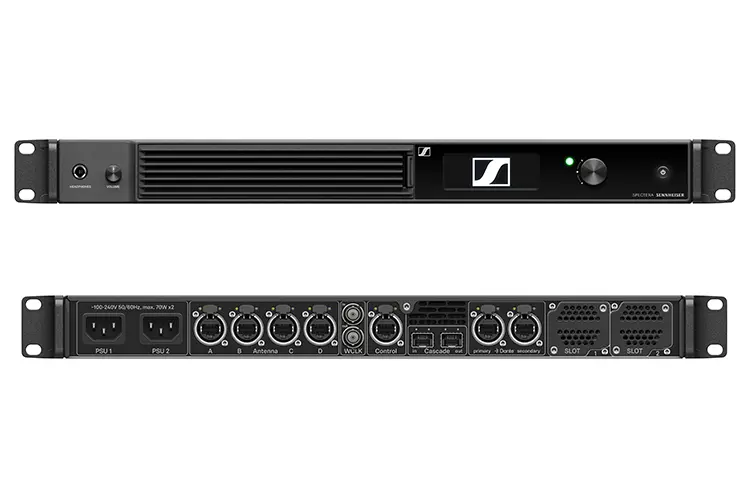
Redundancy has been key in the design of the base station. It features two power supplies (PSUs), primary and secondary Dante connections, two slots for optional redundant MADI connections (optical or BNC), and four antenna ports. These ports not only allow for redundancy but also extended and synchronized antenna zone coverage or increased system capacity through the use of additional frequency ranges. Cascade ports on the unit will be activated with a future firmware update. Notably, there are no RF components in the base station, so there is no interference with other wireless equipment in the rack.
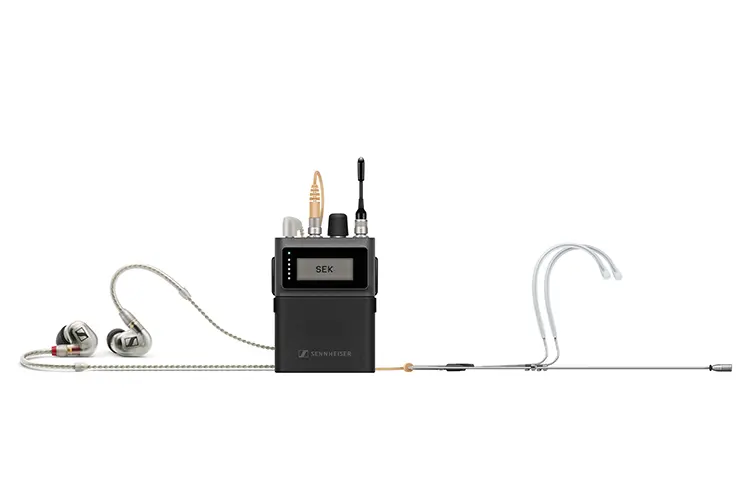
The SEK bodypack – does it all – microphone and IEM
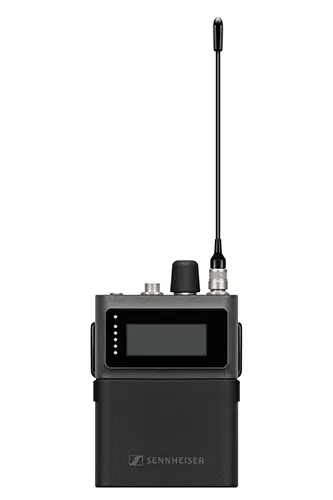
The SEKs are also space savers because the same bodypack can handle both IEM and microphone or instrument requirements, and this can be determined and changed flexibly during a show.
 |
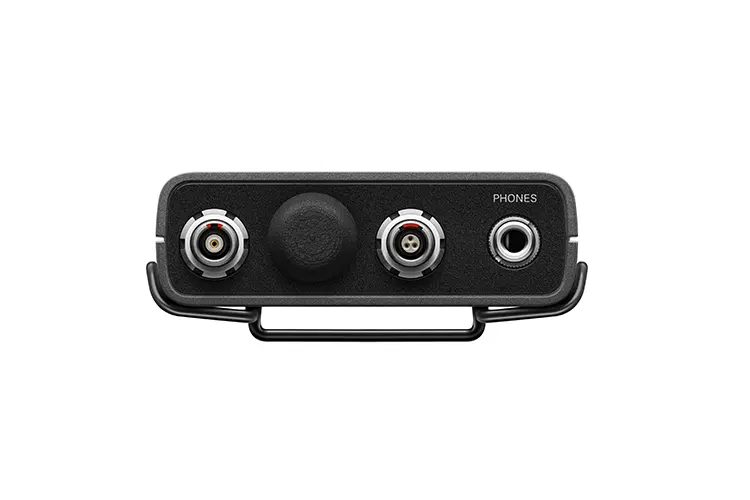 |
The SEK bodypack features a 3-pin connector for a lavalier or headworn microphone (choose from a wide range of Sennheiser models) or an instrument cable (such as the CI 1-4). The 3.5 mm jack connects to Sennheiser’s range of professional in-ear headphones and includes a high-power headphone amplifier with impedance adjustment. The SEK is equipped with a persistent display, where device information remains on the screen even when the unit is turned off.
The bodypack is available in a UHF variant (470 – 608 MHz and 630 – 698 MHz) and a 1G4 variant (1350 – 1400 MHz and 1435 – 1525 MHz). It is powered by a rechargeable BA 70 battery (the same as for Evolution Wireless Digital) and can provide up to seven hours of operating time depending on the selected configuration.
The DAD antenna – a quite different antenna
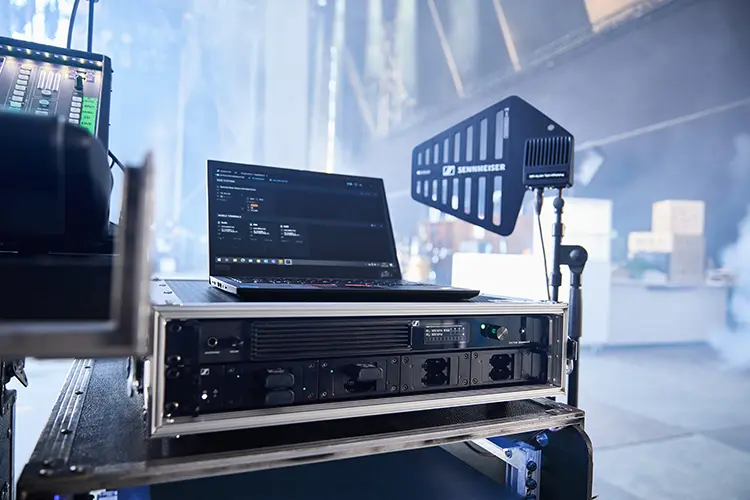
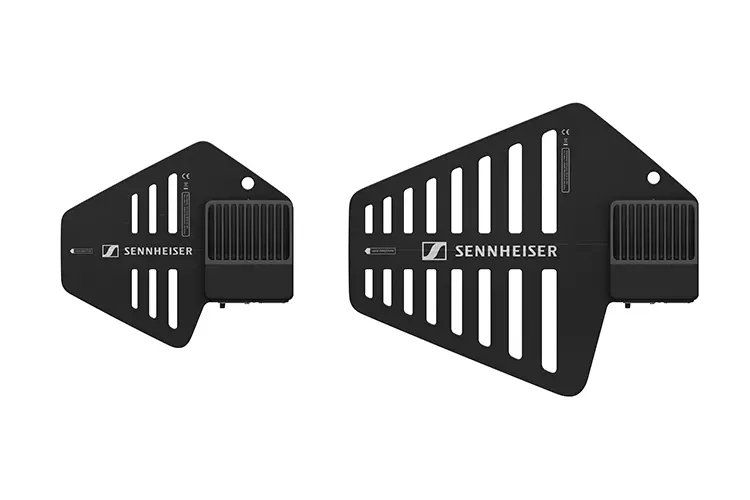
The DAD antenna with IP 54 protection is a transceiver antenna that handles microphone/line signals, IEM signals, and control data simultaneously. The antenna carries the system’s RF components, eliminating the need for amplifiers, splitters, and combiners. The RF is digitized here, so the DAD antenna does not use a BNC connector and coaxial cable for connection to the base station but rather a robust RJ 45 connector and CAT 5e cable, which are much easier to handle, more cost-effective, and less prone to cable losses than coaxial cables. The antenna is powered by the base station via PoE.
LinkDesk software
If the base station is the heart of the Spectera ecosystem, the new LinkDesk software is its backbone. The desktop application works on Mac or PC and turns the device into a control and monitoring hub.
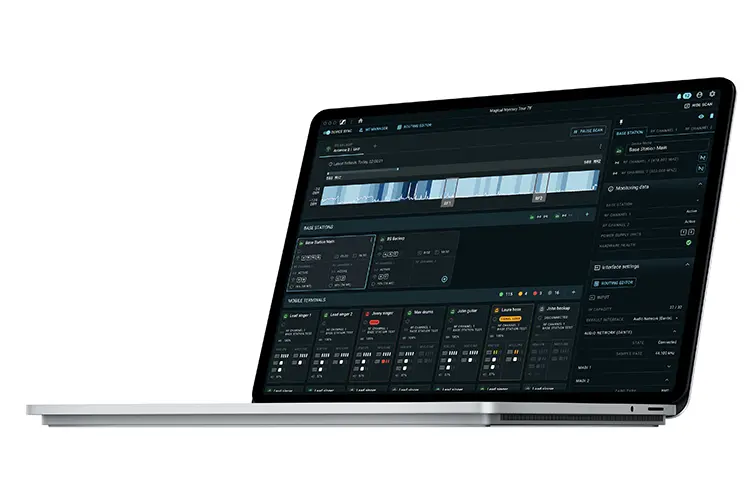
Here, the operator can choose from audio link modes with their various levels of audio quality, latency, possible audio links, and range, as well as full remote control, and monitor the system with visibility of all audio settings and RF statuses.
Euen explains: "Setting up a multichannel wireless system can be a real challenge on the software side as well. Therefore, we introduced assistive behaviors to make system management as fast and intuitive as possible. LinkDesk also stores productions, so operators can quickly recall their system settings and save time at the event". Smart notifications offer additional assistance.
The LinkDesk software also handles base station activation through node-based licenses. By entering the specific local license code, the software ensures that the system operates within local regulatory requirements for frequencies, RF channel bandwidth, and transmission power, ensuring operators comply with regulations.
Availability and ecosystem advancement
Spectera can be pre-ordered starting today. The shipping start date will be announced during the first half of 2025. Throughout the year, there will be a special introductory price.
Spectera will evolve over time with ongoing improvements in hardware, software, features, and services. On the hardware side, the next addition will be the handheld transmitter SKM. As for features, the implementation of the SMPTE ST 2110 standards family for professional media signal transmission is planned, which can be achieved in the meantime with Merging Technologies’ Hapi.

"The Spectera ecosystem is a tool for the industry that will help tackle the problems that have complicated the use of wireless systems so far", says Neubauer. "We will collaborate with the industry on the new technology and obtain valuable feedback from customers on system performance, usage scenarios, and future updates".
New applications on the horizon
Spectera will not only revolutionize multichannel wireless audio but will also open up many new opportunities. 3D immersive audio is one such opportunity. Thanks to its word clock synchronized for RF audio, Spectera will be the first solution capable of capturing coherent phase wireless audio for immersive recording and playback, says Andreas Sennheiser.
"With the workflows this ecosystem facilitates, we will see new creative uses of wireless audio technology", concludes Daniel Sennheiser.