



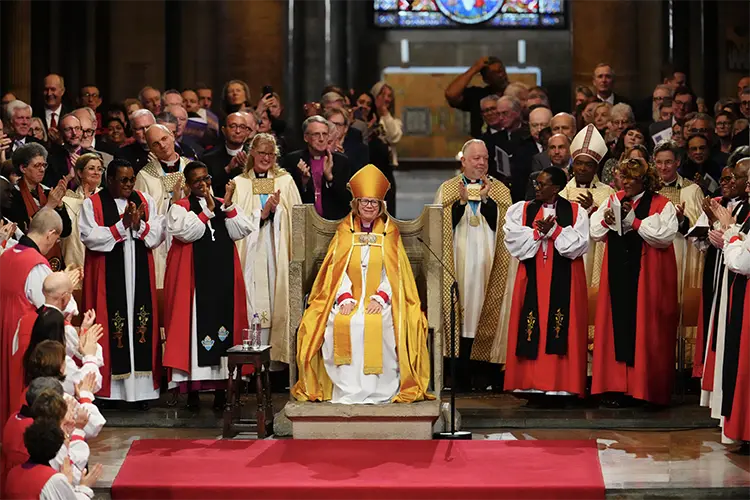
Canterbury Cathedral hosted one of the most significant moments in the 1,400-year history of the Church of England: the installation of Sarah Mullally as the 106th Archbishop of Canterbury, the first woman ever to hold the office.
Seated in the Chair of St. Augustine before around 2,000 guests — including Prince William and the Princess of Wales, as well as representatives from the Commonwealth, the United Nations, and church leaders from around the world — the ceremony required an audio infrastructure of the highest standard, particularly as it was broadcast live by the BBC to an audience of millions.
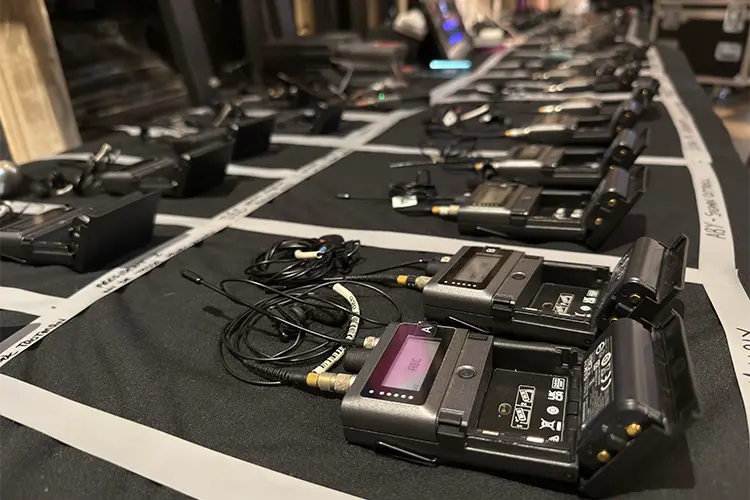
To support the event, d&b solutions deployed Sennheiser’s Spectera wideband wireless system across the Cathedral’s 160-metre length. The setup included 42 beltpacks operating across two Base Stations, ensuring clear and reliable transmission throughout the ceremony.
George Veys, Project Manager at d&b solutions, was among the first industry professionals to recognise Spectera’s potential, placing the company’s order during the product’s official unveiling at IBC 2024.
Our initial interest came from wanting to invest in a state-of-the-art technology that would give us rental flexibility in an increasingly crowded RF spectrum, while also providing a versatile product capable of operating as an IEM receiver, a microphone transmitter, or both simultaneously.
Since then, d&b solutions has deployed Spectera on an increasing number of projects, with Canterbury Cathedral representing its most ambitious deployment to date.
The company has a long-standing relationship with the Church of England and Lambeth Palace, and therefore became involved in the project at an early stage. What was initially planned as a simple live stream evolved into a full BBC broadcast, expanding the technical requirements to include additional microphones, greater redundancy, and a robust signal path to the outside broadcast unit.
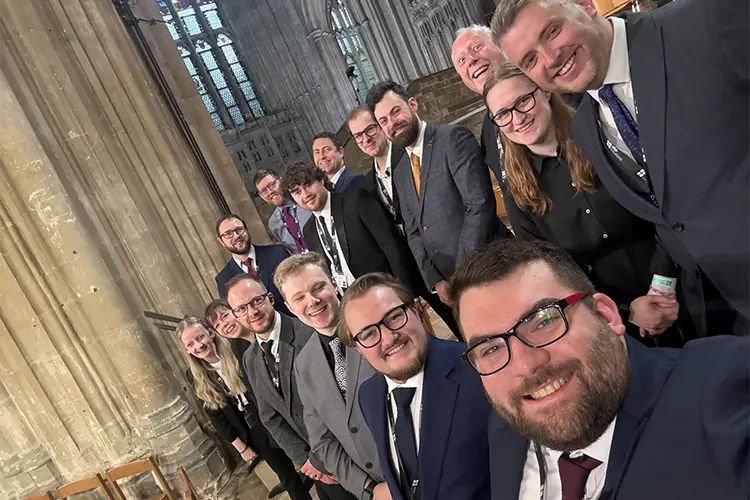
Dave Scarlett, Head of Audio (Live) at d&b solutions, explains: "From a very early stage, we identified that a significant amount of the Cathedral floor space would be used during the service, with processions and different parts of the ceremony taking place in various areas of the building".
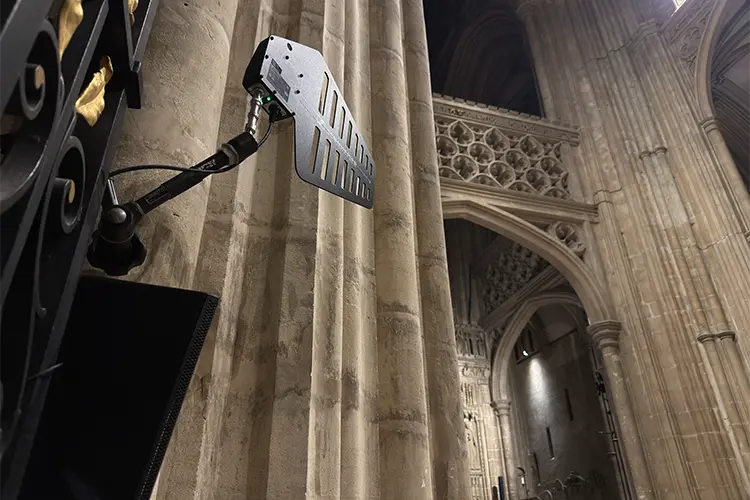
According to Scarlett, Canterbury Cathedral is much larger than it appears at first glance, with some antenna cable runs exceeding 100 metres in length.
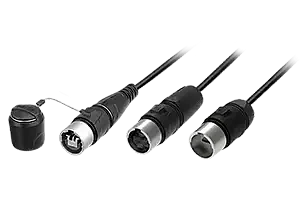
Using conventional systems would have required complex RF-over-fibre solutions involving combiners and challenging cable infrastructure. With Spectera, however, the CAT5 cables from the DAD antennas could easily be combined with fibre optic links using media converters with PoE injection, resulting in a much simpler and cleaner solution.
It was originally intended to be just a live stream, but it eventually became a full broadcast production. At that point, we knew we needed to upgrade the RF system to Spectera. The Archbishop entered at one end of the Cathedral and was installed at the other, so we needed to capture her consistently throughout the entire route. There was no other solution, adds Mitch Jones, Production Account Manager – Live Events at d&b solutions.
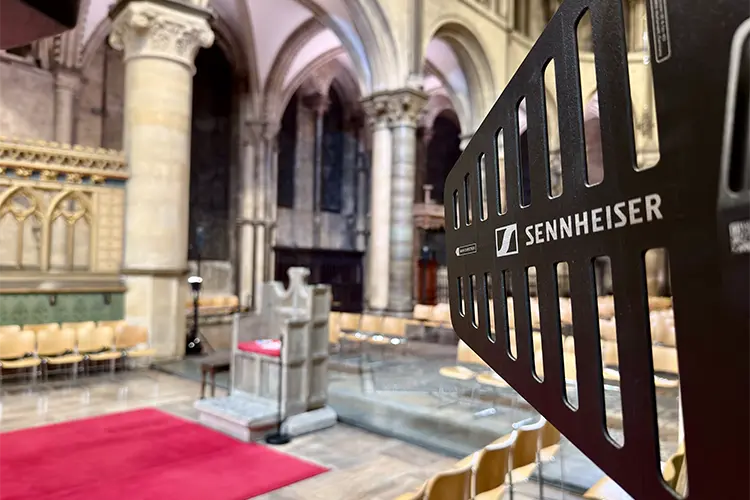
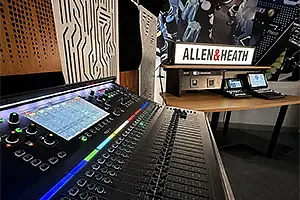
The final system comprised two Spectera Base Stations, eight DAD antennas, and 42 beltpacks operating in microphone mode. Supporting infrastructure included Allen & Heath mixing consoles, Yamaha I/O and conversion systems, and Netgear network switching. No IEM systems were used during the event, creating a microphone-only setup that, according to Scarlett, is highly unusual for a production of this scale. For the Archbishop herself, two beltpacks and two lavalier microphones were deployed, with one pack assigned to each Base Station, providing effective redundancy for the most critical audio source of the broadcast. All microphones were DPA models, including the discreet headset microphones used by the 16-member African choir.
The multiple output options available on the Base Stations also proved essential for broadcast integration. While the Dante outputs fed the audio network managed by d&b solutions, the MADI outputs were sent directly to the BBC’s outside broadcast unit, providing a reliable audio path alongside the digital distribution infrastructure supplied by the company. With every seat in the Cathedral occupied, Spectera’s compact footprint also proved crucial. A conventional narrowband 42-channel system would have required rack space that simply was not available.
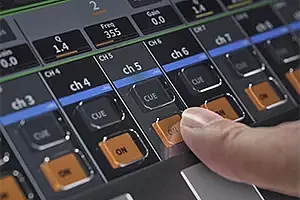
With dignitaries arriving from around the world, the team knew that not every microphone could be tested on its intended wearer before the broadcast began. The ability to remotely adjust parameters such as gain during the service was therefore essential. In traditional workflows, this would have required an additional antenna infrastructure dedicated to control data. With Spectera, mobile terminal control is carried within the main RF carrier itself, eliminating that requirement entirely.
The team also integrated Spectera with Sonoros, a UK-developed monitoring and control application, allowing microphone engineers El Ashwood, Carys Walker, and Ian Reeves to monitor system status and listen to individual feeds from anywhere on the Wi-Fi network via laptop or iPad. This proved especially valuable when fitting microphones to 42 people within a very short timeframe.
This was d&b solutions’ most ambitious Spectera deployment to date and its first using fibre-connected antennas at this scale. Working alongside Sennheiser’s Kevin Gwyther-Brown and Technical Application Engineer Marcus Blight, the team received extensive remote support, including access to a pre-release firmware version that helped optimise the performance of the fibre infrastructure. The pre-production phase also benefited from the SoundBase Spectera Mode Planning tool, which allowed link modes to be mapped and system capacity verified before any equipment was shipped.
For Mitch Jones, the manufacturer’s support played a key role in the decision: "The confidence Dave had in the system gave me confidence that it was the right solution. When you need to manage that number of beltpacks within limited space, a compact solution simply makes sense, and we were extremely pleased with the outcome".
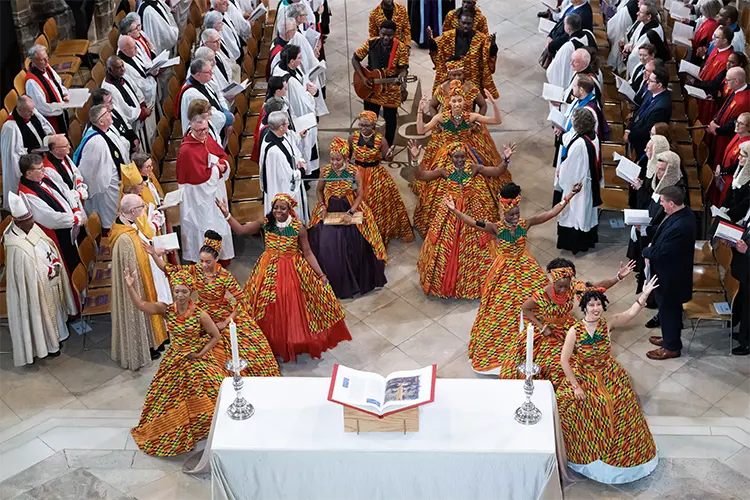
Load-in began on the Thursday before the ceremony while the Cathedral remained open to the public. The BBC began its setup on Monday, rehearsals took place on Tuesday, and the live broadcast was successfully completed on Wednesday without incident.
The outside broadcast team, initially cautious about using a receiver without XLR outputs, was ultimately convinced by the results. "After the event, they agreed that the deployment had been excellent and that the system had performed flawlessly", recalls Scarlett. "In an increasingly complex RF environment, products like Spectera are becoming essential tools".
For George Veys, the Canterbury ceremony demonstrated Spectera’s capabilities in particularly demanding environments:
The combination of high RF performance and the ability to operate seamlessly across multiple coverage zones was crucial in a venue of this size. This project perfectly matched the type of application we had envisioned for Spectera, and its performance fully met our expectations.