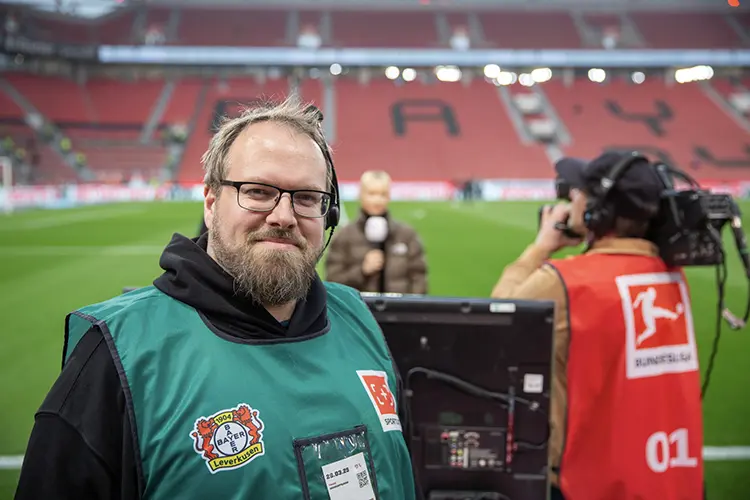
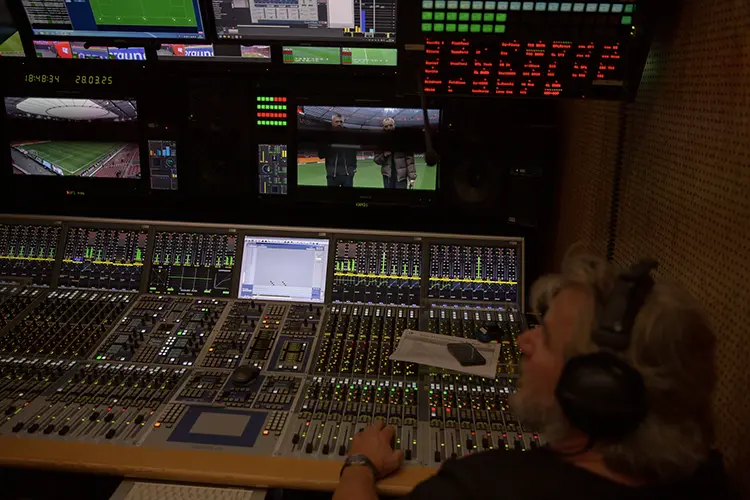
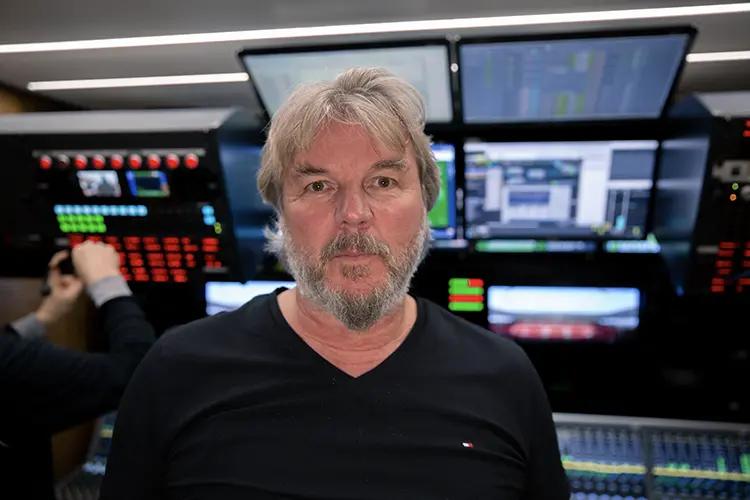
Before a German league football match is broadcast, sound engineer Ecki Kehrer and sound technician Daniel Kersten from the production company TopVision get to work.
With more than 30 years of experience in sports and football productions, TopVision has been an independent subsidiary of TVN Live Production since 2024, providing services to commissioning producer Sportcast – and therefore to German football fans – with thrilling live broadcasts direct from the stadiums.
Pitch microphones and wireless systems for interviews bring the excitement of a live match into the homes of TV and streaming audiences.
So, what does a typical Saturday look like for Kehrer and Kersten, and what do they think of the new Sennheiser MKH 8018 stereo shotgun microphone?
 |
 |
Three days before the match: preparation is key!
A few days before the match, TopVision receives the production plan prepared by Sportcast.
This document outlines how the production should be organized. For example, how many cameras will be used, how many reporters will take part, how many broadcasters will be served, and how many additional commentators need to be accommodated. It also specifies whether they need a monitor, and whether the commentary position should be fully or only partially equipped. From there, our team gets to work on the preparations, explains Ecki Kehrer.
Match day!
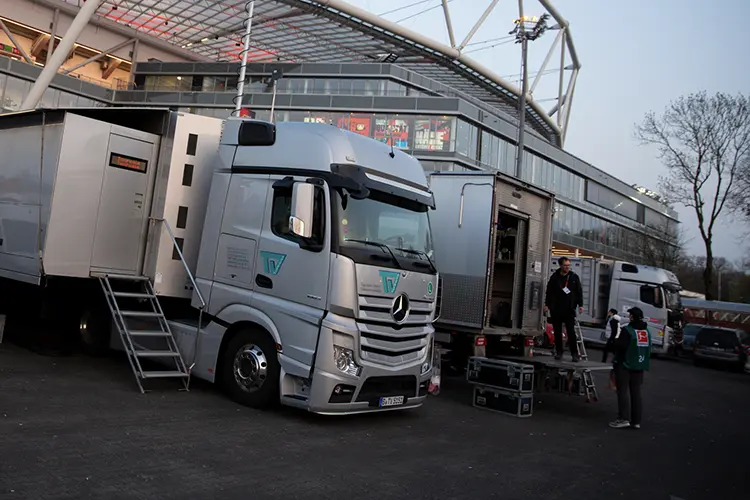
On the day of the broadcast, about six and a half hours before kick-off, Kehrer and Kersten begin work in the production truck, which is already parked in the stadium’s broadcast compound.
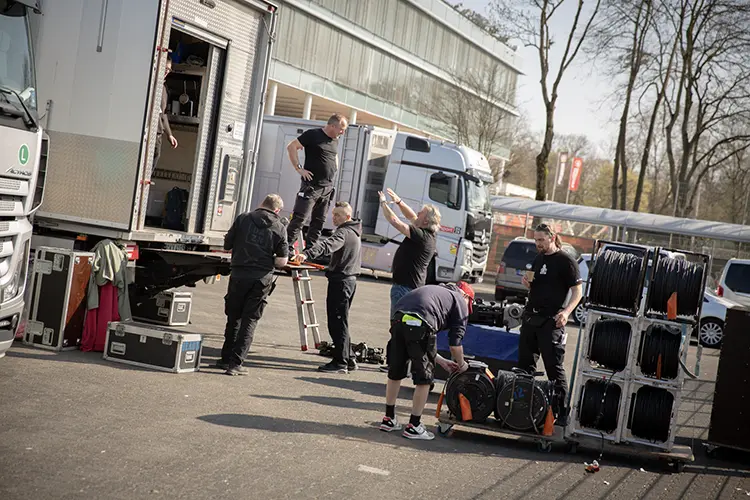
“It may sound incredible, but the OB van is a vehicle that’s much bigger on the inside than on the outside”, says Kehrer. “The side extensions double the interior space. The large OB van has four rooms, plus video and audio control. Next to it is the tender truck, our support vehicle, which contains all the equipment: cameras, microphones, monitors — everything we need. This equipment is loaded onto a trolley and taken to the edge of the pitch, where one of our colleagues sets up the microphones — and hopefully gets some help laying the cables. After all, together with the camera cables, we’re talking about several kilometers!”
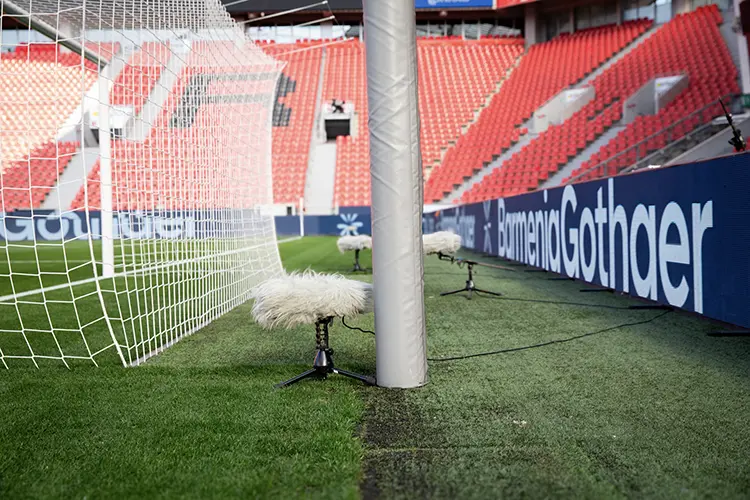
The commissioning producer Sportcast specifies the equipment to be used in the stadium to ensure that all league matches are broadcast to a consistently high quality. “On the pitch, that means 17 microphones: three behind each goal, one in the center, and two aimed toward the corners of the goal area”, explains Daniel Kersten. “Microphones are also installed in all four corners of the field. At the main camera position (Camera 1) we place three microphones — two at the 20-meter marks and one at the halfway line. On the opposite side of the stadium, there are four more microphones positioned between the 22- and 40-meter marks. In addition, we use ambience microphones to capture the crowd noise and create a more immersive experience”.
In the past, MKH 8060 and MKH 8070 shotgun microphones were used to capture on-field sound, but with the new setup, MKH 8040 cardioid microphones are now positioned around the edges of the pitch. As Kehrer notes: “Sometimes you want to hear the ‘close kicks’ — the sound of the players striking the ball — but you don’t want the microphone to be too directional, since they’re fixed and not moved around as shotgun mics would be”.
 |
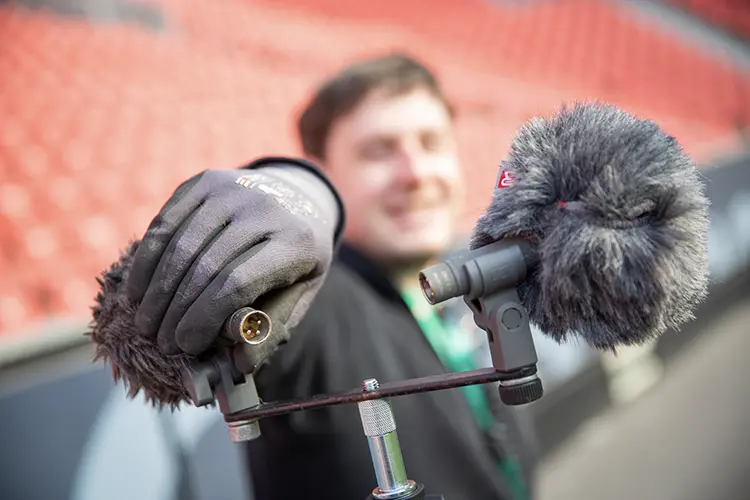 |
In our setup, what really makes the difference is the number of microphones. When you have 17 spread around the field, directionality becomes less critical. Of course, we still have it, but with so many microphones, the shorter ones work just fine. This happens more often than you might think, especially when both teams are warming up on the field. We start transmitting the signal an hour before kick-off, so the microphones are already in place. And maybe three or four times a season, one gets kicked out of place. If you’re lucky, you can just put it back where it was. If not, something breaks, explains Kersten.
Kehrer adds: “The microphones near the goal are especially at risk. We’ve had players who, after a foul or missing a goal, vent their frustration by giving the microphone a good kick. Unfortunately, that sort of thing happens from time to time”.
Optimum service for the customer
In addition to the pitch microphones, Kehrer and Kersten also set up the necessary wireless equipment.
TopVision offers different packages depending on what the broadcast client wants to provide to their TV or streaming audience, including presenter and analyst teams, field reporters conducting interviews, and of course guests such as players, coaches, officials, or other VIPs.
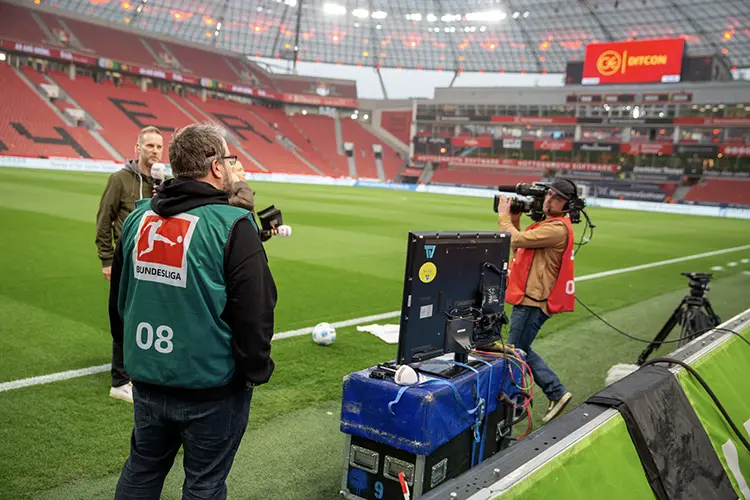
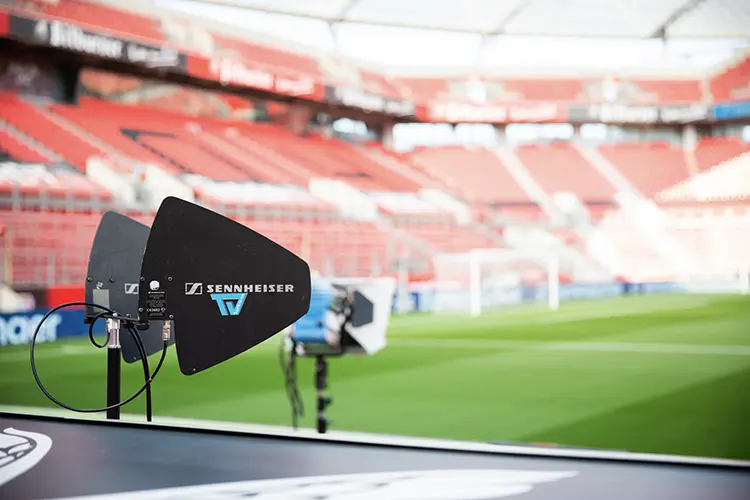
Kersten: “Wireless microphones and in-ear monitoring systems are used for presenters inside the stadium. We first study the venue to see where everything will fit and what the client has requested. Sometimes the packages are small and the workload isn’t too heavy. But other times, the packages are larger and the effort required — together with our colleagues in the OB van — is considerable. If a client wants to move around the pitch with a camera, we have to ensure that the audio is transmitted correctly and without dropouts. That requires careful planning: where do we place the rack and antennas? Where can we install additional antennas so the OB van can switch seamlessly from one to another?”
 |
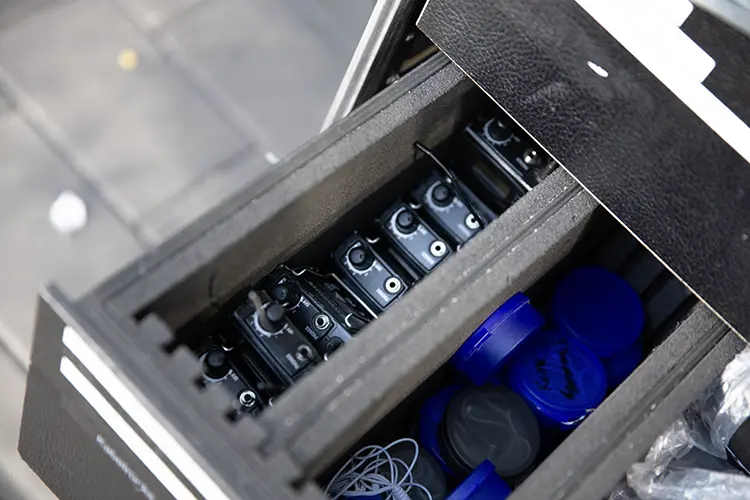 |
When asked whether on-field interviews are planned in advance or if there’s still room for improvisation, Kehrer explains: “Most of them are arranged before the match. There are fixed spots along the sidelines and in the mixed zone where interviews and presentations take place. During major matches, there can be up to 30 broadcasters in the compound, and everyone wants to do interviews! That’s why each outlet has its own assigned area, everything is coordinated in advance, and each one books its service package ahead of time. Of course, there can always be exceptions, especially during midweek matches. Sometimes the producer tells us: ‘Today we’ll have to do the interview in the press room because a player doesn’t want to come out and talk’. You have to be ready for such situations, since it’s not easy to run cables all the way to the press area or locker rooms. That’s why we’ve recently reinvested in Sennheiser equipment, like the EK 6042 two-channel camera receiver, which captures audio from both the reporter and the interviewee. It’s funny — you can go almost anywhere with a camera, but when it comes to sound, things get tricky, because sound is invisible... Nowadays, audio plays a fundamental role, even though television still tends to focus on the visuals”.
Wired microphones for cameras
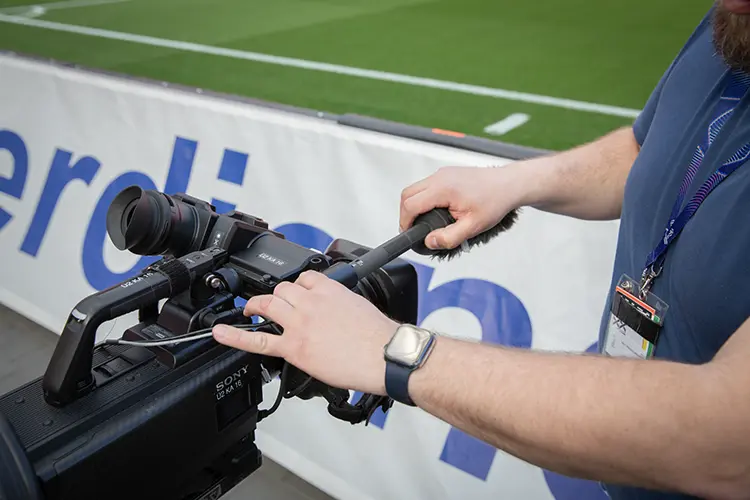
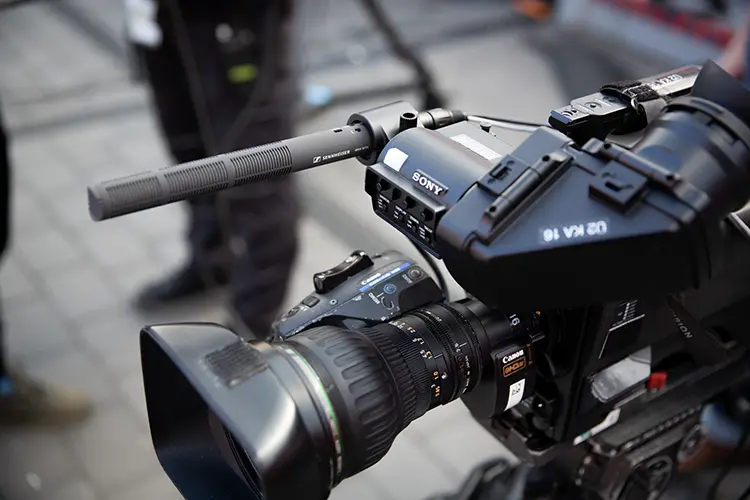
TopVision uses around 20 cameras during a match, about a quarter of which are handheld units equipped with wired shotgun microphones. While handheld cameras for interviews use mono microphones, those used to capture players arriving at the stadium, entering the field, or waiting in the locker room are fitted with MS stereo microphones.
“For example, we have an FX6 camera mounted on a gimbal, so we try to keep the weight as low as possible and use a compact microphone”, says Kersten. “Every gram you can save and every centimeter you can shorten is always an advantage”.
The new MKH 8018 stereo shotgun microphone
Kersten adds: “In the stadium, we use the MKH 8018 with the FX6 camera and gimbal, and we’re very pleased with both its handling and sound quality. On a small gimbal, even a few grams make a noticeable difference, and when combined with such a clean sound, it’s the perfect camera microphone for live broadcasts”.
The microphone provides excellent stereo definition — with a clear left-right separation — and a very balanced frequency response, allowing for a clean and natural capture of everything happening in front of the camera. We found its directivity to be superior to the previous 418-S model, enabling us to pick up details more precisely, even during subtle moments like when teams decide which side to play on before kick-off. Its bass response also impressed us — deeper than that of the MKH 8060 — but that’s something we appreciate: you can always remove low frequencies with a high-pass filter on the mixing console, but you can’t add them if they weren’t captured in the first place, concludes Ecki Kehrer.
 |
 |
During the tests, we also considered using the microphone as a ‘close ball’ mic, configured in three directions — 45° left, center, and 45° right. The result would have been perfectly feasible and with a sound character very similar to the MKH 8060. In summary, the MKH 8018 is an outstanding microphone that we truly enjoy using.